
Healthcare organizations across the United States are facing a workforce environment where having the right professionals available at the right time is increasingly important. Hospitals, health systems, clinics, long-term care organizations, and other healthcare providers need staffing strategies that can respond to changing patient volumes, specialized talent requirements, geographic shortages, and long-term workforce needs.
The U.S. Bureau of Labor Statistics (BLS) projects employment in healthcare and social assistance to grow 8.4% from 2024 to 2034, adding approximately 2 million jobs. Healthcare support occupations are projected to grow 12.4%, while healthcare practitioners and technical occupations are projected to grow 7.2% during the same period.
This growing demand makes healthcare staffing companies an important resource for organizations that need to recruit, deploy, and manage qualified healthcare professionals.
But what exactly do healthcare staffing companies provide?
The answer goes far beyond simply finding candidates.
Modern healthcare staffing companies can support organizations with temporary staffing, travel nurses, allied health professionals, per diem coverage, permanent hiring, specialized professionals, workforce management, and other flexible staffing models.
This guide explains the major healthcare staffing company services available in the U.S., when organizations may need them, and what to consider when choosing a healthcare staffing partner.
What Is a Healthcare Staffing Company?
A healthcare staffing company connects healthcare organizations with qualified professionals who can meet temporary, contract, permanent, or specialized workforce requirements.
Depending on the staffing provider, services may include:
- Candidate sourcing
- Recruitment and screening
- Credentialing and compliance support
- Temporary healthcare staffing
- Travel nursing
- Allied health staffing
- Per diem staffing
- Local staffing
- Nurse practitioner staffing
- Non-clinical healthcare staffing
- Permanent placement
- Contract-to-hire staffing
- Workforce management
- Float pool support
- In-house agency support
The exact service mix varies between providers.
For healthcare organizations, the important consideration is whether a staffing company can provide the workforce model required for the specific operational situation.
Why Are Healthcare Staffing Services Important in the U.S.?
Healthcare workforce demand continues to evolve because of population demographics, changing care models, technology, geographic differences in workforce availability, and the need to replace professionals who leave the workforce.
BLS projects approximately 1.9 million openings per year across healthcare occupations, on average, from 2024 through 2034 due to employment growth and replacement needs.
Nursing is a particularly important part of this workforce equation. BLS projects registered-nurse employment to increase by approximately 166,100 positions between 2024 and 2034, representing 5% employment growth.
At the same time, some healthcare occupations are projected to experience substantially faster growth. Nurse practitioner employment, for example, is projected to increase by 40.1% between 2024 and 2034.
For healthcare organizations, these trends can create several workforce challenges:
- Difficult-to-fill positions
- Competition for specialized professionals
- Local talent shortages
- Unexpected staffing gaps
- Seasonal changes in workforce demand
- Extended vacancies
- Increased need for flexible staffing
- Permanent workforce expansion
A healthcare staffing company can help organizations address these requirements through different recruitment and workforce models.
What Services Do Healthcare Staffing Companies Offer?
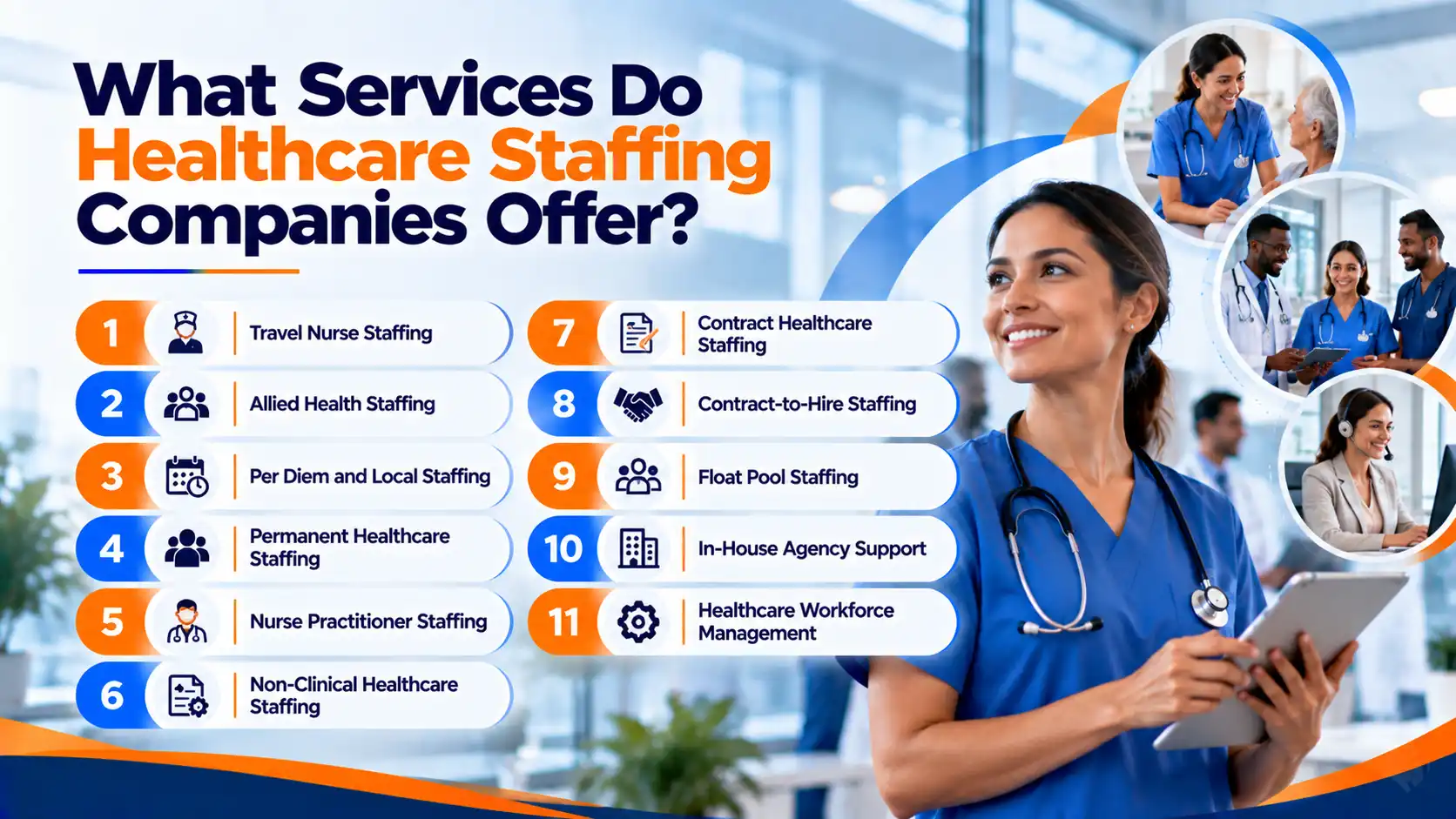
Healthcare staffing company services can vary considerably, but several categories are commonly used by U.S. healthcare organizations.
1. Travel Nurse Staffing
Travel nursing is one of the most recognizable healthcare staffing models.
Travel nurses typically accept temporary assignments in locations where healthcare organizations need additional nursing capacity.
Travel nurse staffing can be useful when an organization is dealing with:
- Short-term nursing shortages
- Geographic talent shortages
- Increased patient volumes
- Extended employee leave
- Difficult-to-fill specialties
- Temporary workforce requirements
- Gaps while permanent recruitment is underway
Travel staffing can also help healthcare organizations access professionals outside their immediate geographic labor market.
For facilities located in areas where local recruitment is particularly difficult, expanding the potential talent pool can become an important part of workforce planning.
2. Allied Health Staffing
Healthcare delivery depends on much more than physicians and registered nurses.
Allied health professionals contribute to diagnosis, treatment, rehabilitation, patient support, and other essential functions.
Depending on the staffing provider, allied health staffing may include professionals such as:
- Physical therapists
- Occupational therapists
- Respiratory therapists
- Radiologic technologists
- Medical technologists
- Laboratory professionals
- Speech-language pathologists
- Other specialized healthcare professionals
BLS projects strong growth across several allied health occupations through 2034. For example, physical therapist assistants are projected to grow 22%, while occupational therapy assistants are projected to grow 19%.
For healthcare organizations, this means allied health recruitment can be an important component of long-term workforce planning.
3. Per Diem and Local Staffing
Not every staffing requirement requires a long-term commitment.
Per diem staffing allows healthcare organizations to add workforce capacity based on short-term or fluctuating needs.
This model can be useful for:
- Shift coverage
- Fluctuating patient volumes
- Employee absences
- Seasonal demand
- Weekend requirements
- Short-term workforce gaps
- Local professionals seeking flexible schedules
Local staffing can also reduce the need to rely exclusively on a permanent hiring pipeline when an organization needs additional workforce capacity.
4. Permanent Healthcare Staffing
Permanent hiring is designed for positions that are expected to remain part of an organization’s long-term workforce.
Examples can include:
- Registered nurses
- Nurse practitioners
- Allied health professionals
- Clinical specialists
- Healthcare managers
- Administrative healthcare professionals
- Other long-term positions
Permanent recruitment can help organizations build workforce continuity and develop teams with deeper institutional knowledge.
It is particularly relevant when the staffing requirement is expected to remain stable over the long term.
5. Nurse Practitioner Staffing
Nurse practitioners play an increasingly important role in healthcare delivery.
BLS projects nurse practitioner employment to grow 40.1% from 2024 to 2034, making it one of the fastest-growing occupations in the U.S. economy.
Healthcare staffing companies can help organizations source qualified nurse practitioners for different workforce requirements.
This can be particularly valuable for organizations expanding services or looking for professionals with specialized clinical capabilities.
6. Non-Clinical Healthcare Staffing
Healthcare organizations also require professionals who support operations outside direct clinical care.
Non-clinical healthcare staffing may include positions related to:
- Administration
- Healthcare operations
- Scheduling
- Revenue cycle functions
- Patient support
- Coordination
- Healthcare management
- Other operational roles
A healthcare organization cannot operate effectively through clinical staffing alone.
Operational and administrative professionals contribute to the systems that allow clinicians to focus on patient care.
7. Contract Healthcare Staffing
Contract staffing provides professionals for a defined period or assignment.
This model can be useful when an organization:
- Has a temporary project
- Needs specialized expertise
- Is experiencing a short-term workforce shortage
- Is expanding a service
- Needs additional capacity before permanent hiring
- Has uncertain long-term workforce requirements
Contract staffing can provide flexibility without immediately creating a permanent workforce commitment.
8. Contract-to-Hire Staffing
Contract-to-hire staffing provides an intermediate option between temporary and permanent employment.
A professional may initially work under a contract arrangement while the organization evaluates the long-term fit.
This can be useful when both the employer and professional want an opportunity to assess:
- Skills
- Performance
- Team compatibility
- Work environment
- Long-term workforce requirements
Contract-to-hire can therefore reduce the pressure to make an immediate permanent hiring decision when the long-term requirement is not yet completely clear.
9. Float Pool Staffing
Healthcare organizations with variable staffing requirements may establish float pools.
A float pool provides access to professionals who can support different departments or facilities according to workforce demand.
This approach can help organizations create greater flexibility across their workforce.
For example, a multi-unit healthcare system may need additional staff in one department during a period of increased demand while another department has relatively stable staffing requirements.
A structured float pool can help redistribute available workforce capacity.
10. In-House Agency Support
Some healthcare organizations use internal staffing agencies or centralized workforce teams to manage temporary staffing requirements across their facilities.
Healthcare staffing companies can support these programs by providing recruiting, staffing, workforce management, or related operational capabilities.
This model can be especially relevant for larger healthcare systems operating multiple locations.
11. Healthcare Workforce Management
Healthcare staffing increasingly involves more than filling individual requisitions.
Workforce management focuses on understanding:
- Current staffing levels
- Future workforce requirements
- Vacancy patterns
- Skill requirements
- Geographic workforce availability
- Temporary versus permanent demand
- Workforce flexibility
- Talent pipelines
The American Hospital Association’s 2026 Health Care Workforce Scan highlights staffing-model redesign, team-based care, changing workforce requirements, AI implementation, and support for a multigenerational workforce as important workforce considerations for healthcare organizations.
This reflects a broader shift toward treating staffing as a strategic workforce function rather than simply a recruitment activity.
How Do Healthcare Staffing Companies Help Hospitals and Health Systems?
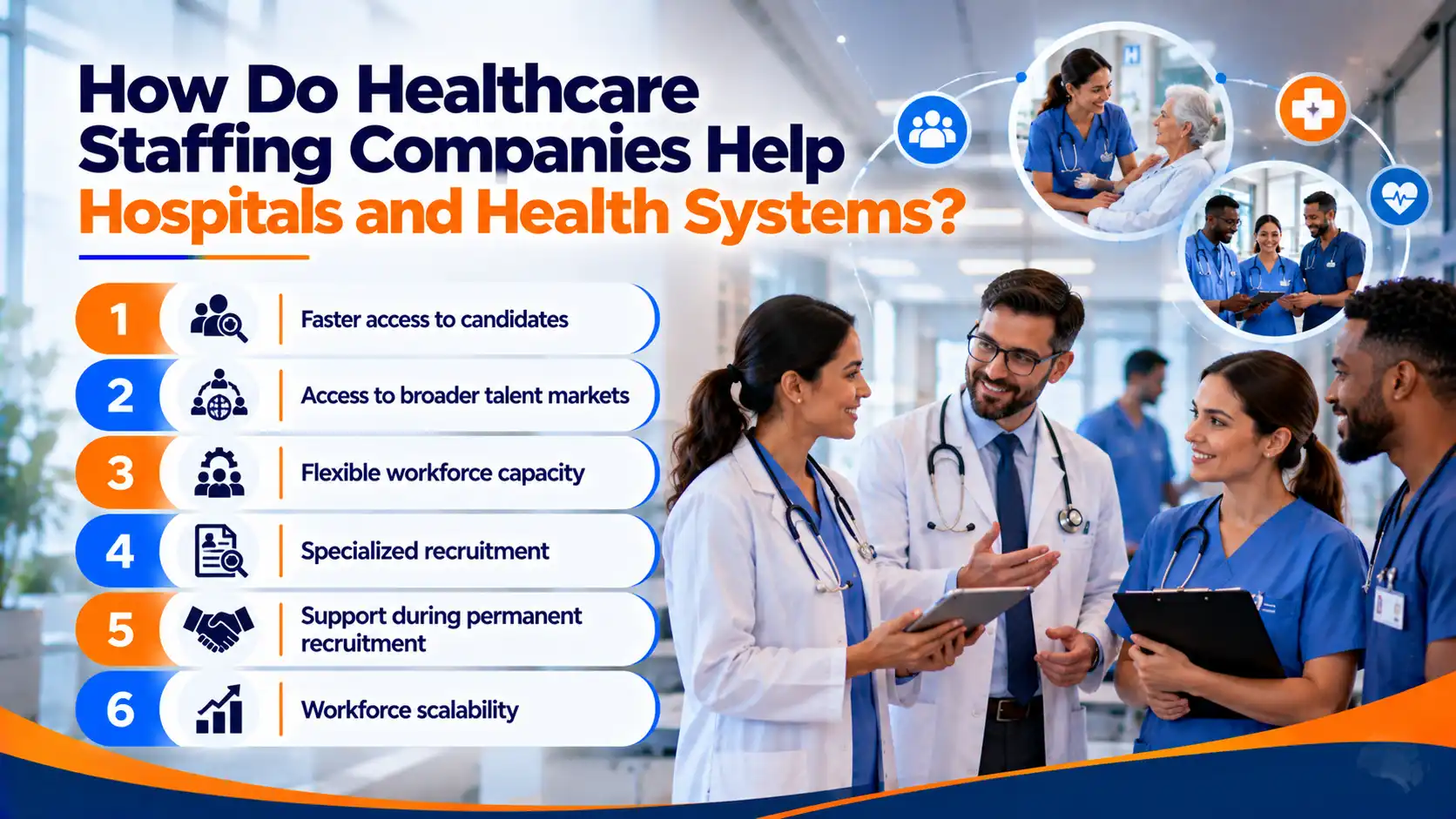
A healthcare staffing company can potentially help organizations address several workforce challenges simultaneously.
Faster access to candidates
Healthcare staffing firms maintain recruitment processes and candidate pipelines that can help organizations identify professionals for open positions.
Access to broader talent markets
A staffing partner with national or regional reach may be able to source professionals beyond the organization’s immediate geographic market.
Flexible workforce capacity
Temporary, contract, travel, and per diem staffing can provide additional capacity when permanent headcount does not fully match operational demand.
Specialized recruitment
Some positions require professionals with specific certifications, specialties, experience, or clinical backgrounds.
A specialized healthcare staffing company can focus recruitment efforts around these requirements.
Support during permanent recruitment
Temporary staffing can provide workforce coverage while an organization continues searching for a permanent employee.
Workforce scalability
Healthcare organizations may experience changing workforce requirements throughout the year. Flexible staffing models allow organizations to respond to those changes without relying exclusively on permanent hiring.
How Do You Choose the Right Healthcare Staffing Company?
Not every healthcare staffing company provides the same services, geographic coverage, recruiting capabilities, or workforce support.
Before you hire a healthcare staffing company, evaluate several factors.
1. Does the company understand your healthcare specialty?
A staffing provider should understand the roles it recruits for and the requirements associated with those positions.
2. What staffing models does it provide?
Look for a provider capable of supporting your actual workforce requirements.
Potential services include:
- Travel staffing
- Per diem staffing
- Allied health
- Nurse practitioner staffing
- Contract staffing
- Permanent recruitment
- Contract-to-hire
- Workforce management
3. Can it recruit outside your local market?
Geographic reach matters when the local talent pool is limited.
4. How does the provider handle screening and compliance?
Healthcare staffing involves credentialing, documentation, background checks, licensing considerations, and other requirements.
Ask how these processes are managed before professionals are placed.
5. Can the provider scale with your organization?
Your staffing needs may change.
A healthcare organization may need temporary professionals today and permanent employees six months from now.
A flexible staffing partner should be able to accommodate those changes.
6. Does the company provide ongoing support?
Recruitment should not necessarily end once a professional begins an assignment.
Ask about communication, workforce support, issue resolution, and assignment management.
7. Does the staffing company offer workforce solutions rather than only candidate placement?
A provider that understands the underlying workforce challenge can potentially offer more strategic options than one focused solely on filling individual job orders.
What Makes a Top Healthcare Staffing Agency?
The phrase top healthcare staffing agency can mean different things to different organizations.
Instead of evaluating providers based solely on size or marketing claims, healthcare organizations should consider measurable and relevant factors such as:
- Quality of candidate matching
- Relevant healthcare specialization
- Geographic reach
- Speed of response
- Compliance processes
- Credentialing support
- Staffing model flexibility
- Communication
- Workforce scalability
- Experience with similar healthcare organizations
- Ability to support both temporary and permanent hiring
The right staffing partner should fit the organization’s specific workforce requirements.
When Should You Hire a Healthcare Staffing Company?
Healthcare organizations may benefit from working with a staffing company when:
- Multiple positions remain open
- Recruitment is taking longer than expected
- Local candidate supply is limited
- Patient demand has increased
- A specialized role is difficult to fill
- Temporary coverage is required
- The organization is opening a new service
- Permanent recruitment is underway
- Seasonal demand is creating staffing pressure
- Workforce requirements vary between facilities
- Internal recruiting resources are stretched
The earlier an organization identifies a recurring staffing problem, the more workforce options it may have.
Temporary vs. Permanent Healthcare Staffing
One of the most important decisions for healthcare organizations is determining whether a staffing requirement should be temporary or permanent.
| Workforce Need | Potential Staffing Model |
| Immediate staffing gap | Temporary staffing |
| Short-term leave | Temporary or per diem staffing |
| Fluctuating demand | Per diem or contract staffing |
| Geographic shortage | Travel staffing |
| Long-term vacancy | Permanent hiring |
| New permanent department | Permanent hiring |
| Specialized short-term requirement | Contract staffing |
| Uncertain long-term requirement | Contract-to-hire |
| Multi-site workforce variability | Float pool or flexible staffing |
The key is not to view temporary and permanent staffing as competing solutions.
Many organizations need both.
A permanent workforce can provide stability, while temporary and flexible staffing can provide additional capacity when demand changes.
How MetaSense Inc. Supports Healthcare Organizations
MetaSense Inc. has operated as a staffing company since 1999 and expanded into healthcare in 2019. The company states that its Healthcare Workforce Solutions division was created to address staffing needs in complex, high-demand care environments.
Its current healthcare staffing offerings include:
- Travel nurse staffing
- Allied health staffing
- Per diem and local staffing
- Nurse practitioner staffing
- Non-clinical staffing
- Permanent hiring solutions
MetaSense also lists flexible staffing, temp-to-hire, direct-hire placement, and workforce management solutions among its broader services.
This range of services allows healthcare organizations to consider different workforce models based on their operational requirements rather than relying on a single staffing approach.
For example:
Immediate clinical shortage → Travel or temporary staffing
Local short-term coverage → Per diem/local staffing
Specialized healthcare requirement → Targeted professional staffing
Long-term workforce requirement → Permanent hiring
Uncertain long-term requirement → Temp-to-hire
Variable multi-site demand → Flexible workforce solutions
The objective is to align the staffing model with the actual workforce challenge.
Practical Example: Building a Flexible Healthcare Workforce
Consider a hypothetical regional healthcare organization operating several facilities.
It has three separate workforce requirements:
Requirement 1: Immediate nursing shortage
The organization needs additional nurses quickly while its internal recruitment team continues permanent hiring.
A temporary or travel staffing solution could provide interim workforce capacity.
Requirement 2: Long-term allied health vacancy
The position is expected to remain part of the organization’s workforce.
Permanent recruitment may be more appropriate.
Requirement 3: Variable weekend demand
The organization needs additional professionals during specific periods but does not require additional full-time positions.
Per diem staffing could provide greater flexibility.
Instead of using one staffing model for all three problems, the organization can use different approaches for each requirement.
That is the fundamental value of flexible healthcare staffing.
The Future of Healthcare Staffing in the U.S.
Healthcare staffing is becoming increasingly connected to long-term workforce planning.
BLS projects healthcare and social assistance to remain the fastest-growing major industry sector between 2024 and 2034, with approximately 1.98 million additional jobs projected.
At the occupational level, healthcare support occupations are projected to grow 12.4%, while healthcare practitioners and technical occupations are projected to grow 7.2%.
These trends suggest that healthcare organizations will continue to need strategies for:
- Recruiting qualified professionals
- Expanding talent pipelines
- Managing workforce shortages
- Supporting specialized roles
- Responding to changing patient demand
- Balancing permanent and temporary staffing
- Improving workforce flexibility
- Planning for future workforce requirements
Technology will also continue to influence healthcare workforce management. The AHA’s 2026 workforce research highlights the importance of redesigning staffing models and building the foundation for effective AI implementation.
However, technology does not eliminate the need for qualified people.
Healthcare organizations still need professionals with the appropriate skills, credentials, experience, and availability.
That is why staffing strategy will remain an important part of healthcare operations.
Why Healthcare Staffing Should Be Treated as a Workforce Strategy
Healthcare staffing is no longer simply about filling open positions.
A vacancy can affect scheduling, workforce capacity, employee workload, service availability, and organizational growth.
A temporary staffing solution can provide flexibility.
A permanent hiring strategy can provide stability.
A travel staffing program can expand geographic reach.
A per diem model can respond to fluctuating demand.
An allied health staffing strategy can strengthen multidisciplinary care teams.
A workforce management solution can help organizations coordinate these approaches.
The most effective strategy depends on the organization’s specific workforce requirements.
Ready to Solve Your Healthcare Staffing Challenges?
An open healthcare position can become more than a recruitment problem when it begins affecting schedules, workforce capacity, patient services, or organizational growth.
You do not have to use the same staffing model for every workforce challenge.
Whether you need travel nurses, allied health professionals, per diem or local staff, nurse practitioners, non-clinical professionals, contract talent, or permanent healthcare employees, the right workforce strategy can help you respond to immediate requirements while planning for long-term needs.
MetaSense Inc. provides flexible healthcare staffing and workforce solutions designed around different organizational requirements. Its healthcare offerings include travel nurse staffing, allied health staffing, per diem and local staffing, nurse practitioner staffing, non-clinical staffing, and permanent hiring solutions.
Don’t let an open position become a staffing bottleneck.
Talk to the MetaSense Inc. healthcare staffing team today and discuss your staffing requirements.
Explore MetaSense Healthcare Staffing Solutions
Final Takeaway
Healthcare staffing companies can provide much more than candidate placement.
They can help healthcare organizations access qualified professionals, respond to workforce shortages, manage fluctuating demand, recruit specialized talent, and build flexible workforce strategies.
The right solution may be travel staffing, per diem staffing, allied health recruitment, contract staffing, permanent hiring, or a combination of several models.
For healthcare leaders, the key question is not simply “How do we fill this position?”
It is:
“What workforce model will solve this need today while supporting our organization tomorrow?”
That shift, from recruitment alone to strategic workforce planning, can help healthcare organizations build a more adaptable approach to one of their most important resources: their people.
Frequently Asked Questions About Healthcare Staffing Companies
What is a healthcare staffing company?
A healthcare staffing company recruits and connects qualified healthcare professionals with healthcare organizations for temporary, contract, per diem, travel, contract-to-hire, or permanent positions, depending on the provider’s services.
What services do healthcare staffing companies provide?
Common healthcare staffing services include travel nursing, allied health staffing, per diem and local staffing, nurse practitioner staffing, non-clinical staffing, temporary staffing, contract staffing, permanent hiring, contract-to-hire, and workforce management.
Why do hospitals use healthcare staffing agencies?
Hospitals may use staffing agencies to address workforce shortages, access specialized professionals, manage fluctuating demand, cover temporary vacancies, expand recruitment reach, or support permanent hiring.
How do I choose a healthcare staffing company in the U.S.?
Evaluate the provider’s healthcare expertise, staffing models, geographic reach, candidate screening, credentialing processes, response time, communication, scalability, and experience with organizations similar to yours.
Can a healthcare staffing company provide permanent employees?
Yes. Many healthcare staffing companies provide permanent recruitment and direct-hire placement in addition to temporary and contract staffing.
Is travel nursing the same as temporary healthcare staffing?
Travel nursing is a type of temporary healthcare staffing. It generally involves healthcare professionals accepting assignments away from their usual location for a defined period.
What is contract-to-hire healthcare staffing?
Contract-to-hire allows a professional to initially work under a contract arrangement with the possibility of transitioning into a permanent position, depending on the agreement and circumstances.
Can healthcare staffing companies help with allied health positions?
Yes. Depending on the provider, allied health staffing may include professionals such as physical therapist assistants, occupational therapy professionals, respiratory therapists, laboratory professionals, radiologic technologists, and other specialized roles.
When should a healthcare organization consider flexible staffing?
Flexible staffing can be useful when workforce demand changes frequently, when organizations experience temporary shortages, or when permanent hiring alone cannot efficiently address changing operational requirements.