
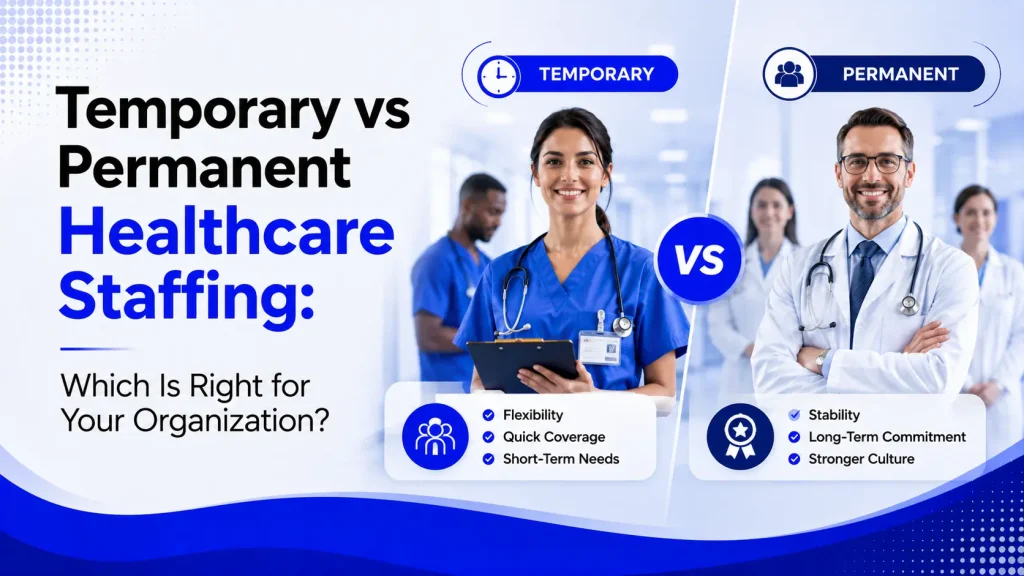
When a healthcare organization has an open position, the obvious question is often, “How quickly can we fill it?”
The more important question may be:
“What type of staffing solution actually fits this workforce need?”
A hospital dealing with a sudden nursing shortage may need temporary professionals immediately. A health system opening a new service line may need permanent employees. A rural facility with a limited local talent pool may need travel clinicians. A healthcare organization facing unpredictable patient volumes may benefit from per diem or contract staffing.
This is why the debate over temporary vs permanent healthcare staffing should not be reduced to a simple list of advantages and disadvantages.
The right model depends on why the position exists, how long it will be needed, how quickly it must be filled, how difficult the talent is to find, and what the organization’s workforce is expected to look like in the future.
The U.S. healthcare labor market makes that decision increasingly important. The U.S. Bureau of Labor Statistics (BLS) projects healthcare and social assistance to grow 8.4% between 2024 and 2034, adding approximately 1.98 million jobs, the largest projected increase among major U.S. industry sectors.
Registered nursing is also expected to remain a major source of workforce demand. BLS projects 5% RN employment growth from 2024 to 2034 and approximately 189,100 RN openings per year, many resulting from workers leaving the occupation or labor force.
Meanwhile, HRSA’s latest workforce projections indicate a projected national shortage of 108,960 full-time-equivalent registered nurses in 2038, with the shortage expected to be more pronounced in nonmetropolitan areas.
That means healthcare organizations need more than a hiring strategy.
They need a workforce strategy that balances stability, speed, flexibility, cost, and future demand.
Quick Answer: Temporary or Permanent Healthcare Staffing?
Temporary healthcare staffing is generally appropriate when workforce demand is urgent, variable, seasonal, specialized, geographic, or clearly limited in duration.
Permanent healthcare staffing is generally appropriate when the organization has an ongoing, predictable requirement for the position.
However, many healthcare organizations will benefit from a blended workforce model that combines permanent employees with temporary, travel, contract, or per diem professionals.
Use this decision guide:
| Workforce Situation | Potentially Best-Fit Model |
| Immediate staffing gap | Temporary staffing |
| Short-term leave coverage | Temporary staffing |
| Seasonal patient-volume increase | Per diem or contract |
| Geographic talent shortage | Travel staffing |
| Long-term recurring vacancy | Permanent hiring |
| New permanent department | Permanent hiring |
| Highly specialized short-term requirement | Contract or temporary staffing |
| Uncertain long-term requirement | Temp-to-hire |
| Stable workforce + fluctuating demand | Blended staffing |
The important word here is “potentially.”
No staffing model should be selected solely because it is faster or appears cheaper on an hourly basis.
What Is Temporary Healthcare Staffing?
Temporary healthcare staffing gives an organization access to qualified professionals for a defined assignment or workforce requirement.
Depending on the organization, temporary staffing may include:
- Travel nurses
- Contract nurses
- Per diem professionals
- Local healthcare professionals
- Allied health professionals
- Temporary advanced practice professionals
- Other contingent healthcare workers
- Temp-to-hire professionals
The purpose isn’t necessarily to replace permanent employees.
Often, temporary staffing provides capacity while the organization solves a longer-term workforce problem.
For example, imagine a hospital has five open RN positions and expects permanent recruitment to take several months.
The organization has two separate problems:
- It needs nurses now.
- It needs permanent nurses for the long term.
Temporary staffing can address the first problem while permanent recruitment addresses the second.
That distinction is central to using temporary healthcare staffing effectively.
What Is Permanent Healthcare Staffing?
Permanent healthcare staffing focuses on positions that are expected to remain part of an organization’s ongoing workforce.
It may be appropriate for:
- Core nursing teams
- Long-term physician requirements
- Nurse practitioner positions
- Permanent allied health roles
- Leadership positions
- Long-term service-line expansion
- Recurring clinical requirements
Permanent employees can develop deeper knowledge of an organization’s systems, culture, clinical processes, patient population, and team structure.
That continuity can be particularly valuable in positions where experience within the organization improves operational effectiveness.
Temporary vs Permanent Healthcare Staffing: The Real Difference
The fundamental difference isn’t simply temporary employment versus permanent employment.
It is workforce flexibility versus workforce continuity.
Temporary staffing gives an organization greater ability to adjust workforce capacity.
Permanent staffing provides a more stable foundation for ongoing workforce requirements.
| Consideration | Temporary Staffing | Permanent Staffing |
| Main purpose | Flexible workforce capacity | Long-term workforce capacity |
| Best fit | Variable or short-term demand | Stable recurring demand |
| Geographic reach | Can extend beyond local market | Often focused on local/regional recruitment |
| Speed | Can provide a faster workforce response | Usually requires a longer hiring process |
| Continuity | Assignment-dependent | Generally stronger |
| Institutional knowledge | Develops over assignment | Builds over longer tenure |
| Workforce flexibility | High | Lower |
| Long-term workforce stability | Limited by design | Stronger |
| Useful during shortages | Yes | Yes |
| Useful for permanent roles | Sometimes as a bridge | Yes |
| Best strategic use | Manage variability | Build core capacity |
Neither model is inherently superior.
The mistake is using the same model for every workforce requirement.
When Should a Healthcare Organization Use Temporary Staffing?
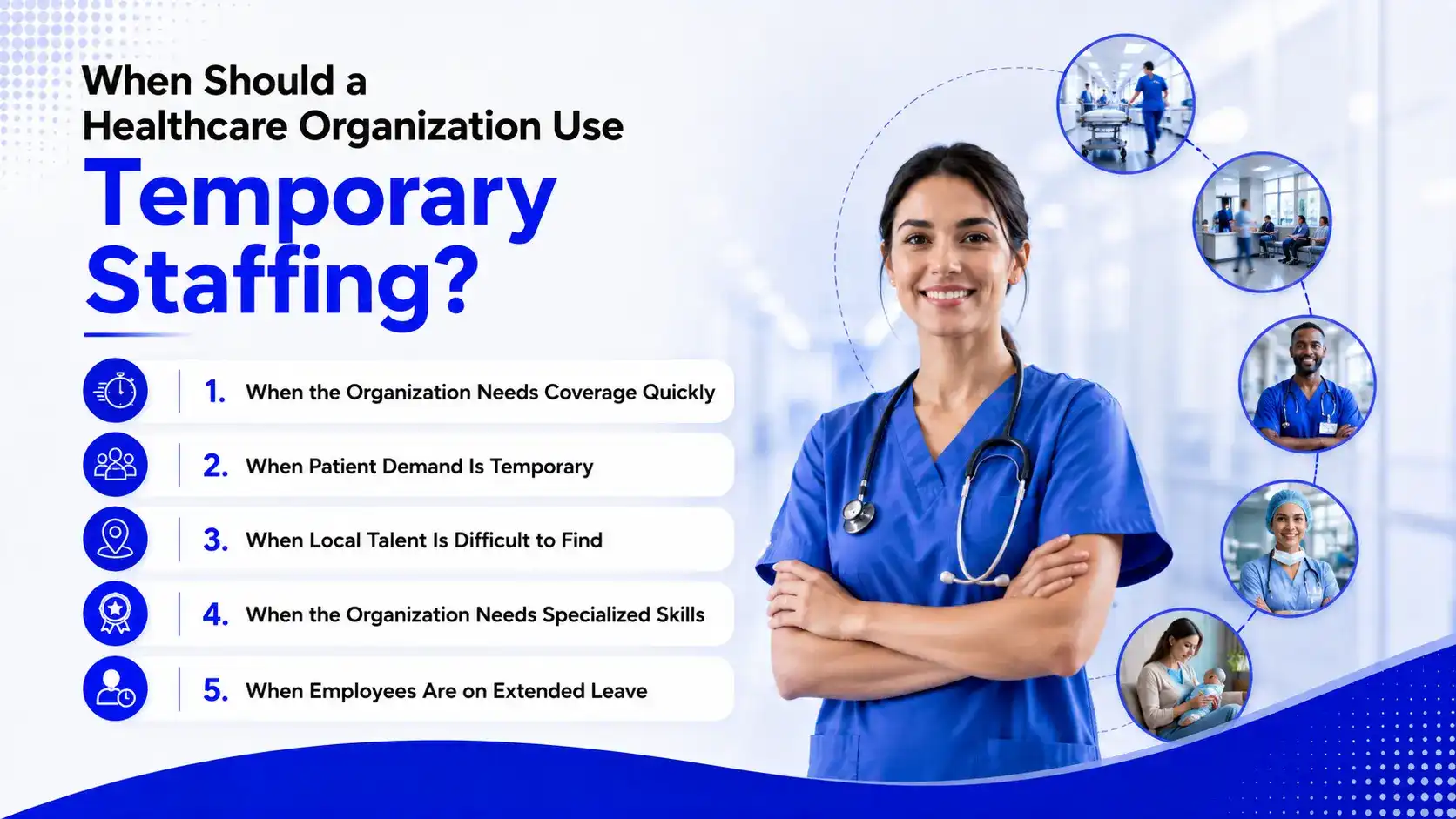
1. When the Organization Needs Coverage Quickly
Healthcare vacancies can create immediate operational pressure.
If a hospital loses several nurses at once, waiting for a lengthy permanent recruitment process may leave existing employees covering additional shifts.
Temporary staffing can provide an interim solution.
The strategy can be:
Temporary coverage now + permanent recruitment for the long term.
This is often more practical than choosing between the two models.
2. When Patient Demand Is Temporary
Healthcare demand changes.
A facility may experience higher staffing requirements because of:
- Seasonal illnesses
- Temporary patient-volume increases
- Emergency department fluctuations
- Facility transitions
- New programs
- Short-term capacity expansion
- Employee leave
Permanent hiring for every temporary increase can create excess workforce capacity after demand falls.
Temporary or per diem staffing provides a way to respond without permanently increasing headcount for a short-lived requirement.
3. When Local Talent Is Difficult to Find
Healthcare staffing is also a geographic challenge.
HRSA’s current workforce projections show that the distribution of healthcare professionals matters significantly. For registered nurses, HRSA projects an 11% shortage in nonmetropolitan areas in 2038 compared with 2% in metropolitan areas.
For an organization operating in a smaller or underserved market, the problem may not be a lack of qualified professionals across the United States.
The problem may be a lack of qualified professionals within commuting distance.
Travel staffing can help expand the geographic reach of recruitment.
4. When the Organization Needs Specialized Skills
Some clinical positions are difficult to fill because the required combination of specialty, experience, credentials, and availability is uncommon.
In such situations, an organization may benefit from accessing a broader candidate pool through temporary or contract staffing.
This can also give the organization time to build a permanent talent pipeline.
5. When Employees Are on Extended Leave
Temporary professionals can provide workforce continuity during:
- Maternity or parental leave
- Medical leave
- Extended vacation
- Military leave
- Other planned absences
The organization knows the workforce gap has a defined cause and may have a reasonable expectation that permanent staff will return.
Creating a permanent position may therefore not make sense.
When Should a Healthcare Organization Hire Permanently?
1. When the Position Represents Long-Term Demand
If the organization expects to need the position year after year, permanent recruitment should generally be considered.
For example, if a hospital has consistently required 50 medical-surgical RNs, treating recurring vacancies as temporary problems may simply postpone the underlying workforce decision.
2. When Institutional Knowledge Matters
Some healthcare positions become more valuable as employees develop experience inside the organization.
Permanent employees can build familiarity with:
- Clinical workflows
- Electronic health records
- Department procedures
- Internal policies
- Patient populations
- Team relationships
- Leadership structures
That continuity can support long-term workforce stability.
3. When a Service Line Is Expected to Continue
Suppose a healthcare system opens a new cardiology, oncology, behavioral health, or rehabilitation service that is expected to operate for years.
The workforce requirement is structural rather than temporary.
Permanent recruitment should therefore form the foundation of the staffing strategy.
Temporary professionals can still be useful during the launch or while permanent recruitment is underway.
Is Temporary Healthcare Staffing More Expensive?
Sometimes, but hourly or bill rate alone does not answer the question.
This is one of the most important distinctions healthcare leaders should make.
Temporary staffing can carry a higher direct rate than the base wage of a permanent employee.
But permanent employees also have costs beyond salary, including:
- Benefits
- Payroll-related costs
- Recruiting
- Advertising
- Interviews
- Onboarding
- Training
- Credentialing
- Retention programs
- Turnover
- Vacancy-related overtime
There is also the cost of leaving a position unfilled.
The American Hospital Association reported that hospital labor represented 56% of total hospital costs in 2024, or approximately $890 billion.
A separate AHA report found that hospitals spent approximately $51.1 billion on contracted staff in 2023, demonstrating how significant contingent labor can become when organizations face workforce shortages.
The lesson is not that temporary staffing is bad.
The lesson is that temporary staffing should be managed strategically.
Healthcare leaders should compare:
Direct labor cost + vacancy cost + overtime + recruitment cost + turnover + speed + flexibility
rather than comparing two hourly rates.
The Cost of Leaving a Healthcare Position Vacant
Consider a hospital with an unfilled clinical position.
The vacancy may lead to:
- Additional overtime
- Increased workload for existing employees
- Difficulty covering shifts
- Delayed service expansion
- Reduced workforce flexibility
- Increased burnout risk
- Additional recruitment pressure
This means the cost of a vacancy can continue increasing while an organization waits for the “perfect” permanent candidate.
Temporary staffing can sometimes be economically rational because it purchases something that a vacant position cannot provide:
immediate workforce capacity.
The decision should therefore consider the operational cost of waiting.
Temporary vs Permanent Nursing Staffing
Nursing provides one of the clearest examples of why healthcare organizations need both staffing models.
BLS projects approximately 189,100 RN openings annually from 2024 through 2034. These openings include both new workforce demand and replacement needs caused by workers leaving the occupation or labor force.
Temporary nursing staffing may be appropriate when:
- A hospital has an immediate nursing shortage.
- Local recruitment cannot provide enough candidates.
- Patient volume has temporarily increased.
- A facility needs travel nurses.
- Existing nurses are covering extended leave.
- Permanent recruitment is underway.
- A specific specialty is difficult to source.
Permanent nursing staffing may be appropriate when:
- The RN position is consistently required.
- The organization is expanding permanently.
- Long-term continuity is important.
- The facility has predictable workforce demand.
- The organization is building a stable clinical team.
The strongest strategy can be both.
A hospital may maintain a permanent nursing workforce for baseline demand while maintaining access to temporary professionals for periods when demand exceeds that baseline.
What About Allied Health Staffing?
The same decision applies beyond nursing.
Healthcare organizations may require:
- Respiratory therapists
- Physical therapists
- Occupational therapists
- Imaging professionals
- Laboratory professionals
- Medical technologists
- Other specialized allied health professionals
A temporary solution may make sense when a specialized professional is urgently required but difficult to source locally.
Permanent recruitment may be preferable when the position supports a stable, long-term service.
This distinction is particularly important because healthcare delivery depends on interconnected clinical teams.
A shortage in one profession can affect the productivity of others.
What Is Temp-to-Hire Healthcare Staffing?
Temp-to-hire is a middle-ground staffing model.
A professional initially works on a temporary basis while the organization and employee evaluate whether a permanent relationship makes sense.
It can be useful when:
- The organization is uncertain about long-term demand.
- The position is new.
- Both sides want to evaluate fit.
- Permanent recruitment is desirable but immediate coverage is also required.
- The organization wants flexibility before making a long-term commitment.
It can therefore reduce the pressure to make a permanent decision before enough information is available.
Organizations should, however, understand the applicable contract and conversion terms before using a temp-to-hire arrangement.
A Real-World Lesson From MetaSense’s Healthcare Staffing Experience
The COVID-19 pandemic demonstrated why healthcare organizations sometimes need workforce solutions that can move faster than conventional permanent recruitment.
MetaSense describes its experience supporting a New Jersey hospital during the pandemic when demand for respiratory therapists and other clinical professionals increased sharply.
According to MetaSense, the company worked around the clock to support the hospital and supplied a significant number of respiratory therapists while also deploying nurses and support staff. The company describes working with hospital leadership to identify workforce requirements and accelerate credentialing and deployment.
The important lesson isn’t that temporary staffing should replace permanent hiring.
It is that some workforce events require immediate capacity before a long-term workforce solution can be built.
In an acute crisis, waiting for conventional permanent recruitment may not be operationally realistic.
Temporary staffing can serve as the bridge.
The Case for a Blended Healthcare Staffing Model
For many healthcare organizations, the most practical answer is neither temporary nor permanent.
It is a blended workforce.
Imagine a hospital has a predictable baseline requirement of clinical professionals but experiences occasional spikes in demand.
Its workforce strategy could include:
Permanent employees → Core workforce
Per diem professionals → Variable local demand
Travel professionals → Geographic or temporary shortages
Contract professionals → Defined workforce requirements
Permanent recruitment pipeline → Future workforce needs
This creates a layered workforce rather than forcing the organization to solve every staffing requirement with one employment model.
The benefit is flexibility without abandoning long-term workforce development.
A 7-Factor Framework for Choosing the Right Staffing Model
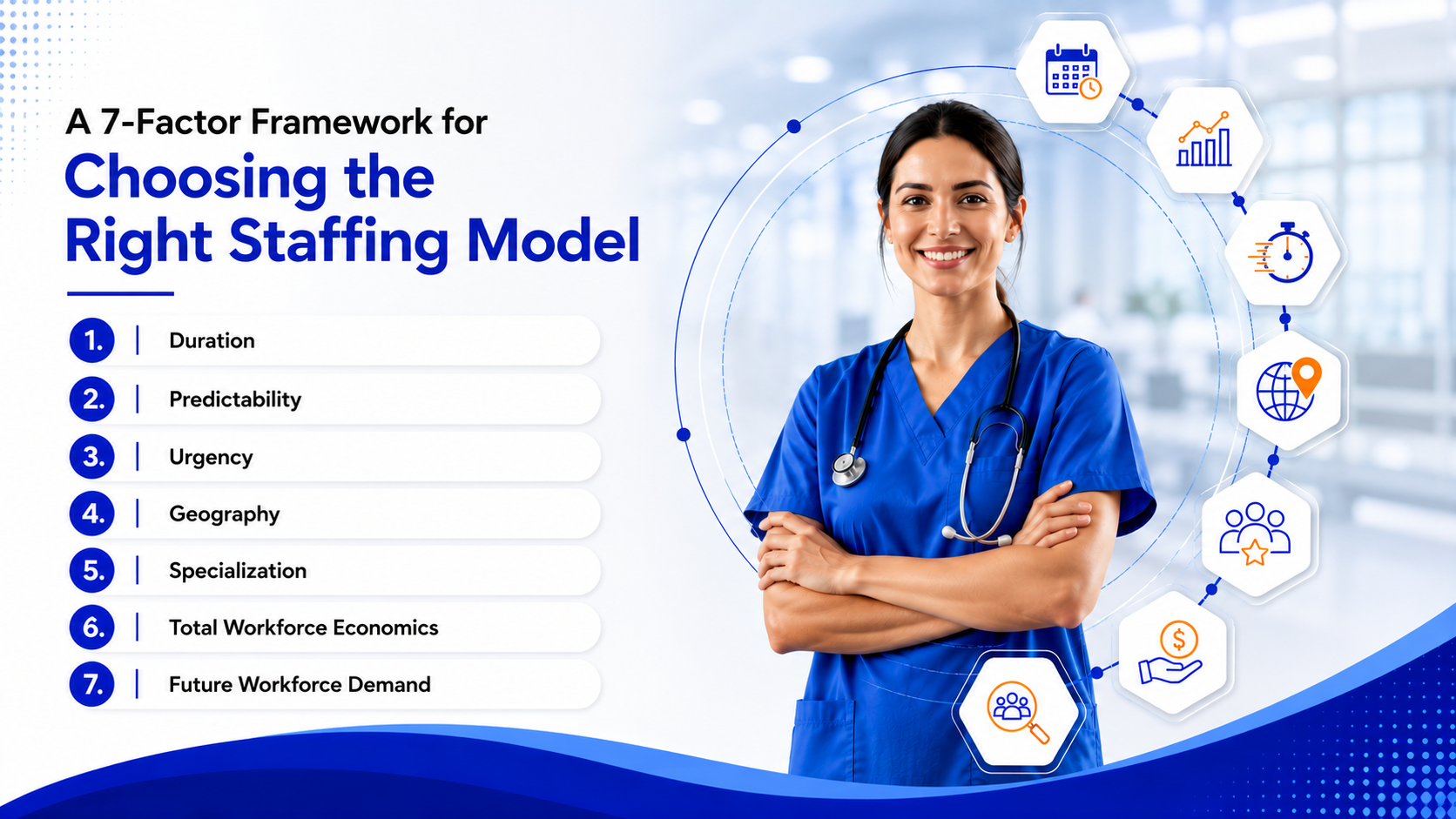
Instead of asking whether temporary or permanent staffing is “better,” healthcare leaders can evaluate seven factors.
1. Duration
How long is the workforce requirement expected to exist?
Short duration → Temporary
Long-term → Permanent
2. Predictability
Can the organization forecast the demand?
Stable demand → Permanent
Variable demand → Flexible staffing
3. Urgency
How quickly must the position be covered?
Immediate need → Temporary may provide a faster bridge
Planned requirement → Permanent recruitment can proceed
4. Geography
Can qualified professionals be found locally?
Strong local talent pool → Permanent recruitment may work well
Limited local supply → Consider travel or broader recruitment
5. Specialization
How difficult is the position to source?
Highly specialized roles may justify expanding the candidate pool through temporary, travel, or national recruitment while a permanent pipeline is developed.
6. Total Workforce Economics
Don’t compare only wages.
Evaluate:
Recruitment + benefits + overtime + vacancy + turnover + agency cost + productivity + flexibility
7. Future Workforce Demand
This may be the most overlooked factor.
Ask:
Will we still need this professional 12 months from now?
If yes, temporary staffing may be a bridge to permanent recruitment.
If no, flexible staffing may be the more appropriate long-term model.
Temporary vs Permanent Staffing Decision Matrix
| Question | Temporary Staffing | Permanent Staffing |
| Is the need urgent? | Strong fit | May take longer |
| Is demand seasonal? | Strong fit | Usually less suitable |
| Is demand permanent? | May be a bridge | Strong fit |
| Is local talent limited? | Travel can help | Broader recruitment needed |
| Is the role highly specialized? | Can provide faster access | Important for long-term capacity |
| Is the future requirement uncertain? | Strong fit | Higher commitment |
| Is the position repeatedly vacant? | Investigate underlying issue | Consider permanent solution |
| Is institutional knowledge important? | Limited by assignment | Stronger fit |
| Is workforce flexibility critical? | Strong fit | Less flexible |
| Is the organization building long-term capacity? | Supporting role | Strong fit |
This matrix should be treated as a decision aid, not a universal rule.
When Temporary Staffing Becomes a Warning Sign
Temporary staffing itself isn’t a problem.
Unplanned dependence on temporary staffing can be.
Healthcare leaders should review their workforce strategy when:
- The same temporary positions are continuously extended.
- Agency utilization keeps increasing.
- Permanent vacancies remain open for long periods.
- Overtime remains high despite substantial temporary staffing.
- Temporary workers are being used for predictable baseline demand.
- Recruitment pipelines are not improving.
- The organization has stopped investing in retention.
At that point, the issue may no longer be a temporary staffing need.
It may indicate a structural workforce gap.
The answer could involve permanent recruitment, compensation changes, retention initiatives, geographic expansion, scheduling changes, or a combination of solutions.
When Temporary Staffing Is the Strategic Choice
On the other hand, organizations shouldn’t avoid temporary staffing simply because they want to minimize contingent labor.
Temporary staffing can be strategically appropriate when it provides:
Speed
Qualified professionals can help address an immediate gap.
Flexibility
Organizations can adjust workforce capacity as demand changes.
Geographic Reach
Travel staffing can expand access beyond the local labor market.
Specialized Expertise
Organizations can access professionals with specific skills or experience.
Continuity
Temporary professionals can provide coverage while permanent recruitment is underway.
Risk Management
Organizations can avoid making permanent headcount commitments for uncertain short-term demand.
How MetaSense Supports Different Healthcare Staffing Needs
MetaSense’s current healthcare workforce offerings include travel nursing, allied health, per diem and local staffing, professional staffing, permanent hiring, float pool, and in-house agency opportunities. The company also lists flexible staffing, temp-to-hire, direct-hire placement, and workforce management solutions among its services.
This breadth allows a healthcare organization to select a staffing model according to the nature of the workforce requirement.
For example:
Immediate or geographic nursing requirement → Travel nursing
Variable local coverage → Per diem/local staffing
Specialized clinical requirement → Allied health/professional staffing
Long-term workforce requirement → Permanent hiring
Need to evaluate long-term fit → Temp-to-hire
The objective should not be to force every organization into a particular staffing model.
It should be to identify which workforce solution fits the organization’s current requirement and future workforce plan.
MetaSense’s healthcare workforce division was created to address staffing shortages in complex, high-demand care environments, building on the company’s broader staffing background. MetaSense was founded in 1999 as an IT staffing company before expanding its healthcare workforce solutions.
8 Questions to Ask Before Choosing Temporary or Permanent Staffing
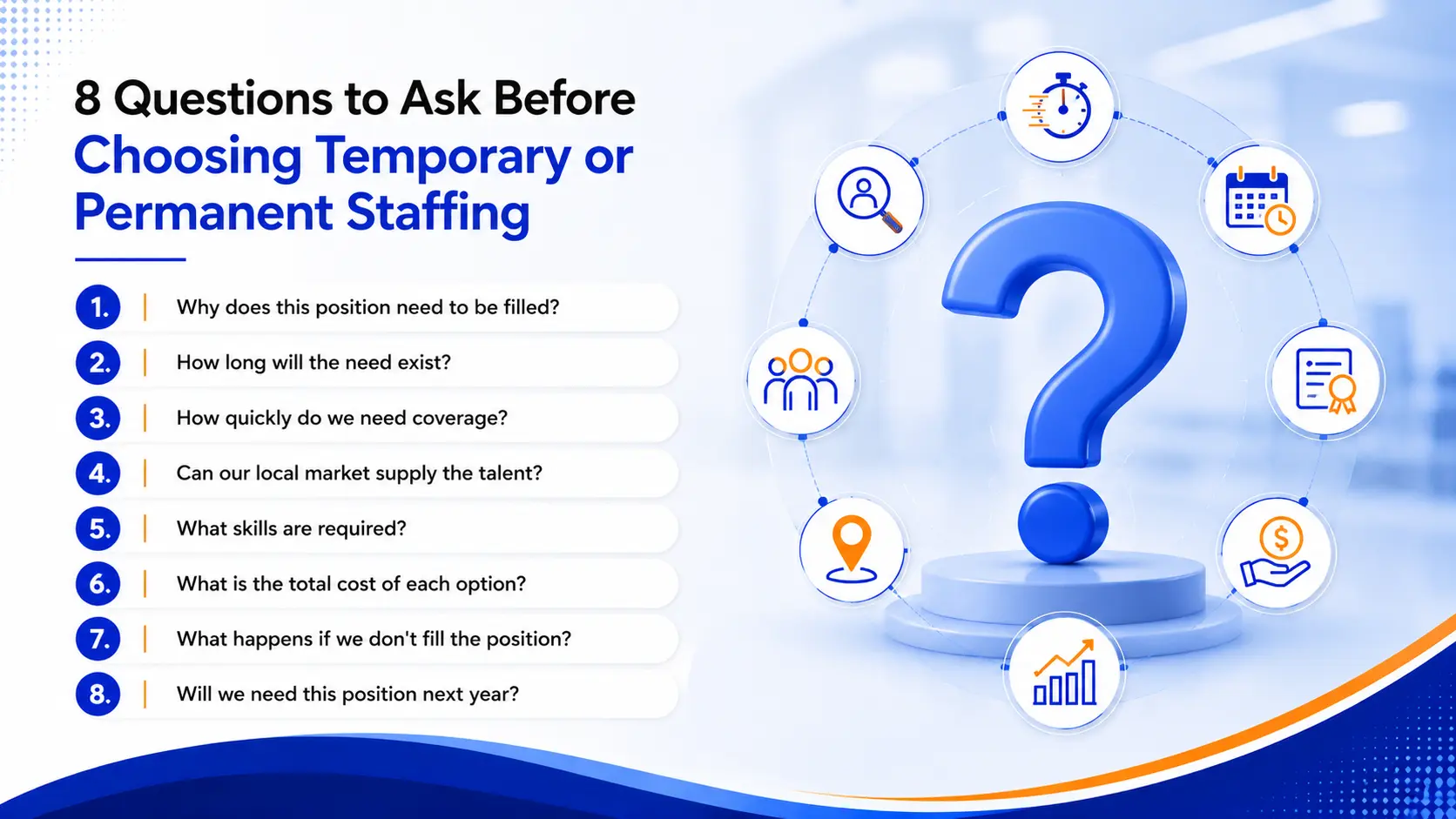
Before approving a staffing request, healthcare leaders should ask:
1. Why does this position need to be filled?
Is the cause growth, turnover, leave, seasonality, or an emergency?
2. How long will the need exist?
A defined short-term need and an ongoing workforce requirement should not receive identical solutions.
3. How quickly do we need coverage?
If the answer is “immediately,” temporary staffing may provide a bridge.
4. Can our local market supply the talent?
If not, consider travel or broader geographic recruitment.
5. What skills are required?
Specialized positions may require a wider talent search.
6. What is the total cost of each option?
Include vacancy and overtime costs, not just compensation.
7. What happens if we don’t fill the position?
Quantify the operational consequences.
8. Will we need this position next year?
The answer can help distinguish a temporary workforce problem from a permanent one.
Common Mistakes Healthcare Organizations Make
Mistake #1: Choosing Based Only on Price
The cheapest hourly option isn’t necessarily the lowest total-cost option.
Mistake #2: Treating Temporary Staffing as a Last Resort
Temporary staffing can be a deliberate workforce-management tool.
Mistake #3: Treating Temporary Staffing as the Permanent Solution
If the same temporary position exists indefinitely, leadership should reassess the underlying workforce requirement.
Mistake #4: Waiting Until a Vacancy Becomes Critical
Difficult-to-fill positions should enter the recruitment pipeline before they become emergencies.
Mistake #5: Ignoring Geography
A shortage may require a broader talent strategy rather than more local job advertising.
Mistake #6: Measuring Only Time-to-Fill
A position isn’t truly solved when a candidate accepts an offer.
Organizations should also consider time-to-start, retention, workforce coverage, and long-term fit.
Final Verdict: Temporary vs Permanent Healthcare Staffing
The strongest healthcare workforce strategy isn’t about choosing one staffing model and rejecting the other.
It is about matching the staffing model to the workforce problem.
Choose temporary staffing when the organization needs flexibility, speed, specialized talent, geographic reach, or short-term coverage.
Choose permanent staffing when the organization has stable, predictable, long-term workforce requirements.
Use a blended strategy when the organization needs a permanent workforce foundation but also experiences changing demand.
The most useful question for healthcare leaders is therefore not:
“Which is cheaper: temporary or permanent staffing?”
It is:
“What type of workforce capacity do we need, how long will we need it, and what is the most sustainable way to provide it?”
That approach accounts for the realities of today’s U.S. healthcare labor market.
Healthcare and social assistance is projected to add roughly 1.98 million jobs between 2024 and 2034, while HRSA continues to project nursing shortages and significant geographic differences in workforce supply.
Healthcare organizations therefore need both workforce stability and workforce agility.
MetaSense supports that need through multiple healthcare staffing options, including travel nursing, allied health, per diem and local staffing, professional staffing, permanent hiring, and flexible workforce solutions.
Temporary staffing shouldn’t replace permanent workforce planning. Permanent hiring shouldn’t eliminate the need for flexibility. The strongest organizations know when they need each, and how to use them together.
Frequently Asked Questions
Is temporary or permanent healthcare staffing better?
Neither is universally better. Temporary staffing is generally better for urgent, variable, specialized, seasonal, or geographically difficult workforce requirements. Permanent staffing is generally better for predictable, recurring, long-term positions.
Is temporary healthcare staffing more expensive than permanent staffing?
It can have a higher direct rate, but direct rate alone does not represent total workforce cost. Healthcare organizations should also consider recruitment, benefits, overtime, vacancy costs, turnover, onboarding, and the value of immediate workforce capacity.
When should a hospital use temporary nurses?
Hospitals may use temporary nurses during immediate shortages, seasonal demand, extended employee leave, geographic shortages, difficult-to-fill specialty requirements, or while permanent recruitment is underway.
When should a healthcare organization hire permanent employees?
Permanent hiring is generally appropriate when the organization expects to need the position consistently over the long term and wants to build stable workforce capacity.
What is the difference between contract and permanent healthcare staffing?
Contract staffing provides professionals for a defined period or requirement, while permanent staffing is intended to establish an ongoing employment relationship and long-term workforce capacity.
Is travel nursing considered temporary staffing?
Yes. Travel nursing is a temporary staffing model in which qualified nurses accept assignments for defined periods, often in locations where healthcare organizations need additional workforce capacity.
What is temp-to-hire staffing?
Temp-to-hire allows a professional to begin in a temporary capacity while both the organization and professional evaluate whether a permanent relationship is appropriate.
Can a hospital use temporary and permanent staffing at the same time?
Yes. A blended model can provide permanent employees for baseline workforce requirements while temporary, travel, contract, or per diem professionals provide flexibility when demand changes.
How do healthcare organizations choose the right staffing model?
Evaluate the duration, urgency, predictability, geography, specialization, total workforce economics, and expected future demand. The result may be temporary staffing, permanent hiring, or a combination.