

Choosing the right IT staffing agency can determine how quickly a company fills critical technology positions, how well new hires perform, and how effectively it manages changing workforce demands.
That decision has become more important in the U.S. technology market in 2026. Technology leaders are competing for professionals in areas such as AI, cybersecurity, data engineering, cloud, DevOps, and software development. Robert Half’s 2026 research found that 65% of technology hiring managers say finding skilled professionals is more difficult than it was a year ago. At the same time, 78% of technology leaders surveyed plan to increase permanent technology headcount and 66% plan to increase contract hiring in the second half of 2026.
This means businesses aren’t simply looking for an agency that can send resumes.
They need a staffing partner that understands:
- Their technology environment
- Their business objectives
- The skills they actually need
- The U.S. talent market
- Different IT staffing models
- Candidate evaluation
- Hiring speed
- Workforce scalability
- Long-term talent requirements
So, how do you choose the right IT staffing agency?
The best approach is to evaluate an agency against a structured set of criteria rather than choosing based on price, company size, or the number of resumes in its database.
Quick Answer: How to Choose an IT Staffing Agency
Before signing an agreement, evaluate an IT staffing agency on these 10 factors:
- IT and technical specialization
- Understanding of your industry
- Candidate sourcing capabilities
- Technical screening process
- Speed and time-to-fill
- Contract and permanent staffing options
- Geographic and remote talent reach
- Compliance and background verification
- Pricing and contract transparency
- Track record, communication, and ongoing support
The right agency should be able to explain how it will solve your specific hiring problem, not simply tell you how many candidates it can access.
Why Choosing the Right IT Staffing Agency Matters
An IT staffing agency can influence much more than recruitment.
A poor staffing partner can lead to:
- Unqualified candidates
- Repeated interviews
- Longer vacancies
- Project delays
- Poor candidate fit
- High replacement requirements
- Communication problems
- Unexpected staffing costs
A strong partner can help an organization:
- Access specialized talent
- Reduce sourcing workload
- Improve hiring speed
- Expand its geographic talent pool
- Add temporary technical capacity
- Find permanent employees
- Support contract-to-hire hiring
- Scale teams around project requirements
The difference matters because technology vacancies can affect actual business operations.
Robert Half’s 2026 research found that 71% of technology leaders surveyed said skills shortages had caused project delays during the previous year, while 49% reported projects being canceled. AI integration, security, and software engineering were among the initiatives most affected.
A staffing agency should therefore be evaluated based on its ability to help protect business outcomes, not merely its ability to produce candidates.
1. Look for IT and Technical Specialization
The first question to ask is:
Does the staffing agency actually understand technology hiring?
IT isn’t one skill category.
A software engineer, cloud architect, cybersecurity engineer, data engineer, and ERP business analyst require very different technical knowledge.
A strong IT staffing agency should understand roles such as:
- Software engineers
- Full-stack developers
- Data engineers
- Data scientists
- AI/ML engineers
- Cloud engineers
- DevOps engineers
- Cybersecurity professionals
- Network engineers
- Systems administrators
- IT project managers
- Business analysts
This matters because a recruiter who understands the terminology can ask better questions and identify stronger candidates.
For example, an agency shouldn’t treat:
AWS + Azure + Kubernetes + Terraform
as four interchangeable keywords.
The recruiter should understand how those technologies relate to the actual position.
Questions to Ask
Ask the staffing agency:
- Which technology roles do you specialize in?
- How do you evaluate technical candidates?
- Do your recruiters understand the technologies involved?
- Which difficult-to-fill IT roles have you successfully staffed?
- Can you provide examples from our technology environment?
If the answers remain vague, investigate further.
2. Evaluate Industry Experience
Technical expertise is important, but industry knowledge can also matter.
A cybersecurity professional working in healthcare may face different requirements from one working in retail.
A data engineer supporting financial services may operate in a different regulatory and security environment than someone working for a consumer technology company.
Ask whether the agency has experience supporting organizations in your industry.
Relevant sectors may include:
- Healthcare
- Financial services
- Technology and SaaS
- Manufacturing
- Retail
- Logistics
- Professional services
- Government
- Education
Industry experience can help recruiters understand not only the technical requirement but also the environment in which the professional will work.
3. Understand How the Agency Sources Candidates
A staffing agency’s candidate pool is only as valuable as its ability to identify the right people within it.
Ask how candidates are sourced.
Does the agency rely primarily on:
- Job boards?
- Internal databases?
- Employee referrals?
- Professional networks?
- Passive candidate outreach?
- Social recruiting?
- Specialized technical communities?
- AI-assisted sourcing?
A strong agency should have multiple sourcing channels.
This becomes particularly important for specialized positions.
If a company needs a cybersecurity architect with cloud-security experience, simply posting a job and waiting for applications may not produce enough qualified candidates.
4. Examine the Technical Screening Process
This is one of the most important questions to ask.
How does the agency determine whether a candidate can actually perform the job?
A resume may contain dozens of technical keywords.
That doesn’t prove proficiency.
For example, a candidate might list:
Python, AWS, Kubernetes, Terraform, Docker
But the hiring manager still needs to know:
- How deeply has the candidate used these technologies?
- In what environment?
- At what scale?
- What problems did they solve?
- Were they responsible for architecture or implementation?
- Did they work in production?
A strong IT staffing agency should have a defined screening process.
This may include:
- Technical screening
- Skills validation
- Experience verification
- Behavioral interviews
- Reference checks
- Certification verification
- Background checks
- Role-specific assessments
Don’t Ask Only “How Many Candidates Can You Send?”
Ask:
“How do you determine which candidates are actually qualified before they reach our hiring manager?”
That question can reveal the difference between a staffing partner and a resume supplier.
5. Compare Time-to-Fill and Hiring Speed
Speed matters in IT hiring, particularly when the vacancy affects an active project.
However, fast hiring should not mean low-quality hiring.
You need both:
Speed + candidate quality
Ask the agency:
- What is your typical time-to-submit?
- What is your average time-to-fill for similar positions?
- How quickly can you respond to urgent requirements?
- How many qualified candidates can you typically provide?
- What happens if the first candidate isn’t selected?
Don’t accept a generic promise such as “we can fill it quickly.”
Ask for performance information relevant to your type of role.
6. Make Sure the Agency Offers the Right Staffing Model
Your company may need different hiring models at different times.
A good IT staffing agency may offer:
Contract staffing
Useful for:
- Temporary projects
- Technology implementations
- Cloud migrations
- Digital transformation
- Short-term skills gaps
Contract-to-hire
Useful when:
- Long-term demand is uncertain
- The employer wants to evaluate fit
- Immediate talent is needed
- The company expects the role may become permanent
Direct/permanent hire
Useful for:
- Long-term positions
- Core technology teams
- Leadership roles
- Strategic technology capabilities
Flexible staffing
Useful when workforce requirements fluctuate.
Before choosing an agency, determine whether it can support your likely future needs rather than only today’s vacancy.
7. Evaluate Geographic Reach
Your local talent market may not contain enough candidates for specialized technology positions.
Ask:
Can the agency recruit nationally?
Also determine whether it supports:
- Remote talent
- Hybrid talent
- On-site staffing
- Relocation
- Regional recruiting
- Multi-location hiring
This can significantly expand the available talent pool.
A company in a smaller U.S. market shouldn’t necessarily limit its search to professionals within commuting distance if the role can be performed remotely or through a distributed team.
8. Ask About Compliance and Candidate Verification
Technology staffing involves more than finding a technically qualified person.
Depending on the role and industry, employers may need:
- Background checks
- Employment verification
- Identity verification
- Education verification
- Certification verification
- Drug screening where applicable
- Contract documentation
- Work authorization verification
- Industry-specific compliance
Ask exactly which responsibilities belong to the staffing agency and which remain with your company.
The contract should make those responsibilities clear.
This is particularly important when staffing roles involving:
- Sensitive data
- Financial systems
- Healthcare information
- Government systems
- Critical infrastructure
- Privileged access
9. Don’t Choose an Agency Based Only on Price
Price is important.
But the lowest staffing fee isn’t necessarily the lowest total cost.
Consider the broader equation:
Staffing cost + vacancy cost + hiring time + candidate quality + turnover risk + replacement cost + internal recruiting effort
Suppose Agency A charges less but repeatedly provides candidates who fail technical interviews.
Agency B charges slightly more but consistently provides qualified candidates who can be interviewed and hired quickly.
Agency B may create greater value.
Ask about:
- Markups
- Placement fees
- Conversion fees
- Contract terms
- Replacement guarantees
- Payment terms
- Candidate ownership
- Cancellation policies
- Contract-to-hire conditions
Get the commercial terms in writing before proceeding.
10. Investigate the Agency’s Track Record
Before selecting an IT staffing agency, ask for evidence.
Look for:
- Relevant client experience
- Case studies
- Client references
- Candidate testimonials
- Independent reviews
- Retention data
- Time-to-fill data
- Years in business
- Industry expertise
- Technology specialization
Don’t focus only on how long the company has existed.
A company with decades of experience but limited expertise in your required technology may not be the right fit.
Likewise, a newer specialist agency may have excellent technical expertise.
The important question is:
Does this agency have evidence that it can solve a hiring problem like ours?
The 10-Point IT Staffing Agency Scorecard
You can use the following framework to compare agencies objectively.
| Evaluation Factor | Weight to Consider |
| IT/technical expertise | 15% |
| Candidate quality | 15% |
| Technical screening | 15% |
| Relevant industry experience | 10% |
| Time-to-fill | 10% |
| Staffing model flexibility | 10% |
| Geographic reach | 5% |
| Compliance | 5% |
| Pricing transparency | 5% |
| Track record and support | 10% |
You don’t have to use these exact percentages.
The important point is to evaluate agencies using the same criteria.
This prevents the decision from being driven solely by price or sales presentation.
Questions to Ask an IT Staffing Agency Before Signing
Use these questions during your evaluation:
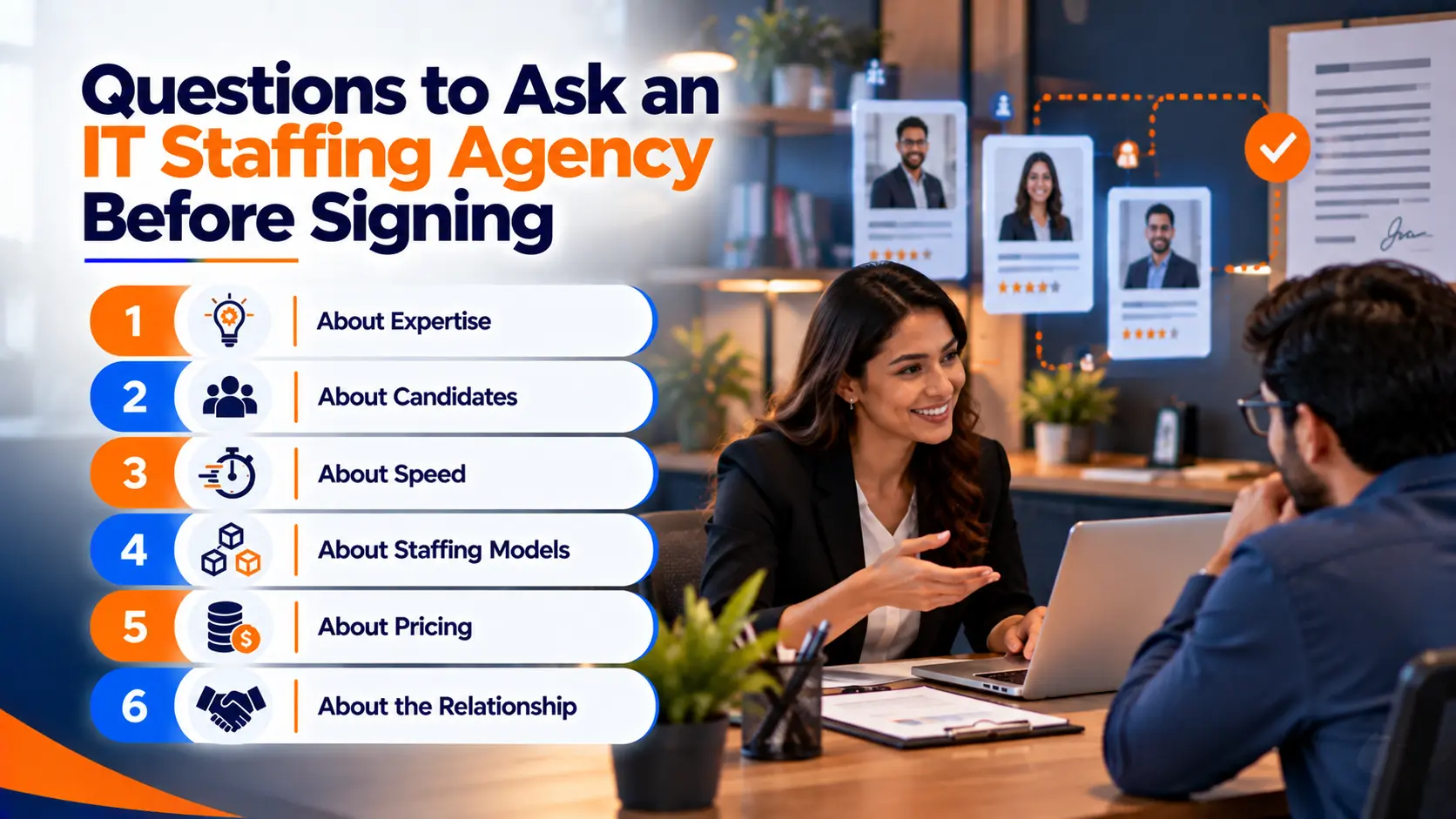
About Expertise
- What IT roles do you specialize in?
- How long have you recruited technology professionals?
- Do you have recruiters who understand our technology stack?
About Candidates
- How do you source candidates?
- How do you technically screen them?
- How do you verify their experience?
- Can you provide references from similar clients?
About Speed
- What is your typical time-to-submit?
- How quickly can you respond to urgent requirements?
- What happens if a candidate doesn’t work out?
About Staffing Models
- Do you offer contract staffing?
- Do you provide permanent placement?
- Do you offer contract-to-hire?
- Can you support staff augmentation?
About Pricing
- What fees will we pay?
- Are there conversion fees?
- What happens if we end an assignment early?
- Is there a replacement guarantee?
About the Relationship
- Who will manage our account?
- How frequently will we receive updates?
- What happens after a candidate starts?
A good agency should be comfortable answering these questions clearly.
How to Compare Two IT Staffing Agencies
Imagine you’re comparing two providers.
Agency A
- Lower markup
- Large candidate database
- General staffing experience
- Limited technical screening
- Mostly job-board sourcing
Agency B
- Slightly higher fee
- Smaller but specialized technology talent pool
- Technical recruiters
- Structured candidate screening
- Contract and permanent staffing
- Strong experience with your industry
Agency A may appear cheaper.
But Agency B may deliver better total value if it produces qualified candidates faster and reduces internal hiring workload.
This is why the decision should be based on outcomes rather than headline pricing.
Warning Signs of the Wrong IT Staffing Agency
Be cautious if an agency:
Sends resumes without understanding the requirement
You shouldn’t have to explain basic technical concepts repeatedly.
Promises unrealistic hiring timelines
Speed is valuable, but highly specialized roles may require a genuine search.
Can’t explain its screening process
If the agency can’t tell you how candidates are evaluated, ask more questions.
Focuses heavily on resume volume
More resumes don’t necessarily mean better candidates.
Avoids discussing fees
Pricing should be transparent.
Has no relevant references
Ask for clients with similar requirements.
Doesn’t understand your industry
Technical skill alone may not be enough in regulated or specialized industries.
Stops communicating after placement
A good staffing relationship should include ongoing support.
Why Technical Expertise Matters More in 2026
The technology hiring market is becoming increasingly specialized.
Robert Half’s 2026 analysis identifies strong demand for:
- AI/ML engineers
- Data engineers
- Data scientists
- DevOps engineers
- Cybersecurity engineers
- Network/cloud engineers
- Software engineers
- IT project managers
- Systems administrators
Its research also identifies skills such as AI adoption, automation workflows, DevSecOps, machine learning, governance, enterprise software, and product management as important areas for technology employers.
This makes technical recruiting expertise increasingly valuable.
A company hiring a cybersecurity engineer shouldn’t necessarily use the same evaluation process as a company hiring a business analyst.
The staffing partner should understand the difference.
How AI Is Changing IT Staffing Agencies
AI is changing both sides of the staffing process.
Agencies can use AI and technology to assist with:
- Candidate sourcing
- Resume matching
- Skills analysis
- Talent-pool searches
- Candidate communication
- Workforce analytics
- Recruitment workflows
But AI shouldn’t replace human evaluation.
In fact, Robert Half’s 2026 research found that 70% of technology leaders surveyed said the AI factor alone made them more likely to turn to a staffing or consulting firm, particularly for specialized AI skills, identifying AI-related skills gaps, and managing increased volumes of AI-generated applications. The same research reported that 93% of surveyed technology and IT leaders said staffing firms had been effective in helping with AI-related hiring challenges.
That creates a useful principle for employers:
Look for an IT staffing agency that combines technology with experienced human recruiters, not one that relies exclusively on either.
Ask How the Agency Uses AI
Don’t simply ask:
“Do you use AI?”
Ask:
- Where is AI used in your recruiting process?
- How are candidates evaluated beyond automated matching?
- How do recruiters verify AI-generated resumes?
- How do you protect candidate and client data?
- Is human review part of the process?
- How do you prevent keyword matching from producing poor-fit candidates?
The technology should improve candidate discovery and efficiency while preserving human judgment.
Does the Size of the IT Staffing Agency Matter?
Not necessarily.
A large agency may provide:
- Broad geographic coverage
- Large candidate databases
- Multiple staffing models
- Enterprise infrastructure
A specialized agency may provide:
- More focused technical expertise
- More personalized service
- Specialized recruiter knowledge
- Greater attention to specific roles
The better question is:
Does the agency have the resources and expertise required for your hiring problem?
A 20-person startup and a multinational enterprise may need very different staffing partners.
What About Local vs National IT Staffing Agencies?
Both can be effective.
Local agency
May have stronger knowledge of:
- Local salaries
- Local candidates
- Regional employers
- Local hiring trends
National agency
May provide:
- Broader talent access
- Remote candidates
- Multi-state recruiting
- Larger candidate networks
- Specialized national searches
For hard-to-fill IT roles, national reach can be especially valuable.
What Should a Good IT Staffing Partnership Look Like?
The relationship shouldn’t end when the candidate accepts an offer.
A strong partnership can include:
Before hiring
- Workforce consultation
- Role definition
- Talent-market insight
- Compensation guidance
- Candidate sourcing
During hiring
- Candidate screening
- Interview coordination
- Feedback management
- Offer support
After hiring
- Onboarding support
- Assignment management
- Performance communication
- Replacement support
- Workforce planning
The best staffing relationships become ongoing workforce partnerships rather than one-time transactions.
How MetaSense Approaches IT Staffing
MetaSense has a particularly relevant history for organizations evaluating an IT staffing agency.
The company was founded in 1999 as an IT staffing company. Its current business includes technology staffing and services alongside healthcare workforce solutions, with offerings such as flexible staffing, temp-to-hire, direct-hire placement, and workforce management solutions.
That history provides an important foundation for its technology staffing proposition.
MetaSense’s leadership describes the company as having evolved from its IT staffing roots into a technology-enabled workforce partner, combining human expertise with technology and workforce-management capabilities.
For a business evaluating MetaSense, the relevant question isn’t simply:
“Can MetaSense find IT candidates?”
It is:
“Can MetaSense support the workforce model we actually need?”
That could mean:
- Contract IT staffing
- Permanent IT placement
- Temp-to-hire
- Flexible staffing
- Workforce management
When Should You Choose MetaSense?
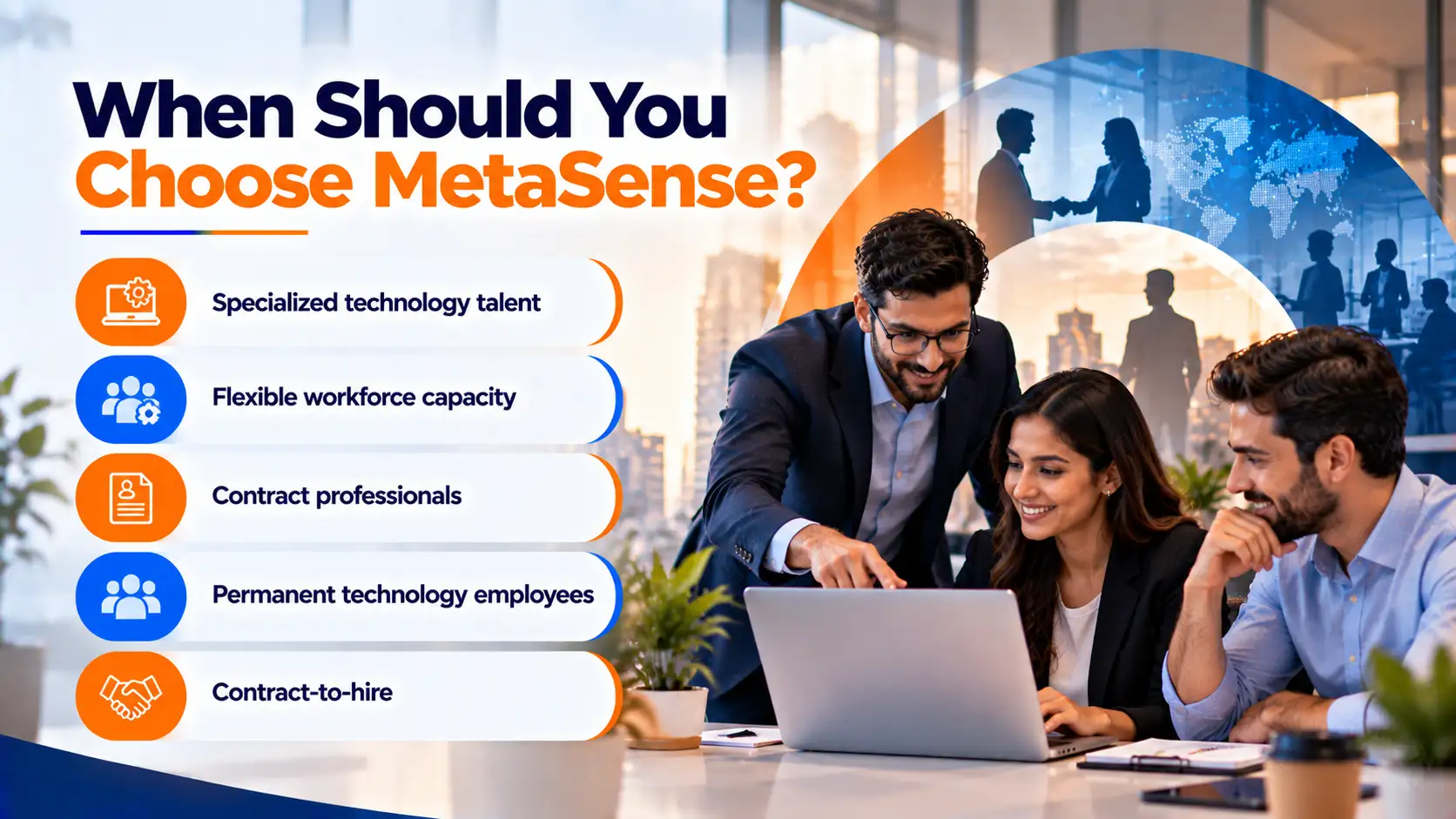
MetaSense may be a relevant option for businesses that need:
Specialized technology talent
When a position requires skills that are difficult to source through general recruitment.
Flexible workforce capacity
When technology demand changes around projects or business growth.
Contract professionals
When a company needs technical talent for a defined period.
Permanent technology employees
When the role represents a long-term workforce requirement.
Contract-to-hire
When the organization wants flexibility before making a permanent commitment.
The company’s IT staffing history also means its technology staffing capabilities are not a recent extension of a primarily unrelated business. MetaSense identifies IT staffing as its original business foundation, dating to 1999.
A Practical Example: Choosing an Agency for Cybersecurity Hiring
Imagine a financial-services company needs three cybersecurity engineers.
The company evaluates two staffing agencies.
Agency A
Promises 20 resumes within 48 hours.
Agency B
Asks about:
- Cloud environment
- SIEM platform
- IAM architecture
- Compliance requirements
- Security operations model
- Required certifications
- Incident-response responsibilities
- On-site/remote requirements
Agency B may initially appear slower.
But it is asking questions that determine whether candidates actually fit the position.
For specialized IT hiring, better qualification at the beginning can save significant time later.
A Practical Example: Hiring Software Engineers
A SaaS company needs 10 developers for a product launch.
The company should ask potential staffing agencies:
- Can you provide developers with our technology stack?
- Do you recruit nationally?
- Can you support contract staffing?
- How quickly can you provide qualified candidates?
- How do you validate technical experience?
- Can we convert successful contractors to permanent employees?
- What happens if a contractor leaves?
These questions reveal whether the agency can support the company’s actual workforce strategy.
How to Choose the Right IT Staffing Agency: Final Checklist
Before signing a contract, confirm that the agency can answer “yes” to the following:
- Understands our technology requirements
- Has experience with our industry
- Has access to relevant IT talent
- Uses a defined technical screening process
- Can meet our hiring timeline
- Offers the staffing model we need
- Can recruit in our target geography
- Provides appropriate compliance checks
- Offers transparent pricing
- Has relevant client references
- Provides post-placement support
- Uses technology responsibly
- Has a clear communication process
- Can scale with our future hiring needs
If an agency meets most of these requirements, it deserves serious consideration.
Final Takeaway
Choosing the right IT staffing agency isn’t about finding the company with the biggest candidate database or the lowest fee.
It’s about finding a partner that can understand your technology, business requirements, talent market, hiring timeline, and workforce strategy.
In 2026, this is especially important because technology hiring is becoming more specialized. Robert Half reports that 65% of technology hiring managers surveyed find skilled talent harder to locate than a year earlier, while employers are increasing both permanent and contract hiring.
The right IT staffing agency should therefore help you answer:
What skills do we need?
Where can we find them?
How do we verify them?
How quickly can we hire them?
Should they be contract or permanent?
How will this workforce requirement change in the future?
For businesses considering MetaSense, the company’s IT staffing roots date back to 1999, and its current model includes flexible staffing, temp-to-hire, direct-hire placement, and workforce management solutions.
That makes the broader positioning clear:
The right IT staffing agency shouldn’t simply fill your next technology vacancy. It should help you make better workforce decisions.
When evaluating potential partners, prioritize technical expertise, candidate quality, screening rigor, speed, transparency, flexibility, and proven results over marketing claims.
The best staffing relationship is one that helps your business hire the right technology talent today while remaining capable of supporting the workforce you will need tomorrow.
Frequently Asked Questions
What does an IT staffing agency do?
An IT staffing agency helps businesses identify, evaluate, and hire technology professionals. Depending on the provider, services can include contract staffing, permanent placement, contract-to-hire, staff augmentation, and workforce management.
How do I choose the best IT staffing agency?
Start by evaluating technical expertise, industry experience, candidate quality, screening methods, hiring speed, staffing models, geographic reach, compliance, pricing transparency, and track record.
How much does an IT staffing agency charge?
Pricing varies depending on the staffing model, role, market, contract terms, and provider. Ask agencies to explain all fees, markups, conversion costs, guarantees, and other commercial terms before signing.
Should I choose a large or small IT staffing agency?
Neither is automatically better. Choose based on whether the agency has the technical expertise, talent access, geographic reach, service model, and resources required for your specific hiring needs.
How long does IT staffing take?
The timeline varies by role, market, candidate availability, location, and hiring requirements. Specialized technology roles may require a longer search than high-volume positions. Ask the agency for realistic benchmarks based on comparable roles.
What is the difference between IT staffing and IT recruiting?
IT recruiting primarily focuses on finding and evaluating candidates. IT staffing can encompass broader workforce solutions, including contract, temporary, contract-to-hire, permanent placement, and staff augmentation.
Can an IT staffing agency help with permanent hiring?
Yes. Many technology staffing agencies offer direct-hire or permanent-placement services in addition to contract staffing.
Is contract-to-hire a good option for IT positions?
It can be useful when an organization needs immediate talent but wants to evaluate technical performance, team fit, or long-term workforce requirements before making a permanent commitment.
What should I ask an IT staffing agency before signing?
Ask about technical screening, sourcing methods, time-to-fill, relevant experience, pricing, replacement policies, conversion terms, compliance, communication, and references.
Does an IT staffing agency need to understand my technology stack?
Ideally, yes. The more specialized the role, the more important technical recruiting knowledge becomes. A staffing partner should understand the difference between technologies, skill levels, responsibilities, and the actual requirements of the position.