
Healthcare workforce planning is no longer simply an HR exercise. For hospitals, it is an operational strategy that directly affects patient access, staffing costs, employee workload, service capacity, and the organization’s ability to respond to changing demand.
A hospital may have enough nurses today and still face a serious staffing problem six months from now. A new service line may require additional specialists. An aging workforce may increase retirement-related vacancies. A rural facility may struggle to recruit locally even when national supply appears adequate.
This is why effective healthcare workforce planning starts before a vacancy appears.
The goal is to understand how many people the organization will need, which skills they will require, where those professionals will come from, and what combination of permanent and flexible staffing can meet demand sustainably.
Current U.S. workforce projections make this especially important. HRSA’s latest 2023–2038 projections estimate shortages of 108,960 registered nurses and 141,160 physicians in 2038, expressed as full-time equivalents. HRSA also projects an 11% RN shortage in nonmetropolitan areas compared with 2% in metropolitan areas.
Meanwhile, the BLS projects approximately 189,100 RN openings each year from 2024 through 2034, including openings created by workers leaving the occupation or labor force.
For hospitals, these numbers reinforce a simple principle:
Workforce planning should begin with future demand, not today’s vacancies.
What Is Healthcare Workforce Planning?
Healthcare workforce planning is the structured process of forecasting an organization’s future workforce requirements, comparing those requirements with available talent, identifying gaps, and creating strategies to ensure the right people with the right skills are available at the right time.
For a hospital, that can involve planning for:
- Registered nurses
- Licensed practical/vocational nurses
- Physicians
- Nurse practitioners
- Physician assistants
- Allied health professionals
- Respiratory therapists
- Imaging professionals
- Laboratory professionals
- Therapists
- Behavioral health professionals
- Healthcare administrators
- Non-clinical staff
It also involves deciding how those workforce requirements should be met.
That might include:
- Permanent hiring
- Internal mobility
- Upskilling
- Per diem staffing
- Travel professionals
- Contract staffing
- Float pools
- Temp-to-hire
- Retention initiatives
- Workforce technology
In other words, workforce planning is not simply:
“How many employees do we need?”
It is:
“What workforce will we need, when will we need it, what skills will be required, and what is the most sustainable way to provide that capacity?”
Why Is Healthcare Workforce Planning Important?
Healthcare demand is not static.
Population demographics, patient acuity, retirement, workforce participation, technology, new care models, geographic distribution, and service utilization can all affect staffing requirements.
HRSA’s workforce modeling projects U.S. population growth from 334.9 million in 2023 to 361.4 million in 2038, with nearly half of that growth occurring among people age 75 and older. HRSA notes that this demographic shift is expected to increase demand for healthcare services used by older adults.
At the same time, the AHA’s 2026 Health Care Workforce Scan identifies workforce redesign, AI-enabled workflows, changing workforce roles, engagement, well-being, and multigenerational workforce management as major priorities for hospitals and health systems.
This means hospitals cannot rely exclusively on historical staffing patterns.
They need to plan for what comes next.
Healthcare Workforce Planning vs. Staffing
These terms are often used interchangeably, but they solve different problems.
Staffing
Staffing answers:
“Who can fill this position or shift?”
Workforce planning
Workforce planning answers:
“Why do we need this position, how much capacity will we need in the future, and what workforce strategy should we use?”
For example, suppose a hospital has 12 open RN positions.
A staffing response might be to recruit 12 nurses.
A workforce-planning response asks:
- Why are the positions vacant?
- Are they replacement positions or growth positions?
- Is patient volume increasing?
- Are retirements expected?
- Is turnover increasing?
- Is the specialty difficult to recruit?
- Can internal employees be upskilled?
- Should some positions be permanent?
- Should temporary staffing cover the immediate gap?
- What will demand look like next year?
That distinction separates reactive hiring from strategic workforce planning.
The 10-Step Healthcare Workforce Planning Process
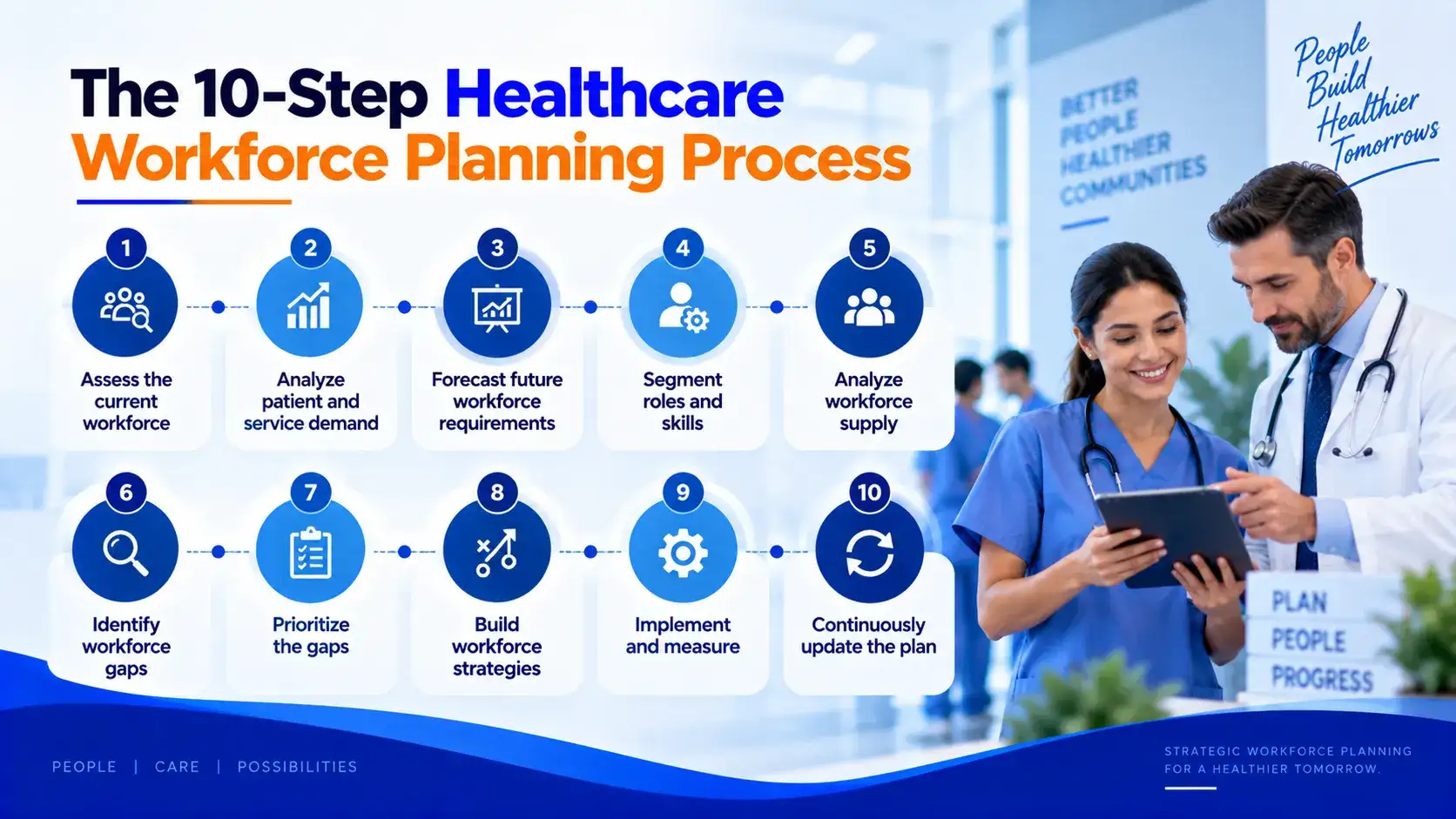
A practical hospital workforce-planning strategy can be organized into 10 steps:
- Assess the current workforce
- Analyze patient and service demand
- Forecast future workforce requirements
- Segment roles and skills
- Analyze workforce supply
- Identify workforce gaps
- Prioritize the gaps
- Build workforce strategies
- Implement and measure
- Continuously update the plan
Let’s examine each one.
Step 1: Assess Your Current Healthcare Workforce
You cannot plan the future workforce without understanding the current one.
Start by creating a workforce baseline.
Collect data such as:
- Total headcount
- FTEs
- Vacant positions
- Filled positions
- Turnover
- Retention
- Tenure
- Absenteeism
- Overtime
- Agency utilization
- Internal float utilization
- Retirement eligibility
- Credentials
- Certifications
- Specialties
- Shift coverage
- Location
- Department
- Productivity
For nursing, don’t simply count the number of RNs.
Two hospitals can have the same number of nurses but very different workforce capacity depending on:
- Full-time vs. part-time status
- Experience
- Specialty
- Shift
- Availability
- Patient acuity
- Department assignment
HRSA’s workforce model similarly distinguishes workforce supply in FTEs, allowing supply and demand to be compared on a common basis.
Practical example
A hospital has:
300 RNs
That sounds like a strong workforce.
But if:
- 40 are part-time,
- 25 are approaching retirement,
- 20 positions are vacant,
- turnover is increasing,
- and ICU staffing is below requirement,
the actual workforce position is very different.
Headcount is not the same as workforce capacity.
Step 2: Analyze Patient and Service Demand
The next question is:
How much healthcare capacity will the hospital need?
Workforce demand should be connected to the services the organization expects to deliver.
Relevant indicators can include:
- Admissions
- Patient days
- ED visits
- Surgical volume
- Outpatient visits
- Patient acuity
- Length of stay
- Service-line growth
- Seasonal demand
- New facilities
- New clinical programs
- Population changes
HRSA’s demand model follows this general principle: it first projects healthcare service demand and then estimates the number and mix of healthcare workers required to meet that demand.
Example
Suppose a hospital expects:
- 8% growth in emergency department visits
- 10% growth in surgical procedures
- A new oncology service
- Increased demand for outpatient care
The workforce plan should not simply reproduce last year’s staffing levels.
The expected changes in services should flow into the workforce forecast.
Step 3: Forecast Future Workforce Requirements
Now combine workforce supply and expected demand.
A simple planning equation is:
Future workforce gap = Projected workforce demand − Projected available workforce
For example:
Projected need: 420 RN FTEs
Projected available supply: 390 RN FTEs
Potential gap: 30 RN FTEs
That 30-FTE gap becomes a planning problem.
But don’t immediately assume the solution is to hire 30 people.
First determine why the gap exists.
Is it caused by:
- Growth?
- Turnover?
- Retirement?
- Increased patient volume?
- A specialty shortage?
- Geographic limitations?
- Scheduling?
- Low retention?
- Inefficient workflows?
The cause determines the solution.
Step 4: Identify Critical Roles and Skills
Not every workforce gap deserves the same priority.
A shortage of a hard-to-find ICU specialist may create more immediate operational risk than a vacancy in a role with a large available talent pool.
Create workforce segments based on:
Role criticality
How essential is the position to patient care or operations?
Scarcity
How difficult is the skill set to find?
Time-to-fill
How long does recruitment typically take?
Business impact
What happens if the role remains vacant?
Future demand
Is demand increasing or declining?
Replacement risk
Are many experienced employees approaching retirement?
This helps hospitals move from:
“We have 30 vacancies.”
to:
“These five workforce gaps represent the highest operational risk.”
Step 5: Analyze Workforce Supply
Demand tells you how many professionals you need.
Supply tells you whether you can realistically find them.
Analyze both internal and external supply.
Internal supply
Look at:
- Existing employees
- Internal mobility
- Employees eligible for advancement
- Cross-training opportunities
- Float pools
- Part-time employees who could increase hours
- Employees returning from leave
- Retention opportunities
External supply
Evaluate:
- Local labor market
- Regional labor market
- Training programs
- Competitor employers
- Compensation levels
- Geographic availability
- Travel workforce
- Contract workforce
- Professional pipelines
This is especially important for rural and underserved hospitals.
HRSA projects that nonmetropolitan areas will experience significantly greater workforce shortages in several professions. For RNs, the projected 2038 shortage is 11% in nonmetropolitan areas versus 2% in metropolitan areas.
A hospital therefore needs to understand its actual talent market, not simply national statistics.
Step 6: Identify the Workforce Gap
Now compare:
Current workforce + expected supply
against:
Future workforce demand
The result is the workforce gap.
But gaps can take different forms.
Quantity gap
You don’t have enough people.
Skills gap
You have enough employees, but not enough people with the required skills.
Geographic gap
Talent exists nationally but isn’t available locally.
Timing gap
You will eventually have enough employees, but you need additional capacity immediately.
Retention gap
You can recruit employees, but you cannot retain them.
These require different solutions.
Step 7: Prioritize Workforce Gaps
Not every gap needs immediate action.
A useful prioritization framework is:
| Factor | Question |
| Patient impact | Could this gap affect care delivery? |
| Urgency | How soon is the shortage expected? |
| Scarcity | How difficult is the talent to find? |
| Financial impact | What does the vacancy cost? |
| Volume | How many positions are affected? |
| Retention | Is turnover driving the gap? |
| Strategic importance | Is the role tied to future growth? |
A hospital could then categorize gaps as:
Critical → Immediate intervention
High → Active workforce plan
Moderate → Monitor and prepare
Low → Routine recruitment
This helps workforce leaders allocate resources where they matter most.
Step 8: Build the Workforce Strategy
Once the gaps are understood, determine how to close them.
There is no single solution.
Strategy 1: Permanent Recruitment
Best suited for:
- Long-term demand
- Core workforce positions
- New permanent service lines
- Stable staffing requirements
Strategy 2: Temporary or Travel Staffing
Useful when:
- Demand is temporary
- A vacancy is urgent
- Local recruitment is difficult
- A specialty is scarce
- A permanent pipeline is still developing
Strategy 3: Internal Mobility
Before recruiting externally, examine whether existing employees can move into higher-need areas.
Examples:
- Cross-training
- Career progression
- Specialty training
- Internal transfers
Strategy 4: Retention
Sometimes the fastest way to improve workforce supply is to keep the people you already have.
Retention strategies can include:
- Flexible scheduling
- Career development
- Leadership development
- Recognition
- Professional development
- Well-being initiatives
- Improved workplace conditions
The AHA’s 2026 workforce research highlights engagement, well-being, flexible approaches, career pathways, and support for a multigenerational workforce as important components of hospital workforce strategy.
Strategy 5: Workforce Redesign
A hospital may be able to change how work is distributed.
For example:
Instead of:
One professional performing every task
consider:
Interdisciplinary team + technology + appropriate delegation
The AHA’s 2026 Workforce Scan specifically identifies renewed investment in team-based care and redesigned staffing models.
Strategy 6: Technology and Automation
Technology can help hospitals reduce administrative workload and improve workforce visibility.
Potential applications include:
- Predictive scheduling
- Workforce analytics
- Demand forecasting
- Automated credential tracking
- Talent matching
- Workforce dashboards
- Virtual monitoring
- AI-assisted administrative workflows
The AHA notes that AI tends to deliver more value when paired with redesigned workflows rather than simply being added to existing processes.
This is an important workforce-planning lesson:
Don’t automate a broken workflow. Redesign the workflow and then determine where technology adds value.
Step 9: Create a Permanent + Flexible Workforce Model
One of the strongest approaches for hospitals is a blended workforce strategy.
Instead of expecting permanent employees to absorb every fluctuation in demand, build layers.
Core workforce
Permanent employees provide baseline capacity.
Flexible workforce
Per diem and local contract professionals respond to smaller changes.
Extended workforce
Travel and contract professionals provide additional capacity during larger or geographic shortages.
Talent pipeline
Recruiting continuously develops future permanent candidates.
This model gives hospitals greater elasticity.
For example:
Baseline requirement: 400 FTEs
Permanent workforce: 380 FTEs
Flexible capacity: 20 FTE equivalent
The exact model depends on the hospital, but the principle is important:
Plan workforce capacity around demand variability rather than assuming demand is constant.
Step 10: Measure Workforce Planning Results
A workforce plan isn’t complete when the hiring plan is approved.
It needs measurable outcomes.
Track:
Recruitment metrics
- Time-to-fill
- Time-to-start
- Offer acceptance rate
- Candidate pipeline
- Source of hire
Workforce metrics
- Vacancy rate
- Turnover
- Retention
- Absenteeism
- Overtime
- Agency utilization
- Internal mobility
Operational metrics
- Staffing coverage
- Patient volume
- Productivity
- Service capacity
- Schedule stability
Financial metrics
- Cost per hire
- Cost per vacancy
- Contract labor spending
- Overtime costs
- Turnover costs
Quality metrics
- Patient experience
- Clinical outcomes
- Safety indicators
- Staff engagement
The most useful workforce dashboards connect people metrics to operational outcomes.
A Simple Healthcare Workforce Planning Example
Consider a hypothetical 400-bed hospital.
The workforce team discovers:
- 420 RN FTEs currently available
- 450 RN FTEs required today
- 470 RN FTEs projected to be required in two years
- Expected retirements and turnover will reduce future supply
- ICU and emergency nursing are particularly difficult to recruit
The hospital has:
30 FTE gap today
and potentially:
50 FTE gap in two years.
A reactive strategy would recruit 30 nurses.
A workforce-planning strategy would create multiple actions:
Immediate
Use temporary staffing to stabilize coverage.
Near-term
Recruit permanent RNs for recurring vacancies.
Medium-term
Build ICU and emergency nursing pipelines.
Retention
Improve scheduling and career development.
Internal supply
Expand specialty training and mobility.
Long-term
Forecast workforce requirements annually and adjust recruitment targets.
This is the difference between filling vacancies and managing workforce capacity.
Common Healthcare Workforce Planning Mistakes
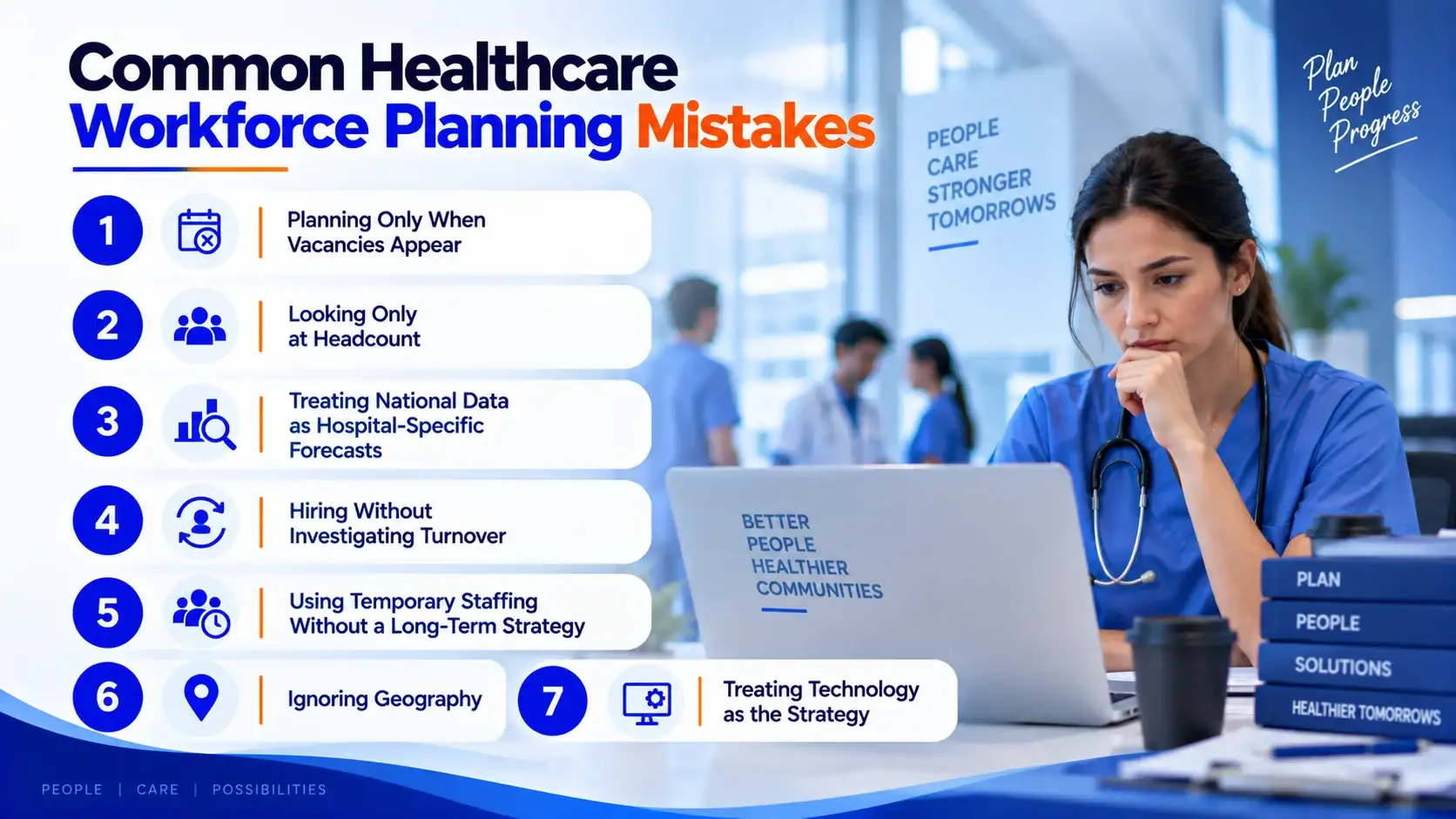
Mistake 1: Planning Only When Vacancies Appear
A vacancy is an outcome.
Workforce planning should identify risks before they become vacancies.
Mistake 2: Looking Only at Headcount
Headcount doesn’t show:
- FTE capacity
- Skills
- Availability
- Specialty
- Shift coverage
- Experience
Analyze the workforce in terms of capacity and capability.
Mistake 3: Treating National Data as Hospital-Specific Forecasts
HRSA projections provide important national and geographic context, but they are not a substitute for a hospital’s own demand and supply analysis. HRSA explicitly models assumptions around service utilization, workforce supply, and demand.
Hospitals should combine national projections with their own operational data.
Mistake 4: Hiring Without Investigating Turnover
If a hospital loses 100 nurses and hires 100 nurses, it may appear to have solved its workforce problem.
But if turnover continues, the recruitment cycle never ends.
Retention belongs inside workforce planning.
Mistake 5: Using Temporary Staffing Without a Long-Term Strategy
Temporary staffing can solve immediate capacity problems.
It should not automatically become the permanent answer to a structural workforce shortage.
Mistake 6: Ignoring Geography
National talent availability doesn’t mean a hospital can hire that talent locally.
Geography must be part of the workforce plan.
Mistake 7: Treating Technology as the Strategy
AI and workforce software can improve planning, but technology doesn’t replace workforce strategy.
The hospital still needs to determine:
What work needs to be done → who should do it → when → where → with what skills → at what sustainable cost.
How AI Is Changing Healthcare Workforce Planning in 2026
AI is becoming increasingly relevant to workforce management.
Potential applications include:
- Forecasting demand
- Predicting staffing requirements
- Identifying turnover patterns
- Matching professionals to roles
- Optimizing schedules
- Identifying skills gaps
- Automating administrative work
- Supporting workforce dashboards
But AI should be treated as a decision-support capability rather than a replacement for workforce leadership.
The AHA’s 2026 Workforce Scan specifically notes that AI works best when organizations pair it with redesigned workflows, appropriate data infrastructure, governance, training, and responsible implementation.
A hospital should therefore ask:
“What workforce decision are we trying to improve?”
before asking:
“Which AI tool should we buy?”
How MetaSense Fits Into Healthcare Workforce Planning
MetaSense’s Inc. model is particularly relevant to this approach because the company describes itself as a healthcare and technology staffing and services organization offering flexible staffing, temp-to-hire, direct-hire placement, and workforce management solutions.
Its healthcare workforce services include:
- Travel nurse staffing
- Allied health staffing
- Per diem and local staffing
- Nurse practitioner staffing
- Non-clinical staffing
- Permanent hiring solutions
This allows workforce strategies to be matched to different types of gaps.
Example:
Immediate staffing shortage → Travel staffing
Local short-term requirement → Per diem/local staffing
Long-term workforce requirement → Permanent hiring
Uncertain workforce need → Temp-to-hire
Specialized shortage → Targeted healthcare staffing
The broader objective is not simply to provide candidates.
It is to help healthcare organizations build a workforce model that can respond to changing demand.
MetaSense Inc. states that its healthcare division launched in 2019 to address critical staffing shortages in complex, high-demand care environments and that its experience includes large-scale, multi-site staffing programs requiring rapid deployment, compliance, and operational oversight.
A MetaSense Workforce Planning Example
MetaSense Inc. publicly describes its experience during the COVID-19 crisis, when its team worked around the clock to support a leading New Jersey hospital and deployed nurses, respiratory therapists, and support staff within days. The company says it supplied the highest number of respiratory therapists to that facility in the state during the crisis.
The useful workforce-planning lesson is not simply “hire temporary staff during a crisis.”
It is:
Crisis demand requires a workforce strategy that can move from forecasting → talent identification → credentialing → deployment → ongoing support.
That same infrastructure can be valuable outside a crisis.
A hospital may need rapid workforce expansion because of:
- Service-line growth
- Geographic shortages
- Seasonal demand
- Facility expansion
- Hard-to-fill specialties
- Unexpected turnover
The scale may be different, but the planning principles remain similar.
A Healthcare Workforce Planning Checklist
Hospital workforce leaders can use this checklist as a starting point.
Current Workforce
- Do we know our actual FTE capacity?
- Do we know our vacancy rate?
- Do we understand turnover by department?
- Do we know which roles are hardest to fill?
- Do we know upcoming retirement risks?
Demand
- Have we forecast patient volume?
- Have we considered service-line growth?
- Have we analyzed patient acuity?
- Are seasonal patterns included?
- Are demographic changes included?
Supply
- Is there sufficient local talent?
- Should recruitment expand geographically?
- Can internal employees be trained or promoted?
- Do we have a candidate pipeline?
- Do we have access to flexible staffing?
Strategy
- Which gaps require permanent hiring?
- Which gaps can use temporary staffing?
- Can technology reduce administrative workload?
- Can workflow redesign improve workforce productivity?
- Are retention initiatives addressing turnover?
Measurement
- Are we tracking time-to-fill?
- Are we tracking retention?
- Are we tracking agency utilization?
- Are we tracking overtime?
- Are workforce metrics connected to operational outcomes?
Final Takeaway
Effective healthcare workforce planning is about anticipating workforce needs before they become staffing emergencies.
The strongest hospitals don’t simply ask:
“How many positions are vacant?”
They ask:
“What workforce will we need six, 12, or 24 months from now—and what must we do today to build it?”
That requires connecting:
Patient demand → workforce demand → talent supply → skills → workforce gaps → staffing strategy → measurable outcomes
The U.S. workforce outlook makes this approach increasingly important. HRSA’s latest projections identify substantial future shortages across nursing, physicians, allied health, and behavioral health, while BLS projects 189,100 RN openings annually through 2034.
At the same time, the AHA’s 2026 workforce research shows hospitals are moving beyond traditional hiring toward team-based care, redesigned staffing models, AI-enabled workflows, workforce role redesign, and stronger employee engagement.
For MetaSense, this creates a natural positioning opportunity.
The company can be presented not merely as a source of healthcare professionals, but as a flexible healthcare workforce partner capable of supporting different stages of a hospital’s workforce strategy, from travel and per diem staffing to permanent hiring and workforce management.
The goal of healthcare workforce planning isn’t simply to fill tomorrow’s vacancies. It’s to build a workforce capable of meeting tomorrow’s patient demand.
Frequently Asked Questions About Healthcare Workforce Planning
What is healthcare workforce planning?
Healthcare workforce planning is the process of forecasting future staffing requirements, analyzing workforce supply, identifying gaps, and developing strategies to ensure an organization has the right number of professionals with the right skills when they are needed.
Why is workforce planning important for hospitals?
It helps hospitals anticipate staffing shortages, manage labor costs, improve workforce stability, prepare for changing patient demand, and avoid relying exclusively on reactive hiring.
What are the main steps in healthcare workforce planning?
A practical process includes assessing the current workforce, forecasting demand, analyzing supply, identifying gaps, prioritizing risks, developing workforce strategies, implementing them, measuring outcomes, and continuously updating the plan.
What data is needed for healthcare workforce planning?
Useful data includes FTEs, headcount, vacancies, turnover, retirement risk, patient volume, patient acuity, service-line growth, overtime, agency utilization, specialty requirements, absenteeism, and local labor-market information.
How does HRSA workforce data help hospitals?
HRSA’s workforce projections provide estimates of future healthcare workforce supply and demand by profession and geography. The latest projections cover 2023–2038 and can help hospitals understand broader workforce trends and geographic shortages.
How can hospitals forecast future staffing needs?
Hospitals can combine historical workforce data with projected patient demand, service-line growth, demographic changes, turnover, retirement, productivity, and expected workforce supply.
What is a workforce gap?
A workforce gap occurs when the organization’s projected workforce supply is insufficient to meet projected demand. The gap can involve the number of employees, specific skills, geography, or timing.
Can temporary staffing be part of workforce planning?
Yes. Temporary, travel, contract, and per diem professionals can provide flexible capacity while permanent workforce strategies are developed or when demand temporarily exceeds baseline staffing.
How does AI help healthcare workforce planning?
AI and analytics can support demand forecasting, scheduling, workforce matching, turnover analysis, and administrative automation. However, hospitals still need human oversight, governance, appropriate data, and redesigned workflows.
How often should hospitals update their workforce plan?
A hospital should maintain workforce planning as an ongoing process rather than treating it as an annual document. Strategic forecasts can be reviewed annually or more frequently, while critical workforce indicators should be monitored continuously.