
Artificial intelligence is changing IT hiring in 2026, but not in the way many early predictions suggested.
AI is not simply eliminating software developers, replacing recruiters, or making technical interviews unnecessary.
Instead, it is changing what employers look for, how candidates demonstrate their abilities, how recruiters identify talent, and how quickly organizations can evaluate and deploy technical professionals.
The biggest shift is from job-title-based hiring toward skills-based, AI-aware hiring.
A software developer who knows how to use AI coding tools effectively may now be evaluated differently from a developer who relies entirely on traditional development workflows. A cybersecurity professional may be expected to understand AI-driven threats. A data professional may need to work with AI models in addition to conventional analytics.
At the same time, recruiters are using AI to process information faster, but human judgment remains important when evaluating technical depth, communication, motivation, culture fit, and the context behind a candidate’s experience.
The U.S. labor market supports this shift. The Bureau of Labor Statistics (BLS) projects approximately 317,700 openings each year in computer and information technology occupations from 2024 to 2034.
AI is therefore entering a large and evolving technology workforce, not replacing a market that has stopped hiring.
Quick Answer: How Is AI Changing IT Hiring in 2026?
AI is changing IT hiring in five major ways:
- Employers are hiring for AI-related skills across traditional technology roles.
- Recruiters are using AI to improve candidate sourcing and matching.
- Technical assessments are shifting toward practical problem-solving and AI-assisted work.
- Candidates are increasingly expected to demonstrate AI literacy alongside technical expertise.
- Human judgment is becoming more important, not less, because AI-generated resumes and applications make surface-level screening less reliable.
The result is a new hiring model:
Traditional experience + technical skills + AI fluency + problem-solving + human judgment.
Why Is AI Changing IT Hiring So Quickly?
AI has moved from an experimental technology to a practical workplace tool.
Developers use AI-assisted coding tools. Data teams use machine learning and generative AI. Cybersecurity teams use AI for threat detection and analysis. IT teams automate repetitive workflows. Businesses are building AI-enabled products and internal systems.
This creates a feedback loop:
More AI adoption → new technology requirements → new skills → changing job descriptions → changing hiring criteria.
The World Economic Forum’s Future of Jobs Report 2025 identifies AI and information processing as the most transformative technology trend expected through 2030. It also ranks AI and big data, networks and cybersecurity, and technological literacy among the fastest-growing skill areas.
For IT employers, that means hiring requirements can change faster than traditional job descriptions.
A five-year-old definition of a “software developer” may not describe the skills a company needs today.
AI Is Not Eliminating IT Hiring
One of the biggest misconceptions about AI and IT hiring is that automation will simply reduce the need for technology professionals.
The current employment projections tell a more complicated story.
BLS projects that software developers, quality assurance analysts, and testers will experience 15% employment growth from 2024 to 2034, with approximately 129,200 openings per year. BLS specifically links continued demand to software development for AI, IoT, robotics, automation, and other applications.
AI is therefore simultaneously:
- Automating some tasks
- Creating new technical requirements
- Increasing demand for AI-enabled products
- Changing existing IT roles
- Creating new technical specializations
The more accurate question isn’t:
“Will AI eliminate IT jobs?”
It is:
“Which IT tasks will AI automate, which new capabilities will it create, and what will employers expect from the people who perform the remaining work?”
7 Major Ways AI Is Changing IT Hiring in 2026
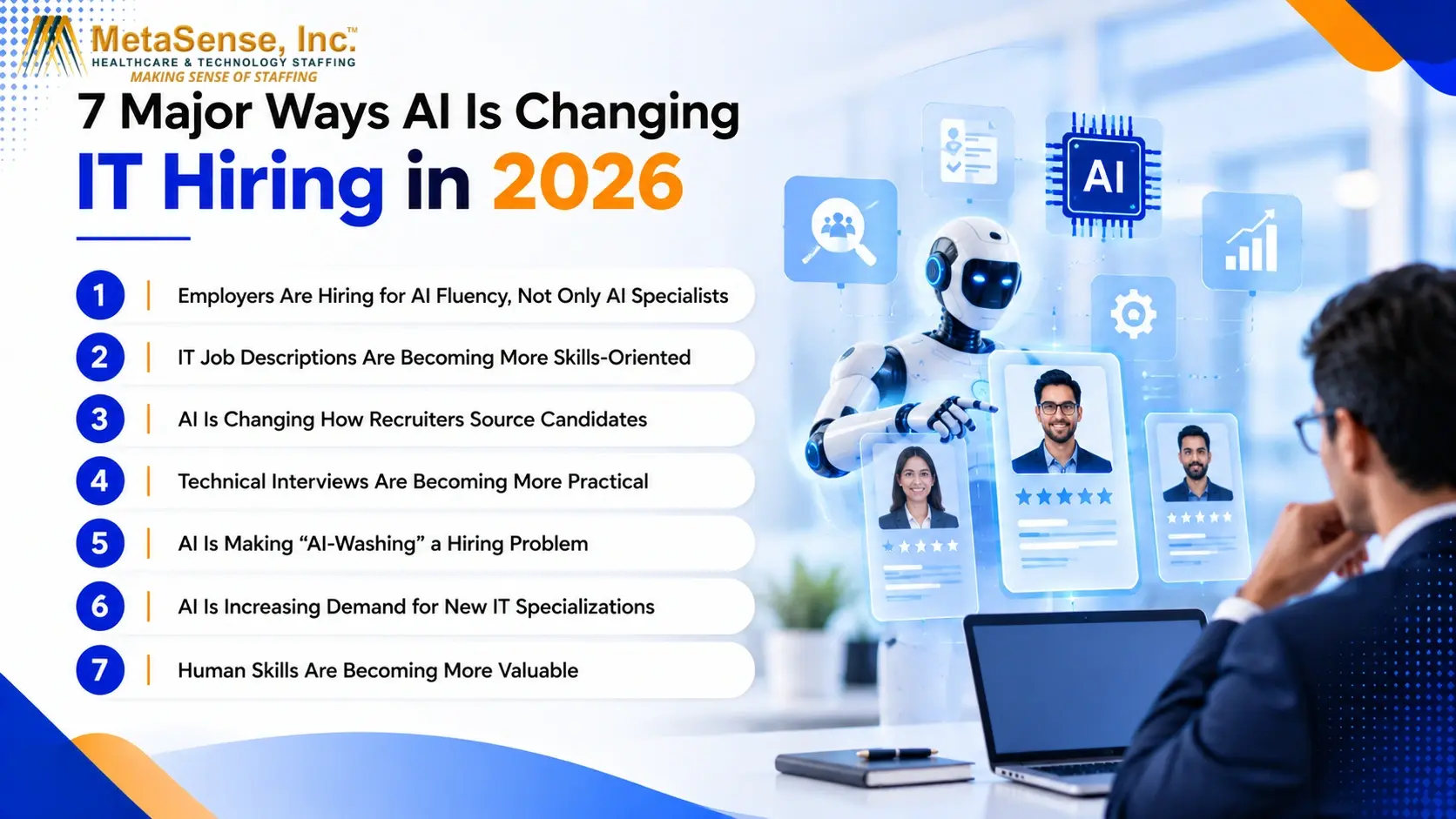
1. Employers Are Hiring for AI Fluency, Not Only AI Specialists
AI skills are no longer limited to machine learning engineers.
A company may increasingly expect its:
- Software developers
- Data analysts
- Cloud engineers
- DevOps engineers
- Cybersecurity professionals
- Product managers
- QA engineers
- IT administrators
to understand how AI affects their work.
That doesn’t mean every employee needs to become an AI researcher.
It means technical professionals increasingly need to understand how to use AI tools, validate AI output, identify limitations, and incorporate AI into appropriate workflows.
The distinction is important.
AI expertise
Building models, AI infrastructure, machine learning systems, or advanced AI applications.
AI literacy
Understanding how AI tools work, where they are useful, how to use them responsibly, and how to verify their output.
In 2026, AI literacy is becoming a broader workplace capability rather than a niche technical specialization.
LinkedIn’s 2026 State of Staffing & Search report found that staffing professionals were adopting AI literacy skills faster than LinkedIn members overall; by 2025, staffing professionals were adding AI literacy skills 46% more often than the broader member population.
2. IT Job Descriptions Are Becoming More Skills-Oriented
Traditional job descriptions often start with:
Degree + years of experience + technology stack + job title
AI-driven work is pushing employers toward a more capability-oriented approach.
Instead of simply asking:
“Does this person have five years of Python experience?”
employers may increasingly ask:
“Can this person design, build, test, secure, and maintain AI-enabled software using Python and modern development tools?”
That is a fundamentally different hiring question.
The World Economic Forum reports that approximately 39% of workers’ existing skill sets are expected to be transformed or become outdated between 2025 and 2030.
This does not mean 39% of jobs will disappear.
It means the skills required to perform many jobs are changing.
For recruiters, that means job descriptions need to evolve with the work.
3. AI Is Changing How Recruiters Source Candidates
Recruiters traditionally spend significant time searching resumes, professional profiles, databases, referrals, and applications for relevant candidates.
AI can accelerate parts of this process by helping recruiters:
- Identify relevant skills
- Match candidate profiles to job requirements
- Search large candidate databases
- Identify transferable skills
- Prioritize potential matches
- Automate repetitive communications
- Summarize candidate information
- Assist with scheduling
- Analyze hiring data
But AI should not be treated as the final decision-maker.
A keyword match can identify a candidate who knows Python.
It cannot necessarily determine whether that person can architect a reliable production system.
It can identify “AWS” on a resume.
It cannot automatically establish whether the candidate has designed cloud infrastructure at the scale the employer requires.
That is where experienced technical recruiters remain valuable.
4. Technical Interviews Are Becoming More Practical
Generative AI has changed the meaning of some traditional technical assessments.
If an AI assistant can generate a basic function in seconds, asking a candidate to write that function from memory may reveal less than it once did.
Employers may increasingly evaluate:
- System design
- Debugging
- Architecture
- Code review
- Testing
- Security
- Reasoning
- Trade-off analysis
- AI-assisted development
- Ability to validate AI-generated code
For example, instead of asking:
“Write a Python function that performs X.”
an employer could provide an existing application and ask:
“Use the available tools to identify the problem, explain your approach, improve the implementation, test the result, and discuss the risks.”
That evaluates the candidate’s ability to think like an engineer, rather than simply reproduce syntax.
5. AI Is Making “AI-Washing” a Hiring Problem
There is another side to AI-enabled hiring.
Candidates can now use AI to:
- Rewrite resumes
- Generate cover letters
- Prepare interview responses
- Create portfolio descriptions
- Produce code
- Prepare technical explanations
This makes polished applications less informative.
A candidate may list “AI” repeatedly without actually having meaningful experience applying AI.
This creates a new challenge for recruiters:
How do you distinguish AI fluency from AI keyword stuffing?
The answer is stronger skills validation.
Recruiters and hiring managers should look for evidence such as:
- What did the candidate actually build?
- Which AI tools did they use?
- What problem did AI solve?
- What did the candidate personally contribute?
- How did they validate the output?
- What limitations did they encounter?
- What would they do differently?
The goal is to evaluate applied capability, not AI vocabulary.
6. AI Is Increasing Demand for New IT Specializations
AI is not simply changing existing jobs.
It is creating demand for new technical capabilities.
BLS’s latest projections illustrate the trend.
Between 2024 and 2034, employment is projected to grow:
| Occupation | Projected Growth |
| Data Scientists | 33.5% |
| Information Security Analysts | 28.5% |
| Computer & Information Research Scientists | 19.7% |
| Software Developers, QA Analysts & Testers | 15% |
| Computer & Information Systems Managers | 15% |
| Computer Network Architects | 11.9% |
These numbers don’t mean AI is responsible for every percentage point of growth.
They do show that the broader technology labor market continues to create demand for advanced technical capabilities while AI adoption accelerates.
For employers, this means competition for certain skill combinations may intensify.
7. Human Skills Are Becoming More Valuable
It might seem logical that AI would make technical skills the only thing that matters.
The opposite may happen.
As AI handles more routine technical work, employers may place greater value on professionals who can:
- Define problems
- Communicate clearly
- Make decisions
- Challenge assumptions
- Work across teams
- Understand business requirements
- Manage ambiguity
- Validate AI output
- Take ownership
The World Economic Forum ranks analytical thinking as the most sought-after core skill among employers, followed by resilience, flexibility and agility, and leadership and social influence.
That creates an interesting hiring equation:
AI capability + technical expertise + human judgment
A candidate who can use an AI tool but cannot determine whether its output is correct may be less valuable than a candidate who knows when to trust the tool, and when not to.
Which IT Roles Are Being Most Affected by AI?
AI affects different IT roles differently.
Software Developers
Developers increasingly work with AI-assisted coding, testing, debugging, documentation, and code generation.
The skill shift is not necessarily from:
Developer → No developer
It is more likely:
Traditional developer → AI-augmented software engineer
BLS projects 15% growth for software developers, QA analysts, and testers between 2024 and 2034.
Data Scientists and Data Engineers
AI depends heavily on reliable data.
Organizations need professionals who understand:
- Data pipelines
- Data quality
- Statistics
- Machine learning
- Data architecture
- Model evaluation
- Data governance
BLS projects 33.5% growth for data scientists from 2024 to 2034.
Cybersecurity Professionals
AI creates both opportunities and threats for cybersecurity teams.
Attackers can use AI to improve attacks.
Defenders can use AI to detect anomalies, analyze threats, automate certain investigations, and improve response.
BLS projects 28.5% growth for information security analysts from 2024 to 2034.
Cloud and Infrastructure Engineers
AI workloads require significant infrastructure.
Organizations deploying AI applications may need professionals who understand:
- Cloud architecture
- Containers
- Kubernetes
- GPUs
- Networking
- Infrastructure automation
- Security
- Cost optimization
AI therefore creates infrastructure requirements alongside application requirements.
IT Managers
Technology leaders increasingly need to understand both technology and workforce transformation.
An IT manager may need to decide:
- Which tasks should be automated?
- Which roles require reskilling?
- Which AI tools should employees use?
- What risks do AI systems introduce?
- Which technical skills should be hired externally?
- Which capabilities can be developed internally?
This makes technology leadership increasingly connected to workforce strategy.
How Should Companies Hire IT Professionals in 2026?
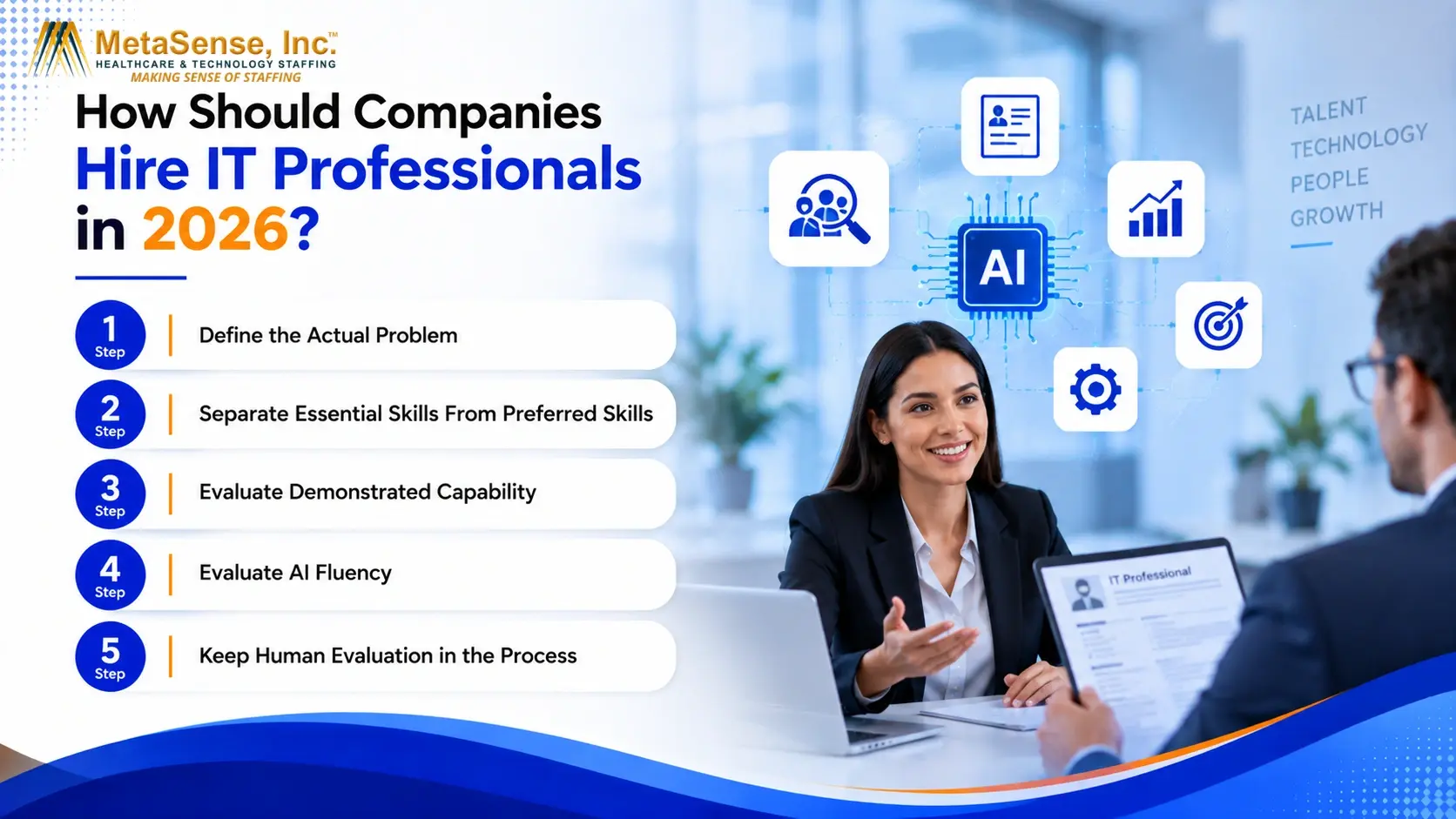
The hiring process needs to evolve alongside the technology.
Step 1: Define the Actual Problem
Don’t start with:
“We need an AI engineer.”
Start with:
“What business problem are we trying to solve?”
Perhaps the organization actually needs:
- An ML engineer
- A data engineer
- A cloud architect
- A software engineer with AI experience
- A cybersecurity specialist
- An AI product manager
The job title should follow the problem, not the other way around.
Step 2: Separate Essential Skills From Preferred Skills
A job description containing 25 technologies can eliminate qualified candidates before the recruiter even speaks with them.
Instead, classify requirements:
Essential
Skills the person must have to perform the role.
Valuable
Skills that improve effectiveness but can be learned.
Emerging
Skills the organization expects to become important.
This makes hiring more skills-based.
Step 3: Evaluate Demonstrated Capability
Look beyond resumes.
Consider:
- Portfolio projects
- GitHub activity where relevant
- Technical assessments
- Architecture discussions
- Real-world scenarios
- Problem-solving exercises
- Technical conversations
- Professional references
The goal is to understand what the candidate can actually do.
Step 4: Evaluate AI Fluency
Don’t simply ask:
“Do you know AI?”
Ask:
“How have you used AI in your work?”
Then explore:
- Which tools?
- For what tasks?
- What was the outcome?
- How did you validate results?
- What risks did you identify?
- What did you choose not to automate?
These questions reveal practical AI maturity.
Step 5: Keep Human Evaluation in the Process
AI can accelerate candidate discovery.
It should not automatically determine who deserves an opportunity.
Recent reporting has highlighted concerns around AI hiring systems, including allegations involving automated candidate screening, transparency, and potential discrimination. These concerns reinforce the importance of human oversight, documented evaluation criteria, and responsible use of automated hiring tools.
For employers, the principle should be simple:
Use AI to improve hiring decisions, not to avoid making them.
What Should Recruiters Look for in an AI-Ready IT Candidate?
A strong AI-ready candidate does not necessarily have to be an AI engineer.
Look for a combination of:
Technical foundation
Does the candidate understand the underlying technology?
AI literacy
Can the person use AI tools appropriately?
Validation skills
Can they identify incorrect or unreliable AI output?
Problem-solving
Can they define and solve problems independently?
Adaptability
Can they learn new tools as technology changes?
Communication
Can they explain technical decisions to nontechnical stakeholders?
Security awareness
Do they understand privacy, security, and governance considerations?
Business understanding
Can they connect technology decisions to business outcomes?
This combination may become more valuable than simply counting years of experience.
What Does AI Mean for IT Recruiters?
AI is also changing the role of the recruiter.
The traditional recruiter may spend significant time on repetitive administrative activities.
An AI-enabled recruiter can potentially spend more time on:
- Talent strategy
- Candidate relationships
- Technical conversations
- Market intelligence
- Client consultation
- Workforce planning
- Candidate engagement
- Closing difficult searches
The role evolves from:
“Find resumes.”
to:
“Understand the workforce problem and identify the right talent strategy.”
That does not make recruiters less important.
It changes where their expertise creates value.
Why Human Recruiters Still Matter in AI-Driven Hiring
Consider two candidates.
Both have:
- Python
- AWS
- AI
- Machine learning
- Five years of experience
An automated system might consider them similar.
An experienced recruiter may discover:
Candidate A built internal prototypes but has limited production experience.
Candidate B designed a production ML platform, led a migration, worked directly with stakeholders, and understands the organization’s business environment.
The difference isn’t visible through keywords alone.
It comes from conversation, context, verification, and judgment.
This is particularly important for specialized IT roles where a poor hire can affect projects, security, infrastructure, and business continuity.
How MetaSense Approaches Technology Staffing in an AI-Driven Market
MetaSense has a useful perspective on this transformation because technology staffing is part of its original business foundation.
The company was founded in 1999 as an IT staffing company before expanding into healthcare in 2019. Today, MetaSense describes itself as a technology-enabled workforce partner serving healthcare and technology organizations and offering flexible staffing, temp-to-hire, direct-hire placement, and workforce-management solutions.
That background matters in the AI era because effective technology recruitment increasingly requires more than matching job titles to resumes.
MetaSense describes its model as combining technology with human insight and emphasizes understanding both professional skills and longer-term goals. Its CEO, Jatin V. Mehta, has described the company’s evolution toward a technology-enabled workforce model while retaining human relationships as an important part of successful placements.
For employers, this approach is increasingly relevant.
AI can help identify potential matches.
Experienced recruiters help determine whether the match actually makes sense.
What Companies Should Change in Their IT Hiring Strategy in 2026
Organizations don’t necessarily need to rebuild their entire recruiting function.
They should start by changing several assumptions.
Move From Job Titles to Skills
Define what the person must be able to accomplish.
Move From Resume Screening to Evidence
Ask candidates to demonstrate relevant capabilities.
Move From “AI Experience” to Specific AI Use Cases
Ask what the candidate actually did with AI.
Move From Degree Filtering to Capability Evaluation
Education can be relevant, but it should not automatically substitute for evidence of practical ability.
Move From One-Time Hiring to Continuous Talent Pipelines
Technology skills change quickly.
Organizations should maintain relationships with relevant talent even when there is no immediate vacancy.
Move From AI Automation to AI-Assisted Decision-Making
Automate repetitive tasks while maintaining human oversight for consequential decisions.
How AI Is Changing IT Hiring for Candidates
The transformation isn’t only happening on the employer side.
IT professionals also need to change how they present themselves.
A resume that simply lists:
Python | AWS | SQL | Java | AI
may not communicate enough.
A stronger profile explains:
What was built → what technology was used → what problem was solved → what changed as a result.
For example:
Instead of:
“Used AI to improve development.”
A candidate could demonstrate:
“Integrated an AI-assisted development workflow into a software project, using automated code generation and testing while introducing review controls to reduce incorrect outputs.”
The second description provides evidence of application and judgment.
Do IT Professionals Need to Learn Prompt Engineering in 2026?
Not necessarily as a standalone career path.
Prompting is increasingly becoming part of broader AI literacy.
The more valuable capability is understanding:
- How to communicate with AI systems
- How to structure tasks
- How to provide context
- How to evaluate output
- How to iterate
- How to recognize hallucinations
- How to protect sensitive information
- When not to use AI
For a software engineer, the ability to use AI-assisted development effectively may matter more than holding a generic “prompt engineer” credential.
For a data professional, understanding AI-assisted analysis may be more valuable.
For a cybersecurity professional, understanding AI-driven attack and defense techniques may matter more.
AI skills need to be contextualized to the job.
The Biggest IT Hiring Mistakes to Avoid in 2026
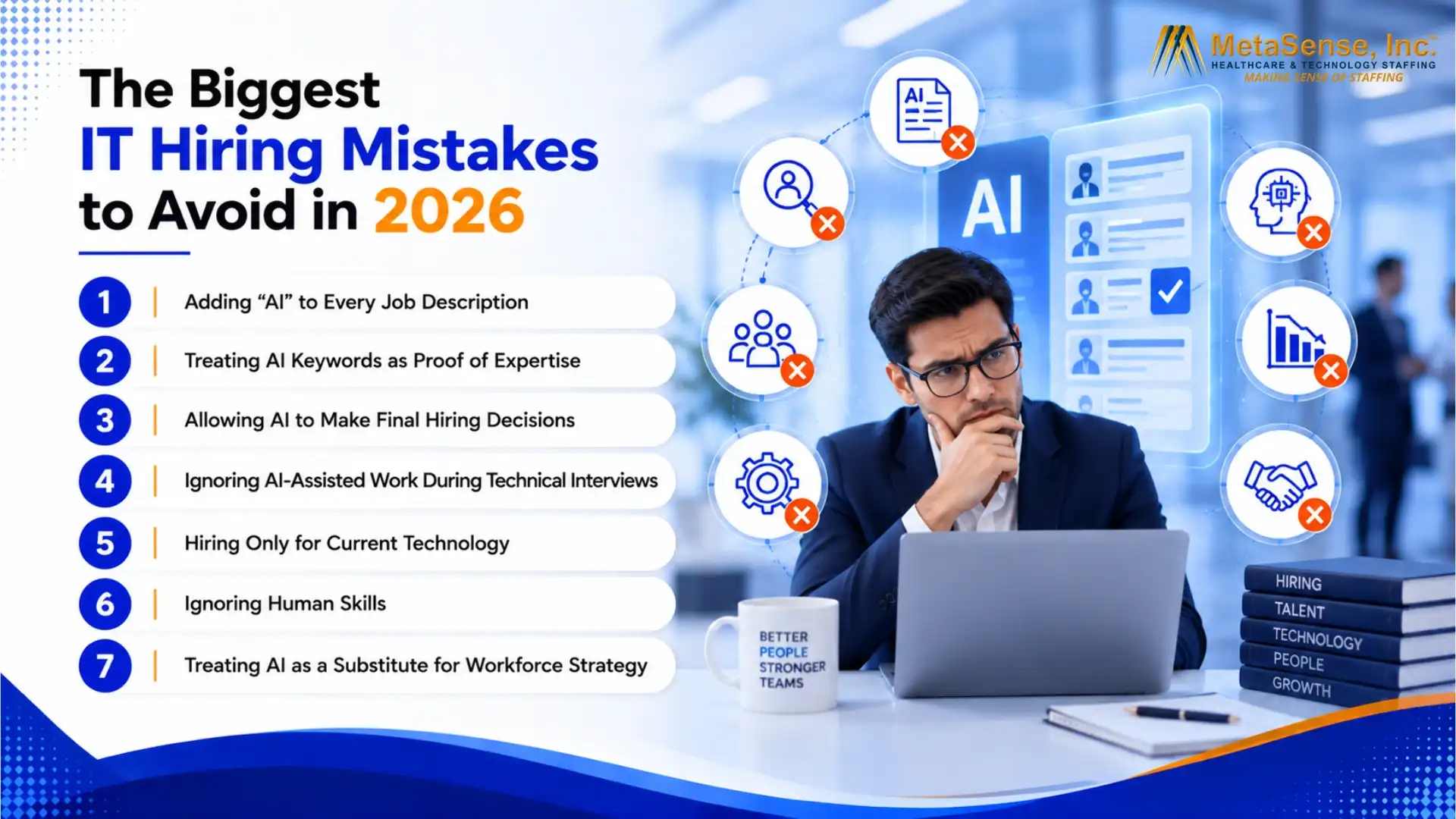
1. Adding “AI” to Every Job Description
Not every role requires deep AI expertise.
Define the actual requirement.
2. Treating AI Keywords as Proof of Expertise
“AI” on a resume doesn’t establish practical capability.
3. Allowing AI to Make Final Hiring Decisions
Automated systems can assist with screening but require appropriate oversight.
4. Ignoring AI-Assisted Work During Technical Interviews
Candidates increasingly use AI tools professionally.
Assess whether they can use them responsibly rather than pretending AI doesn’t exist.
5. Hiring Only for Current Technology
Technology changes quickly.
Look for learning ability and transferable technical foundations.
6. Ignoring Human Skills
Technical capability without communication, judgment, and collaboration can create significant organizational problems.
7. Treating AI as a Substitute for Workforce Strategy
AI can improve recruitment efficiency.
It cannot tell an organization exactly which workforce capabilities it will need five years from now without business and human context.
The Future of IT Hiring: What Will Matter Most?
The strongest IT professionals in the coming years are unlikely to be those who simply know the largest number of tools.
They will be professionals who can combine technical expertise with AI-enabled productivity and sound judgment.
The World Economic Forum expects AI and big data, cybersecurity, and technological literacy to be among the fastest-growing skills through 2030, while analytical thinking, resilience, flexibility, and leadership remain important core capabilities.
This suggests a new model for IT talent:
Technical depth + AI fluency + adaptability + critical thinking + communication
That combination is difficult to automate.
Final Takeaway: AI Is Changing the Definition of a Strong IT Candidate
The biggest change AI is bringing to IT hiring in 2026 isn’t simply automation.
It is a change in what employers consider valuable.
Knowing a programming language still matters.
Knowing cloud infrastructure still matters.
Understanding cybersecurity, data, architecture, systems, and software engineering still matters.
But those technical foundations increasingly need to be combined with the ability to work effectively with AI, evaluate its output, adapt to new tools, and make decisions that machines cannot reliably make on their own.
For employers, that means moving beyond keyword-heavy job descriptions and resume screening toward skills-based, evidence-driven hiring.
For IT professionals, it means building AI fluency without abandoning the technical fundamentals that make AI useful in the first place.
And for staffing companies, it means becoming more than a source of resumes.
MetaSense’s roots in IT staffing, dating back to 1999, give it a long history in technology talent acquisition. Today, the company combines technology staffing with workforce solutions, flexible staffing models, direct-hire and temp-to-hire placement, and a technology-enabled approach to workforce management.
The organizations that adapt fastest will not necessarily be the ones that automate the most.
They will be the ones that understand where AI creates leverage, where human expertise remains essential, and what skills their workforce will need next.
Frequently Asked Questions About AI and IT Hiring
How is AI changing IT hiring in 2026?
AI is changing IT hiring by increasing demand for AI-related skills, accelerating candidate sourcing and screening, changing technical assessments, increasing the importance of skills-based hiring, and making AI literacy relevant across more technology roles.
Will AI replace IT recruiters?
AI can automate parts of recruiting, including sourcing assistance, matching, scheduling, and administrative work. It is less capable of replacing the human judgment required for candidate relationships, nuanced technical evaluation, motivation assessment, and complex hiring decisions.
Will AI replace software developers?
AI is automating parts of software development, but current BLS projections still show strong growth for software developers, QA analysts, and testers, with employment projected to grow 15% from 2024 to 2034.
The role is changing toward more AI-assisted development rather than disappearing altogether.
What AI skills should IT professionals learn in 2026?
The right skills depend on the role, but broadly valuable capabilities include AI literacy, AI-assisted development, data analysis, model evaluation, automation, cybersecurity awareness, prompt/task design, and the ability to validate AI output.
Are AI skills required for every IT job?
No. The depth of AI expertise should depend on the position. However, basic AI literacy is becoming increasingly useful across many technology roles.
How should companies evaluate AI skills during hiring?
Ask candidates to demonstrate how they have applied AI to real problems. Discuss the tools used, their contribution, how they evaluated outputs, what limitations they encountered, and how they managed security or quality risks.
Is prompt engineering still a valuable IT skill?
Prompting remains useful, but it is increasingly becoming part of broader AI literacy rather than a standalone skill for every technology professional. The value comes from using AI effectively within a specific technical or business context.
How can AI improve IT recruitment?
AI can assist with candidate sourcing, skills matching, resume analysis, scheduling, communication, workforce analytics, and other repetitive processes. Human recruiters should remain involved in consequential decisions.
Why is skills-based hiring becoming more important?
Technology changes quickly. A candidate’s ability to learn, solve problems, apply tools, and demonstrate relevant capabilities can sometimes provide more useful information than a static list of job titles or technologies.
Should companies use AI to screen IT candidates?
AI can assist with high-volume screening, but organizations should establish appropriate human oversight, consistent evaluation criteria, transparency, and safeguards against discriminatory or inaccurate automated decisions.