
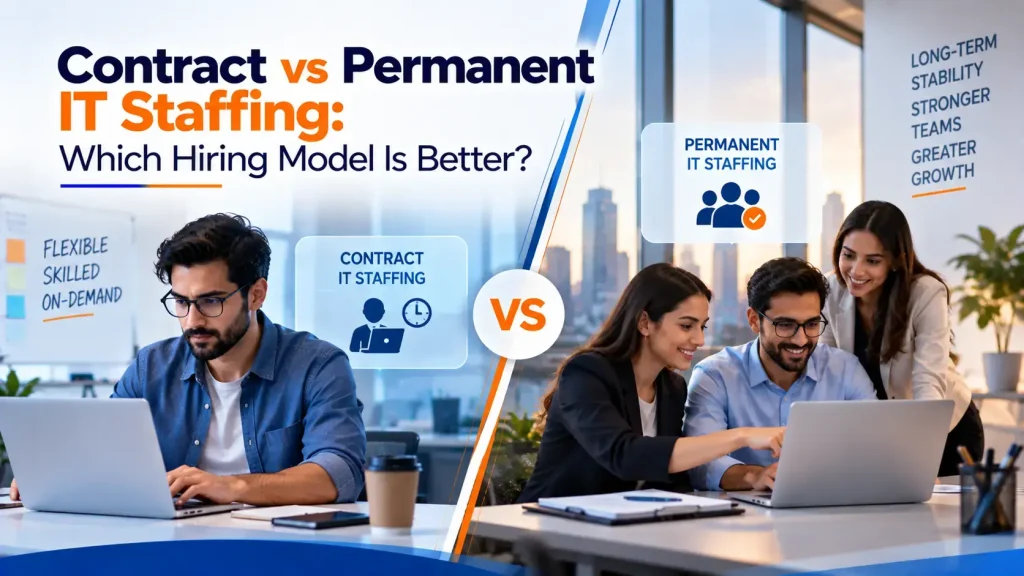
For U.S. companies hiring technology professionals, the choice between contract vs permanent IT staffing is no longer a simple question of cost or job duration.
Businesses are simultaneously investing in AI, cybersecurity, cloud infrastructure, software development, data, and digital transformation. That is creating demand for technology professionals with increasingly specialized skills.
The U.S. Bureau of Labor Statistics projects 317,700 openings per year, on average, across computer and information technology occupations from 2024 to 2034. Software developer employment alone is projected to grow 16%, adding approximately 267,700 jobs during the same period. Data scientists are projected to grow 33.5%, while information security analysts are projected to grow 28.5%.
At the same time, employers are using different workforce models to access that talent.
Recent 2026 research from Robert Half found that 78% of technology leaders surveyed planned to increase permanent technology headcount, while 66% expected to bring in more contract professionals. The same research found that 65% of technology hiring managers said finding skilled talent was more difficult than a year earlier.
This tells us something important:
Contract and permanent IT staffing aren’t necessarily competing strategies. Many organizations need both.
The better question is:
Which hiring model is right for this particular technology requirement?
Contract vs Permanent IT Staffing: Quick Answer
Contract IT staffing is generally better when an organization needs flexibility, specialized expertise, rapid hiring, or additional capacity for a defined project or uncertain workload.
Permanent IT staffing is generally better when the organization has a long-term need for a role, wants to build institutional knowledge, and expects the position to remain strategically important.
Contract-to-hire can be the middle ground when a company needs immediate talent but wants to evaluate long-term fit before making a permanent commitment.
| Factor | Contract IT Staffing | Permanent IT Staffing |
| Primary purpose | Flexible workforce capacity | Long-term workforce building |
| Hiring speed | Often faster | Can take longer |
| Project-based work | Strong fit | May be less suitable |
| Long-term roles | Possible, but not always ideal | Strong fit |
| Specialized skills | Strong fit | Strong fit |
| Workforce flexibility | High | Lower |
| Institutional knowledge | Develops over assignment | Builds over time |
| Short-term demand | Strong fit | Less flexible |
| Uncertain headcount | Strong fit | Higher commitment |
| Employee retention | Assignment-dependent | Long-term focus |
| Contract-to-hire | Can be used | Can lead to permanent placement |
| Best use | Projects, gaps, specialized needs | Core business capabilities |
What Is Contract IT Staffing?
Contract IT staffing allows a company to bring technology professionals into its workforce for a defined period or specific business requirement.
The professional may work for a staffing provider while performing services for the client organization, depending on the engagement structure.
Contract IT professionals can support areas such as:
- Software development
- Cloud engineering
- Cybersecurity
- DevOps
- Data engineering
- AI and machine learning
- IT infrastructure
- Quality assurance
- Business analysis
- Project management
- Enterprise applications
The contract may last for several months, a year, or another agreed period depending on the project and staffing arrangement.
Example
A healthcare technology company is migrating a legacy platform to a cloud environment.
It needs:
- 4 cloud engineers
- 3 software developers
- 2 DevOps engineers
- 1 security specialist
The project is expected to take nine months.
The organization may not want to permanently increase its technology headcount by 10 employees.
Contract staffing can provide the required expertise for the project while keeping the long-term workforce structure more flexible.
What Is Permanent IT Staffing?
Permanent IT staffing refers to hiring technology professionals into ongoing positions within the organization’s workforce.
These employees become part of the company’s long-term team.
Permanent hiring is generally appropriate when the organization expects the role to remain important for the foreseeable future.
Examples include:
- CTO
- Engineering manager
- Senior software engineer
- Cloud architect
- Cybersecurity architect
- Data engineer
- Product manager
- DevOps engineer
- IT infrastructure manager
The organization is not simply filling a temporary skills gap.
It is building long-term technology capability.
Contract vs Permanent IT Staffing: What Is the Real Difference?
The simplest distinction is:
Contract staffing provides workforce flexibility. Permanent staffing builds workforce continuity.
But that doesn’t mean contract employees are less valuable or permanent employees are always better.
Consider two different situations.
Situation 1: Cloud Migration
A company needs cloud specialists for a nine-month migration.
Contract staffing may be the better fit.
Situation 2: Cloud Operations
The company will need cloud engineering expertise indefinitely after the migration.
Permanent hiring may make more sense.
The same organization could therefore use contract talent for the migration and permanent employees for ongoing cloud operations.
This is why the hiring model should be determined by the business requirement rather than the job title.
Why Contract IT Staffing Is Becoming More Important
Technology projects are becoming increasingly specialized.
Organizations may need expertise that they don’t require permanently.
The U.S. technology market illustrates the scale of this demand. BLS projects computer and mathematical occupations to grow 10.1% from 2024 to 2034, compared with 3.1% for total employment.
Some technology areas are growing considerably faster.
For example:
- Data scientists: 33.5%
- Information security analysts: 28.5%
- Software developers: 15.8%
- Computer and information research scientists: 19.7%
These projections show why companies may need access to specialized talent even when they don’t want to permanently expand every part of their workforce.
When Should a Company Choose Contract IT Staffing?
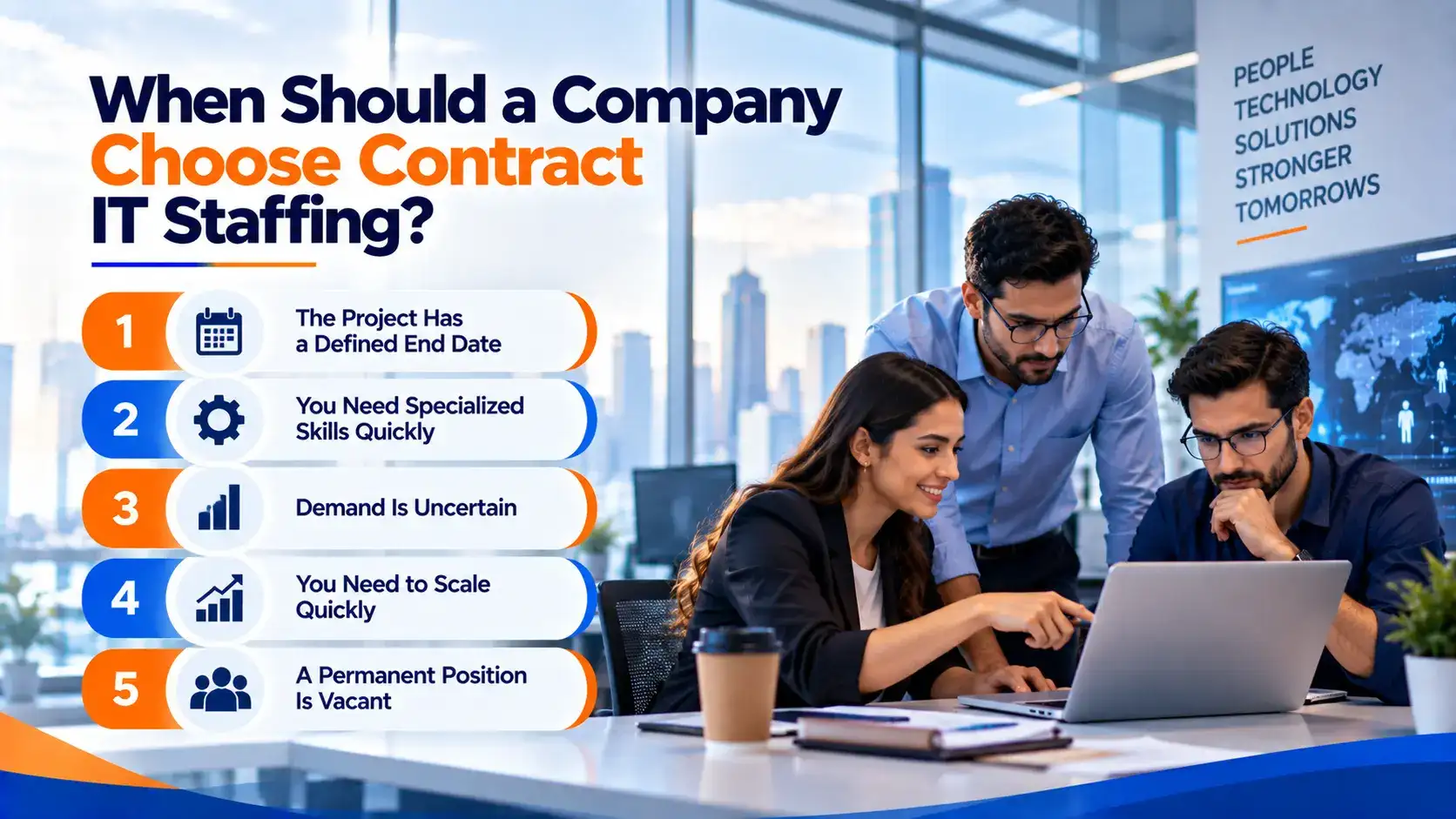
1. The Project Has a Defined End Date
If a project is expected to end in six, nine, or twelve months, contract staffing can prevent a company from creating permanent positions for temporary requirements.
Examples include:
- Cloud migration
- ERP implementation
- Application modernization
- Data migration
- Cybersecurity implementation
- Software rollout
- Infrastructure upgrade
2. You Need Specialized Skills Quickly
A company may have an internal technology team but lack a particular capability.
For example:
The internal engineering team understands application development but lacks Kubernetes security expertise.
Rather than permanently expanding the organization, the company could bring in a specialist for the relevant project.
3. Demand Is Uncertain
Technology demand can change rapidly.
A company may know it needs additional developers today but be uncertain about its requirements 12 months from now.
Contract staffing provides a way to add capacity without making the entire workforce increase permanent.
4. You Need to Scale Quickly
A company launching a major product may suddenly require additional:
- Developers
- QA engineers
- DevOps professionals
- Security specialists
- Data engineers
Contract staffing can help increase workforce capacity while the organization determines its long-term hiring needs.
5. A Permanent Position Is Vacant
Contract staffing can also act as a bridge.
Suppose a company needs a permanent cybersecurity engineer but its recruiting process is taking several months.
A contract professional could potentially provide coverage while the permanent search continues.
This prevents an important technology function from remaining understaffed.
When Should a Company Choose Permanent IT Staffing?
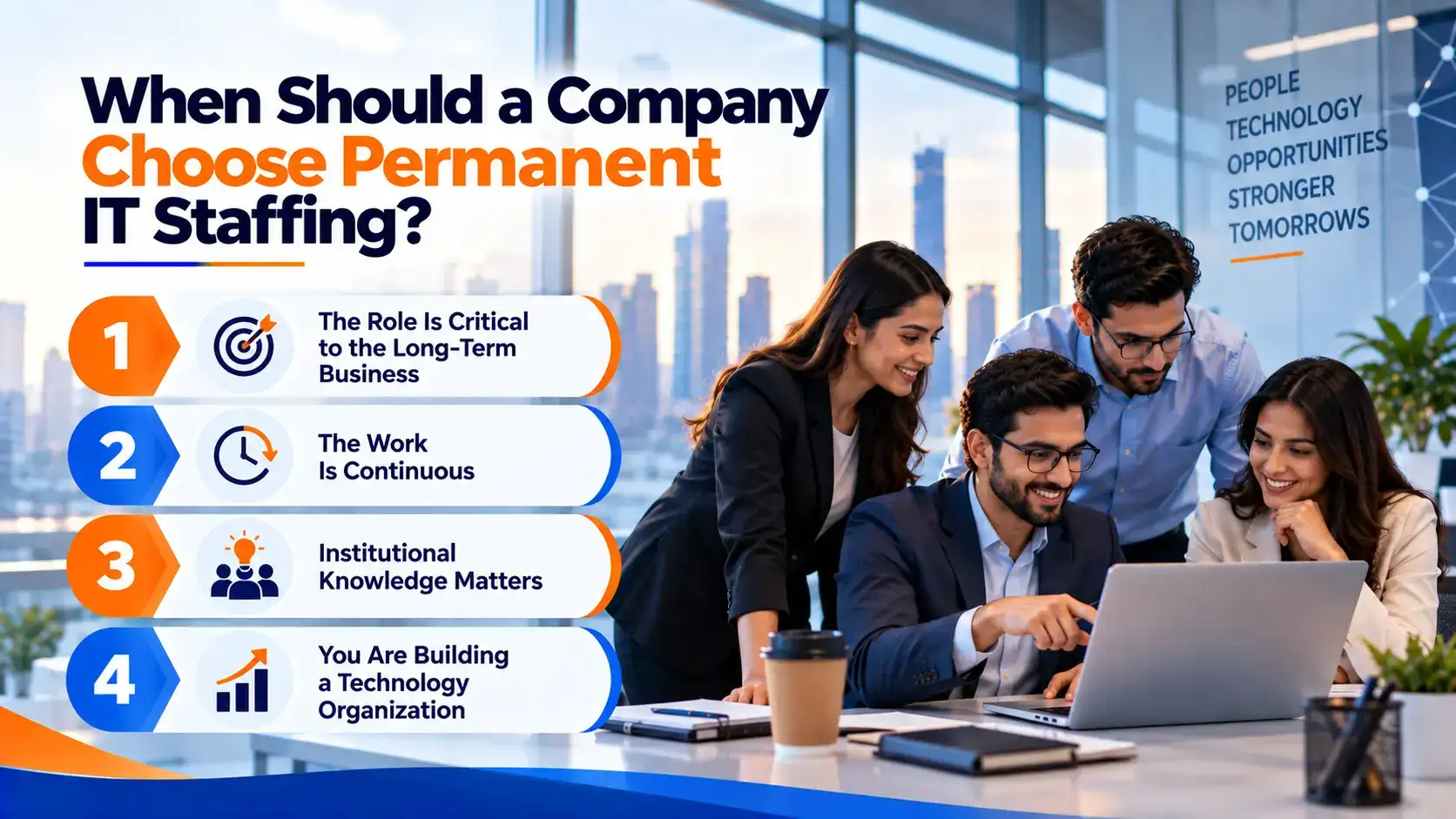
1. The Role Is Critical to the Long-Term Business
Some technology capabilities should remain inside the organization.
For example:
- Core software architecture
- Product engineering
- Security leadership
- Technology strategy
- Data governance
- Enterprise architecture
If the capability is central to the organization’s long-term competitive advantage, permanent hiring may be preferable.
2. The Work Is Continuous
If a company expects the role to be needed indefinitely, repeatedly using contractors may not be the most effective long-term strategy.
For example:
A SaaS company will always need software engineers to maintain and improve its core platform.
That is fundamentally different from hiring developers for a one-time migration.
3. Institutional Knowledge Matters
Permanent employees have more opportunity to build knowledge around:
- Internal systems
- Customers
- Products
- Architecture
- Processes
- Security policies
- Organizational culture
That knowledge can become increasingly valuable over time.
4. You Are Building a Technology Organization
Companies entering a major growth phase often need a permanent foundation.
For example:
Engineering Manager → Senior Engineers → Engineers → QA → DevOps → Product
A permanent workforce can provide continuity as the organization grows.
Contract vs Permanent IT Staffing: Cost Comparison
Cost is one of the first questions hiring managers ask.
But the simplistic assumption:
“Contract workers are more expensive.”
doesn’t tell the whole story.
A company should compare total workforce cost, not simply salary against hourly bill rate.
Permanent employee costs can include:
- Salary
- Benefits
- Payroll costs
- Recruiting
- Interviewing
- Onboarding
- Training
- Equipment
- Paid time off
- Retention initiatives
- Potential severance
- Replacement costs
Contract staffing costs can include:
- Contractor bill rate
- Staffing provider fees
- Assignment administration
- Contract management
- Potential conversion costs
- Project-specific expenses
But there is another factor:
The cost of an unfilled position
A vacant technology position can delay:
- Product launches
- Software releases
- Cloud migrations
- Cybersecurity initiatives
- Customer implementations
- Data projects
- Digital transformation
Therefore, the relevant question isn’t:
“Which person costs less?”
It is:
“Which workforce model delivers the required capability at the right time and at an acceptable total cost?”
Contract Staffing vs Permanent Staffing: A Simple Cost Example
Imagine a company needs a senior DevOps engineer.
Option A: Permanent
The organization hires a permanent employee.
The company takes on long-term compensation, benefits, onboarding, and employment costs.
Option B: Contract
The organization hires a contractor for a nine-month cloud migration.
The contractor may have a higher hourly bill rate, but the organization gets the expertise for the period it actually needs it.
Option C: Contract-to-Hire
The professional begins as a contractor.
After several months, the organization determines that the role will remain necessary and converts the professional to permanent employment according to the applicable agreement.
The third option can provide additional flexibility when long-term demand is uncertain.
What Is Contract-to-Hire IT Staffing?
Contract-to-hire combines elements of contract and permanent hiring.
The professional initially works in a contract capacity, with the possibility of transitioning into a permanent role.
This model can be useful when:
- The organization needs talent immediately.
- Long-term demand isn’t fully certain.
- The company wants to evaluate technical performance.
- Team fit is important.
- The candidate wants to evaluate the organization.
- A permanent hiring decision requires additional time.
It can effectively create a bridge between:
“We need this skill now.”
and
“We know we need this employee permanently.”
Contract vs Permanent IT Staffing by Business Situation
| Business Situation | Recommended Starting Point |
| 6-month software project | Contract |
| 12-month cloud migration | Contract |
| Permanent software product team | Permanent |
| Temporary cybersecurity project | Contract |
| Permanent CISO/security leadership | Permanent |
| Sudden increase in development workload | Contract |
| Building a new engineering department | Permanent |
| Uncertain future headcount | Contract or contract-to-hire |
| Need to evaluate candidate fit | Contract-to-hire |
| Core technology architecture | Permanent |
| Short-term ERP implementation | Contract |
| Long-term application maintenance | Permanent |
| Specialized AI implementation | Contract or permanent depending on future need |
Contract IT Staffing Can Be a Strategic Tool, Not Just a Temporary Fix
Contract workers are sometimes viewed as a solution companies use only when they cannot hire permanent employees.
That is too narrow.
Contract staffing can be a deliberate workforce strategy.
Consider a company building an AI-powered product.
It may need:
- AI engineers for the initial implementation
- Data engineers
- Cloud architects
- Security specialists
Some of those skills may become permanent requirements.
Others may only be needed during the initial development phase.
A flexible staffing model allows the organization to adjust its workforce as the product matures.
Permanent Hiring Builds Institutional Knowledge
The strongest argument for permanent IT hiring is not simply employee loyalty.
It is accumulated organizational knowledge.
A permanent employee may understand:
- Why a system was designed a certain way
- Which customers depend on a particular feature
- Which legacy systems cannot be changed easily
- How internal teams work together
- Which security controls are most important
- Where technical debt exists
That knowledge becomes part of the organization’s intellectual capital.
For business-critical technology functions, that can be difficult to replicate through continuously changing contract assignments.
The Downside of Contract IT Staffing
Contract staffing isn’t automatically the right answer.
Potential challenges include:
Knowledge transfer
When an assignment ends, knowledge needs to be transferred effectively.
Team continuity
Frequent changes can affect team dynamics.
Availability
Highly specialized contractors may not always be immediately available.
Long-term dependency
Organizations should avoid using temporary staffing indefinitely without understanding why permanent positions remain unfilled.
Cost visibility
Companies need to understand the full bill rate and engagement structure.
The solution isn’t to avoid contract staffing.
It is to use it deliberately.
The Downside of Permanent IT Staffing
Permanent hiring also has tradeoffs.
Longer hiring cycles
Specialized positions can take significant time to fill.
Higher long-term commitment
The organization takes on an ongoing workforce obligation.
Less flexibility
Reducing headcount later can be more difficult.
Skills can become outdated
Technology evolves rapidly.
A permanent employee hired for a specific skill set may require continuous development as technology changes.
Hiring risk
A permanent hire who isn’t a good fit can create significant replacement costs.
This is one reason some organizations use contract-to-hire.
How AI Is Changing the Contract vs Permanent Decision
AI is changing technology work itself.
BLS projects data scientist employment to grow 33.5% between 2024 and 2034, while software developer employment is projected to increase by 15.8% and information security analyst employment by 28.5%. BLS attributes some of this demand to continued technology and AI adoption.
This creates an interesting workforce challenge.
An organization may need AI expertise for a specific transformation project today.
But whether it needs the same number of AI professionals permanently is a different question.
Example
A company wants to introduce generative AI into its customer service platform.
It needs:
- AI engineer
- ML engineer
- Data engineer
- Cloud specialist
- Security specialist
for the initial implementation.
A contract workforce could accelerate the project.
Once the system is operational, the company may determine that it needs:
- 1 permanent AI engineer
- 1 permanent data engineer
- 1 permanent security professional
while the other requirements disappear.
This is a good example of why project demand and long-term workforce demand aren’t always the same thing.
Contract vs Permanent IT Staffing in a Skills-Driven Market
The technology market is becoming increasingly skills-driven.
The question isn’t simply:
“Do we need five IT employees?”
It is:
“Which five capabilities do we need?”
For example:
Requirement
“Build and secure a cloud-native platform.”
Potential skills:
- AWS/Azure
- Kubernetes
- Terraform
- DevOps
- Cloud security
- Python
- CI/CD
A company might permanently hire its core engineers and use contractors for specialized cloud security or Kubernetes expertise.
This creates a blended workforce.
The Hybrid IT Workforce Model
For many organizations, the most effective answer is not contract or permanent.
It is:
Contract + Permanent
For example:
Permanent workforce
- CTO
- Engineering manager
- Product engineers
- Core DevOps
- Security leadership
Flexible workforce
- Migration specialists
- Contract developers
- Cloud architects
- Security consultants
- QA professionals
This model creates a stable core while allowing the organization to expand its capabilities when needed.
The current U.S. market supports this approach. Robert Half’s 2026 technology hiring research found that organizations were planning increases in both permanent headcount and contract hiring, rather than moving exclusively toward one model.
A Practical Decision Framework
Before choosing contract or permanent IT staffing, ask these seven questions.
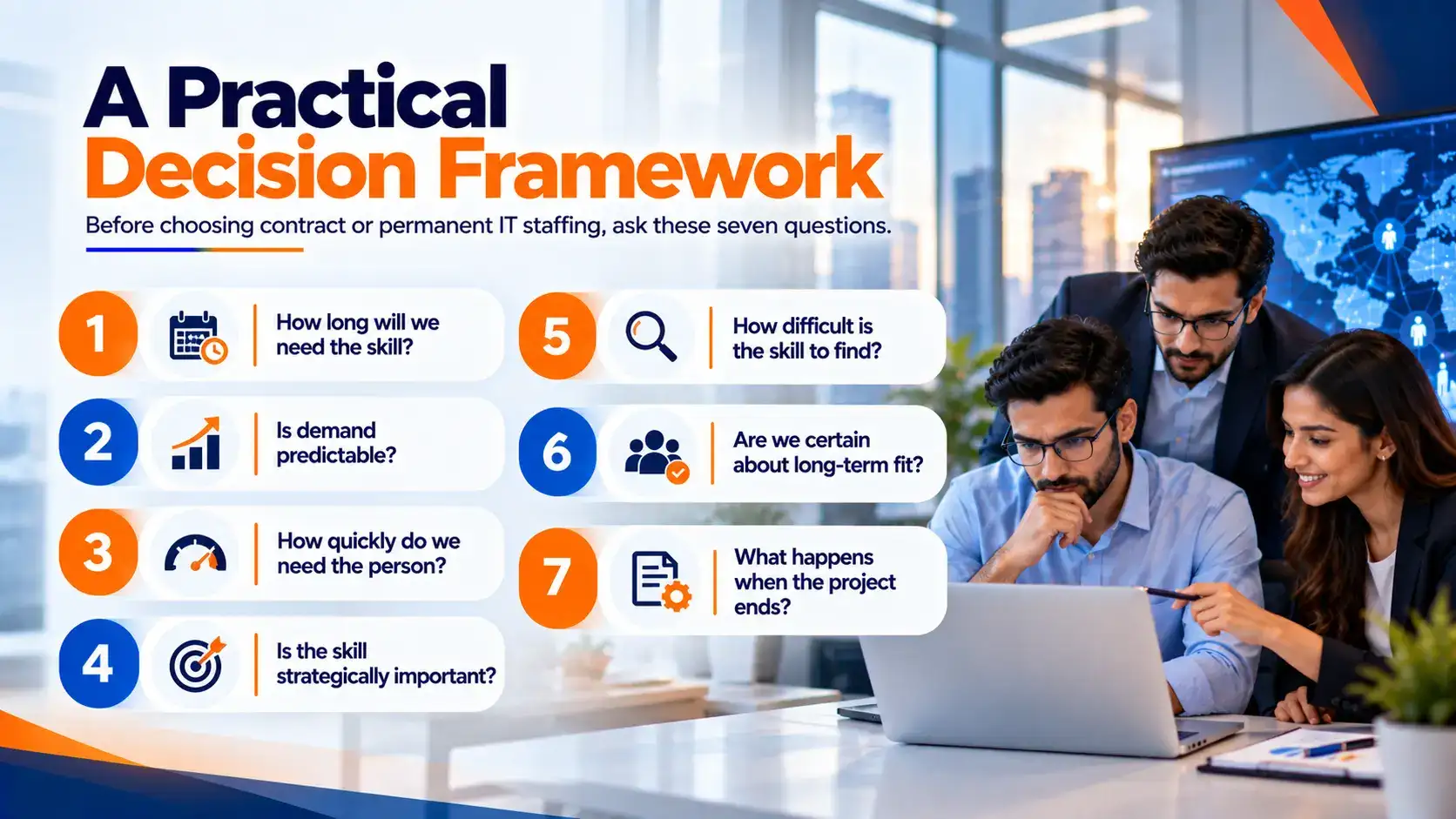
1. How long will we need the skill?
Temporary → Contract
Ongoing → Permanent
2. Is demand predictable?
Stable → Permanent
Variable → Contract or blended
3. How quickly do we need the person?
Urgent → Contract may provide greater flexibility
Planned → Permanent recruitment may be appropriate
4. Is the skill strategically important?
Core capability → Permanent
Specialized project expertise → Contract may fit
5. How difficult is the skill to find?
If the talent pool is extremely limited, broaden the search geographically and consider flexible staffing models.
6. Are we certain about long-term fit?
Yes → Permanent
No → Contract-to-hire
7. What happens when the project ends?
If the requirement disappears, contract staffing may be more appropriate.
If the work becomes a permanent business function, transition toward permanent hiring.
Example: SaaS Company
A SaaS company is launching a new product.
It needs:
- 5 software developers
- 2 QA engineers
- 1 DevOps engineer
- 1 cybersecurity engineer
The product launch is expected to take eight months.
Workforce strategy
Contract: 5 developers + 2 QA engineers
Permanent: DevOps + cybersecurity
Why?
The development workload is expected to peak during the launch.
DevOps and cybersecurity are ongoing capabilities.
This approach allows the organization to align workforce structure with actual demand.
Example: Financial Services Company
A financial-services company needs a permanent security architecture team.
The organization expects security requirements to increase continuously.
Workforce strategy
Permanent: Security architects, security engineers, GRC leadership
Contract: Specialized penetration-testing or implementation professionals when required
This keeps core security knowledge inside the company while allowing access to specialized expertise when needed.
Example: Healthcare Technology Company
A healthcare technology company is replacing a legacy application.
It needs specialists in:
- Cloud migration
- Data integration
- Healthcare interoperability
- Cybersecurity
- QA
The migration has a defined end date.
Workforce strategy
Use contract professionals for project-specific expertise while retaining permanent employees responsible for the company’s core technology platform.
This can provide flexibility without weakening long-term technology ownership.
Questions to Ask Before Choosing a Staffing Model
Before approving a hiring request, hiring managers should answer:
What problem are we solving?
Don’t start with the job title.
How long will the requirement exist?
This determines whether the demand is temporary or permanent.
What skills are actually required?
Separate essential skills from preferred skills.
Can the skill be developed internally?
Upskilling may sometimes be more sustainable than hiring.
How quickly do we need the person?
Urgency may influence the appropriate staffing model.
What happens when the project ends?
This question is particularly important for contract staffing.
What does the vacancy cost?
Include delays, overtime, missed deadlines, and operational impact.
Is this a core capability?
If yes, permanent hiring may be more appropriate.
How MetaSense INC. Helps Companies Choose the Right IT Staffing Model
MetaSense has an especially relevant history for this discussion.
The company was founded in 1999 as an IT staffing company and now describes its business as technology staffing and services alongside healthcare workforce solutions. Its current offerings include flexible staffing, temp-to-hire, direct-hire placement, and workforce management solutions.
That experience gives MetaSense a natural positioning around workforce flexibility rather than treating every technology requirement as a permanent vacancy.
For example:
Need immediate project capacity?
Contract staffing
Need to evaluate long-term fit?
Temp-to-hire
Need a long-term technology professional?
Direct-hire placement
Need changing workforce capacity?
Flexible staffing
This is a stronger approach than asking every organization to choose one staffing model permanently.
Why a Flexible IT Workforce Partner Matters
Technology requirements can change quickly.
A company may need:
10 developers today
3 developers six months from now
2 cybersecurity specialists next year
5 AI professionals for a new initiative
The workforce model should be able to change with the business.
A staffing partner can potentially help organizations access:
- Contract professionals
- Permanent candidates
- Specialized technology talent
- Temp-to-hire professionals
- Flexible workforce capacity
The objective is not simply to fill jobs.
It is to align technology talent with business demand.
Common Mistakes Companies Make
Mistake 1: Choosing based only on hourly cost
A higher contractor rate does not automatically mean higher total workforce cost.
Mistake 2: Using contractors indefinitely
If a role has become permanently necessary, the organization should reassess its workforce strategy.
Mistake 3: Hiring permanent employees for every project
This can create unnecessary long-term headcount after project demand declines.
Mistake 4: Ignoring time-to-hire
A vacant technology position can have significant operational consequences.
Mistake 5: Treating contract workers as interchangeable resources
Specialized IT professionals can provide expertise that internal teams don’t currently have.
Mistake 6: Forgetting contract-to-hire
Companies sometimes overlook the middle ground between temporary and permanent staffing.
Mistake 7: Ignoring workforce planning
The right staffing model should be based on expected future demand, not just today’s vacancy.
Contract vs Permanent IT Staffing: Final Verdict
So, which hiring model is better?
There isn’t one universal answer.
Contract IT staffing is generally better when:
- The requirement is temporary.
- A project has a defined end date.
- Specialized expertise is needed.
- Hiring speed is important.
- Demand is uncertain.
- The company needs additional capacity.
- The organization is testing a new capability.
Permanent IT staffing is generally better when:
- The role is strategically important.
- The demand is ongoing.
- Institutional knowledge matters.
- The company is building a long-term technology team.
- The skill is part of the organization’s core capability.
- Long-term employee development is important.
Contract-to-hire is often better when:
- The company needs immediate talent.
- Long-term demand is uncertain.
- Technical and cultural fit need to be evaluated.
- The organization wants flexibility before making a permanent commitment.
But for many U.S. companies, the strongest answer may be:
Build a permanent core workforce and use contract talent strategically around it.
That approach reflects what the 2026 market is already showing: employers are increasing both permanent and contract technology hiring as they respond to skills shortages, AI adoption, digital transformation, and changing project requirements.
The goal shouldn’t be to decide whether contract or permanent IT staffing is inherently better.
The goal is to determine:
What skills are needed → how long they are needed → how quickly they are needed → whether they are core or specialized → and what workforce model provides the best long-term business outcome.
MetaSense’s evolution from an IT staffing company founded in 1999 into a broader technology staffing and services organization provides a natural foundation for this approach. Its current model includes flexible staffing, temp-to-hire, direct-hire placement, and workforce management solutions.
The best IT hiring model isn’t the one with the lowest immediate cost. It’s the one that gives the business the right technology capability, at the right time, with the right level of workforce flexibility.
Frequently Asked Questions
Is contract IT staffing better than permanent hiring?
Neither is universally better. Contract staffing is generally more suitable for temporary projects, specialized skills, rapid hiring, and uncertain demand. Permanent hiring is generally better for long-term, strategically important roles.
Are contract IT workers more expensive than permanent employees?
Contract workers may have a higher hourly or bill rate, but direct rates don’t represent total workforce cost. Companies should also consider benefits, recruiting, onboarding, vacancy costs, turnover, project delays, and workforce flexibility.
When should a company hire IT contractors?
IT contractors can be useful for short-term projects, technology implementations, cloud migrations, cybersecurity initiatives, urgent skills gaps, and temporary increases in workload.
When should a company hire permanent IT employees?
Permanent hiring is generally appropriate when a technology role represents an ongoing requirement and the organization wants to build long-term knowledge, continuity, and internal capability.
What is contract-to-hire IT staffing?
Contract-to-hire allows a professional to begin in a contract position with the possibility of transitioning to permanent employment under the applicable agreement. It can provide flexibility while the employer evaluates long-term fit.
Is contract staffing good for startups?
It can be. Startups often experience changing technology requirements and may use contractors to access specialized skills without immediately building a large permanent workforce.
Can large enterprises use contract IT staffing?
Yes. Large organizations can use contract professionals for digital transformation, cloud migrations, cybersecurity projects, application development, enterprise implementations, and other specialized requirements.
What IT roles are suitable for contract staffing?
Common examples include software developers, cloud engineers, DevOps professionals, cybersecurity specialists, data engineers, QA professionals, project managers, and implementation specialists.
Does AI make contract IT staffing more important?
AI is creating new and evolving technology requirements. BLS projects data scientist employment to grow 33.5% and information security analyst employment to grow 28.5% from 2024 to 2034. Organizations may use contract professionals for specialized AI and technology projects while determining which capabilities need to become permanent.
Can contract workers become permanent employees?
Yes. A contract-to-hire arrangement can allow a professional to transition to permanent employment when the employer, candidate, and staffing provider’s agreement permits it.