
Hiring cybersecurity professionals in the United States has become a skills-and-strategy problem, not simply a recruiting problem.
Organizations need security professionals who can protect increasingly complex environments while understanding cloud infrastructure, identity, application security, data, compliance, automation, and artificial intelligence. At the same time, employers are competing for candidates whose skills are changing almost as quickly as the threat landscape.
The U.S. Bureau of Labor Statistics projects information security analyst employment to grow 29% between 2024 and 2034, from 182,800 jobs in 2024 to 234,900 in 2034. BLS also projects approximately 16,000 openings per year for information security analysts during that period.
But headcount isn’t the only challenge.
The latest ISC2 research shows that the cybersecurity workforce increasingly faces a skills shortage rather than simply a shortage of people. In its 2025 study of 16,029 cybersecurity professionals and decision-makers, 95% reported at least one cybersecurity skills need, while 59% described those needs as critical or significant.
That changes how companies should approach hiring.
The companies most likely to hire strong cybersecurity talent are not necessarily the ones with the longest job descriptions. They are the ones that can clearly define the security outcomes they need, evaluate skills effectively, and offer candidates a compelling reason to join and stay.
Quick Answer: How Do You Hire Cybersecurity Talent in a Competitive U.S. Market?
A strong cybersecurity hiring strategy should:
- Define the security problem before writing the job description.
- Identify the critical skills rather than listing every possible technology.
- Separate must-have skills from trainable skills.
- Consider transferable IT and security experience.
- Evaluate practical capability, not just certifications.
- Use a broader geographic talent pool when appropriate.
- Offer competitive compensation and career development.
- Include AI, cloud, application security, and risk skills where relevant.
- Move qualified candidates through the hiring process quickly.
- Use permanent, contract, or contract-to-hire staffing strategically.
The most important principle is simple:
Don’t search for a candidate who matches every keyword. Search for someone who can solve the security problem.
Why Is Cybersecurity Talent So Difficult to Hire?
Cybersecurity hiring is difficult because demand is expanding while the required skill set is becoming broader.
A security professional may now need to understand several areas simultaneously:
- Cloud security
- Identity and access management
- Security operations
- Incident response
- Application security
- Network security
- Data security
- Governance, risk and compliance
- Threat intelligence
- Security automation
- Artificial intelligence
- Security architecture
BLS identifies cybersecurity as one of the fastest-growing areas of the U.S. technology workforce. Information security analysts are projected to grow 29% between 2024 and 2034, compared with 3.1% growth across all occupations.
That creates a competitive environment for employers.
However, the problem isn’t simply that there aren’t enough cybersecurity professionals.
ISC2’s latest research provides an important distinction: organizations increasingly need different or deeper skills from the cybersecurity professionals they already employ.
This means companies should consider both:
Talent acquisition
and
Talent development.
Step 1: Define the Cybersecurity Problem Before the Job Title
One of the most common hiring mistakes is starting with a title.
For example:
“We need a cybersecurity engineer.”
That’s not enough information.
A cybersecurity engineer could be expected to work on:
- Cloud security
- SIEM
- Endpoint security
- IAM
- Network security
- Vulnerability management
- DevSecOps
- Security automation
Instead, start with the business problem.
Ask:
What security capability are we missing?
For example:
Problem
“We are moving critical workloads to AWS and need to improve security.”
Potential requirement:
Cloud Security Engineer
Problem
“We have a growing volume of security alerts and insufficient incident-response capacity.”
Potential requirement:
SOC Analyst / Incident Response Professional
Problem
“We need security controls integrated into our software development lifecycle.”
Potential requirement:
Application Security / DevSecOps Engineer
Problem
“We need to improve identity controls across a hybrid environment.”
Potential requirement:
IAM Specialist
The job title should come after the security requirement has been defined.
Step 2: Build a Skills-Based Cybersecurity Job Description
A cybersecurity job description should distinguish between:
Must-have skills
Capabilities required to perform the job.
Preferred skills
Capabilities that would make a candidate stronger.
Trainable skills
Capabilities the organization can realistically develop after hiring.
Future skills
Capabilities likely to become important as the environment evolves.
This prevents an increasingly common problem:
The impossible job description.
For example, an employer may request:
- CISSP
- AWS
- Azure
- Kubernetes
- Python
- SIEM
- SOC
- Penetration testing
- Incident response
- Zero Trust
- IAM
- DevSecOps
- PCI DSS
- HIPAA
- ISO 27001
and then require 8–10 years of experience.
The result may be a job description that describes an ideal candidate rather than a realistic one.
Step 3: Identify the Cybersecurity Skills That Matter Most
The right skills depend on the position.
However, current cybersecurity workforce research highlights several areas that employers increasingly need.
ISC2’s 2025 research identifies skills needs related to AI, cloud computing, risk assessment, application security, and governance, risk and compliance among the areas organizations need to address.
Cloud Security
Candidates should understand the security implications of:
- AWS
- Microsoft Azure
- Google Cloud
- Cloud identity
- Cloud networking
- Container security
- Infrastructure as code
Identity and Access Management
Relevant skills include:
- IAM
- Privileged access management
- Zero Trust
- Authentication
- Authorization
- Identity governance
Security Operations
Depending on the role:
- SIEM
- EDR/XDR
- Threat detection
- Log analysis
- Incident response
- Threat intelligence
Application Security
Increasingly relevant for organizations building software:
- Secure SDLC
- DevSecOps
- SAST/DAST
- API security
- Vulnerability management
- Code security
Governance, Risk and Compliance
Especially important in regulated industries:
- Risk assessment
- Security controls
- Audit preparation
- Compliance frameworks
- Policy development
- Third-party risk
AI Security
An emerging requirement for organizations adopting AI:
- AI governance
- Model security
- Data protection
- Prompt injection risks
- AI application security
- LLM security
- AI-related threat detection
The key is not to require all of these skills for every candidate.
Match skills to the actual role.
Step 4: Don’t Treat Certifications as a Substitute for Experience
Certifications can provide useful evidence of knowledge.
Common cybersecurity certifications include:
- CompTIA Security+
- CISSP
- CISM
- CEH
- OSCP
- CCSP
- GIAC certifications
- Cloud security certifications
But certification should answer:
“Does this candidate demonstrate relevant knowledge?”
It should not automatically answer:
“Can this candidate perform the job?”
For example, a candidate with a CISSP may understand security concepts very well.
But a cloud-security position may still require evidence that the candidate has actually secured production cloud environments.
Similarly, an experienced SOC analyst may have excellent incident-response skills without holding every certification listed in the job description.
Better approach:
Evaluate:
Certification + experience + practical capability + problem-solving
rather than certification alone.
Step 5: Look Beyond Traditional Cybersecurity Candidates
One of the most effective ways to expand a cybersecurity talent pool is to consider professionals with transferable backgrounds.
For example:
Network engineer → Security engineer
A network professional with strong security knowledge may transition effectively into network security.
Cloud engineer → Cloud security engineer
A cloud engineer who understands IAM, infrastructure, networking, and security controls may be a strong candidate for cloud security.
Systems administrator → Security operations
A systems professional with monitoring, endpoint, identity, and scripting experience may transition into security operations.
Software engineer → Application security
A developer with strong secure-development knowledge can potentially move into application security or DevSecOps.
IT auditor → GRC
An IT audit professional may bring valuable experience into governance, risk, and compliance.
This is especially important because ISC2’s current research indicates that organizations can address skills shortages through multiskilling and investment in existing personnel, not only by adding new headcount.
Step 6: Evaluate Practical Cybersecurity Skills
Cybersecurity is an applied discipline.
A candidate’s ability to solve a realistic security problem can tell you more than a long resume.
Instead of asking only:
“Have you worked with Splunk?”
consider asking:
“You receive a series of suspicious authentication events across multiple systems. Walk us through how you would investigate them.”
Or:
“Your organization is migrating an application to AWS. What security controls would you consider before production deployment?”
Or:
“A production server has been compromised. What are your first priorities?”
These questions reveal:
- Analytical thinking
- Technical knowledge
- Incident response
- Prioritization
- Communication
- Risk awareness
- Practical judgment
Step 7: Use Skills-Based Assessments Carefully
Practical assessments can improve cybersecurity hiring, but they need to resemble the actual work.
Useful assessment formats can include:
Scenario-based exercises
Give the candidate a realistic security incident.
Technical discussions
Ask candidates to explain architecture and security decisions.
Security labs
Allow candidates to demonstrate hands-on capabilities.
Portfolio review
Examine relevant projects or security research.
Incident-response simulations
Evaluate how candidates prioritize and communicate during a security event.
The goal isn’t to create the hardest possible test.
It’s to answer:
“Can this person perform the work we need them to perform?”
Step 8: Expand the Geographic Talent Pool
Cybersecurity talent isn’t distributed evenly across the United States.
If an organization limits recruitment to a small geographic area, it may eliminate qualified professionals unnecessarily.
Depending on the role, consider:
- Remote hiring
- Hybrid roles
- Regional recruitment
- National searches
- Relocation support
- Contract professionals
- Distributed security teams
This is particularly relevant for specialized positions where the candidate pool may be small.
A national talent search can be more effective than repeatedly advertising the same local position.
Step 9: Don’t Ignore Compensation and Career Development
Compensation matters, but it isn’t the only factor.
ISC2’s 2025 research found that 31% of respondents cited insufficient pay as an issue affecting job satisfaction, while 32% cited lack of career growth and advancement opportunities.
Cybersecurity professionals may also evaluate:
- Remote/hybrid flexibility
- Technical environment
- Security leadership
- Training
- Certifications
- Career progression
- Interesting security challenges
- Work-life balance
- Organizational commitment to security
An organization can lose strong candidates even with a competitive salary if the role appears stagnant.
A strong cybersecurity employment proposition might include:
Competitive compensation + meaningful security work + learning opportunities + career progression + appropriate flexibility
Step 10: Move Quickly When You Find the Right Candidate
Cybersecurity candidates who match a specialized requirement may have multiple opportunities.
A slow hiring process can lose qualified professionals.
Review your:
- Application process
- Recruiter screening
- Technical interview
- Hiring manager interview
- Executive approval
- Offer process
- Background checks
- Onboarding
Ask:
“How many days does it take from qualified candidate identification to offer?”
Then identify unnecessary delays.
Speed should never replace proper evaluation.
But excessive bureaucracy can be just as damaging.
How AI Is Changing Cybersecurity Hiring in 2026
AI is creating a particularly interesting cybersecurity hiring challenge.
Organizations need professionals who can:
- Secure AI systems.
- Understand AI-enabled threats.
- Use AI to improve security operations.
- Evaluate AI-generated security output.
- Protect sensitive data used by AI systems.
BLS says the increased use of AI and other technologies is among the factors contributing to continued demand for information security analysts.
ISC2’s 2025 research also identifies AI as a major source of new cybersecurity opportunities and changing skills requirements.
This creates a new hiring question:
Does the organization need an AI specialist, a cybersecurity specialist who understands AI, or both?
Those are different roles.
AI Security Is Creating New Hiring Requirements
Consider an organization deploying a generative AI application.
Traditional cybersecurity may focus on:
- Network security
- Identity
- Endpoint protection
- Vulnerability management
AI introduces additional concerns:
- Prompt injection
- Data leakage
- Model manipulation
- Training-data risks
- Unauthorized model access
- Insecure AI integrations
- Sensitive information exposure
A security professional doesn’t necessarily need to be an AI researcher.
But they may need enough AI literacy to understand the security implications of AI-enabled systems.
This is another reason employers should avoid simply adding “AI experience” to every cybersecurity job description.
Define the security problem first.
The Cybersecurity Skills Gap Is Not Only a Hiring Problem
The latest ISC2 findings are particularly important here.
In 2025, 34% of respondents said their organizations had the right number of cybersecurity professionals, while 44% reported only a slight shortage in staffing levels. Yet 95% reported at least one cybersecurity skills need, and 59% described those needs as critical or significant.
That suggests a crucial strategic shift:
Sometimes the organization doesn’t need more cybersecurity employees. It needs different capabilities from the employees it already has.
That creates three possible strategies:
Hire
Bring in missing expertise.
Upskill
Develop existing professionals.
Combine
Hire specialized talent while developing the existing team.
The third approach may often be the most sustainable.
When Should You Hire vs. Upskill Cybersecurity Talent?
| Situation | Potential Strategy |
| Completely missing skill | Hire |
| Existing employee has adjacent skills | Upskill |
| Urgent security gap | Contract staffing |
| Long-term security capability | Permanent hiring |
| New project | Contract/project staffing |
| Emerging technology | Hire specialist + train existing team |
| Difficult-to-find expertise | National search |
| Uncertain long-term requirement | Contract-to-hire |
There is no reason every skills gap must be solved through permanent recruitment.
Permanent vs. Contract Cybersecurity Hiring
A permanent hire can make sense when the organization has an ongoing requirement.
For example:
Permanent Cybersecurity Architect
if the company is continuously expanding its security architecture.
Contract staffing may be appropriate when:
- A company is implementing a new security platform.
- A compliance project has a defined deadline.
- A cloud migration requires temporary security expertise.
- A security incident requires additional response capacity.
- The company needs specialized expertise while recruiting permanently.
Contract-to-hire can provide another option when the organization wants to evaluate long-term fit.
A Practical Cybersecurity Hiring Framework
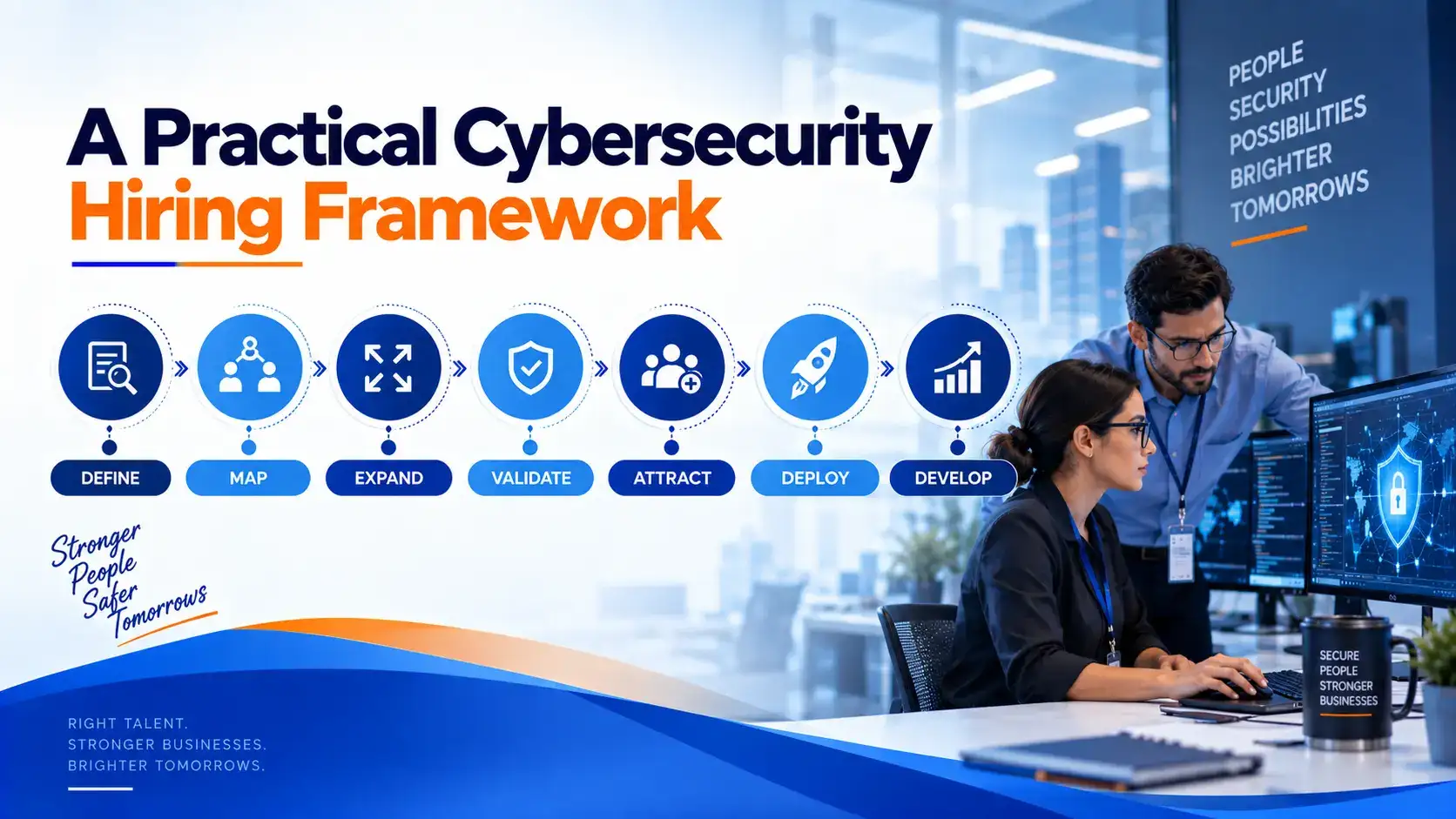
MetaSense can position this article around a simple framework:
DEFINE
What security problem are you solving?
↓
MAP
Which skills are genuinely required?
↓
EXPAND
Which adjacent professionals could develop into the role?
↓
VALIDATE
How will you test practical capability?
↓
ATTRACT
Why would a strong cybersecurity professional choose your organization?
↓
DEPLOY
Should the requirement be permanent, contract, or contract-to-hire?
↓
DEVELOP
How will you maintain and expand the team’s skills after hiring?
This approach is more useful than simply saying:
“Post the job and wait for applications.”
Example: Hiring a Cloud Security Engineer
Imagine a U.S. SaaS company is moving 70% of its infrastructure into AWS.
The company initially creates this requirement:
Cloud Security Engineer with 8+ years of experience, AWS, Azure, Kubernetes, Python, Terraform, SIEM, CISSP, penetration testing, DevSecOps, Zero Trust, and compliance experience.
The candidate pool is extremely small.
A skills-based approach changes the requirement.
Must-have
- AWS security
- IAM
- Cloud networking
- Security automation
- Infrastructure security
Preferred
- Terraform
- Kubernetes
- Python
- SIEM
Trainable
- Specific compliance framework
- Internal tooling
- Organization-specific processes
Outcome
The company has significantly expanded the candidate pool without lowering the core security requirements.
That’s the difference between lowering standards and removing unnecessary barriers.
Example: Hiring a SOC Analyst
A company needs someone to handle security alerts and incident escalation.
Instead of requiring five years of experience with a specific SIEM platform, the employer could prioritize:
- Security fundamentals
- Log analysis
- Incident response
- Network knowledge
- Threat detection
- Analytical thinking
Then evaluate whether the candidate can learn the organization’s particular SIEM.
The result may be a stronger hire because the employer is evaluating transferable security capability rather than one software product.
What Cybersecurity Candidates Should Look for in Employers
Hiring is a two-way process.
Strong candidates are also evaluating the organization.
Employers should be prepared to answer:
What will I be responsible for?
Candidates want clarity.
What security technology will I work with?
The technology environment matters.
Who does security report to?
Organizational positioning can indicate how seriously security is treated.
Will I have opportunities to learn?
Cybersecurity changes rapidly.
Can I pursue certifications?
Professional development can improve both retention and capability.
How flexible is the work environment?
ISC2 reported that 17% of respondents cited lack of flexible work arrangements as an organizational issue affecting job satisfaction.
The strongest cybersecurity employers don’t simply evaluate candidates.
They also make the organization attractive to candidates.
Common Cybersecurity Hiring Mistakes
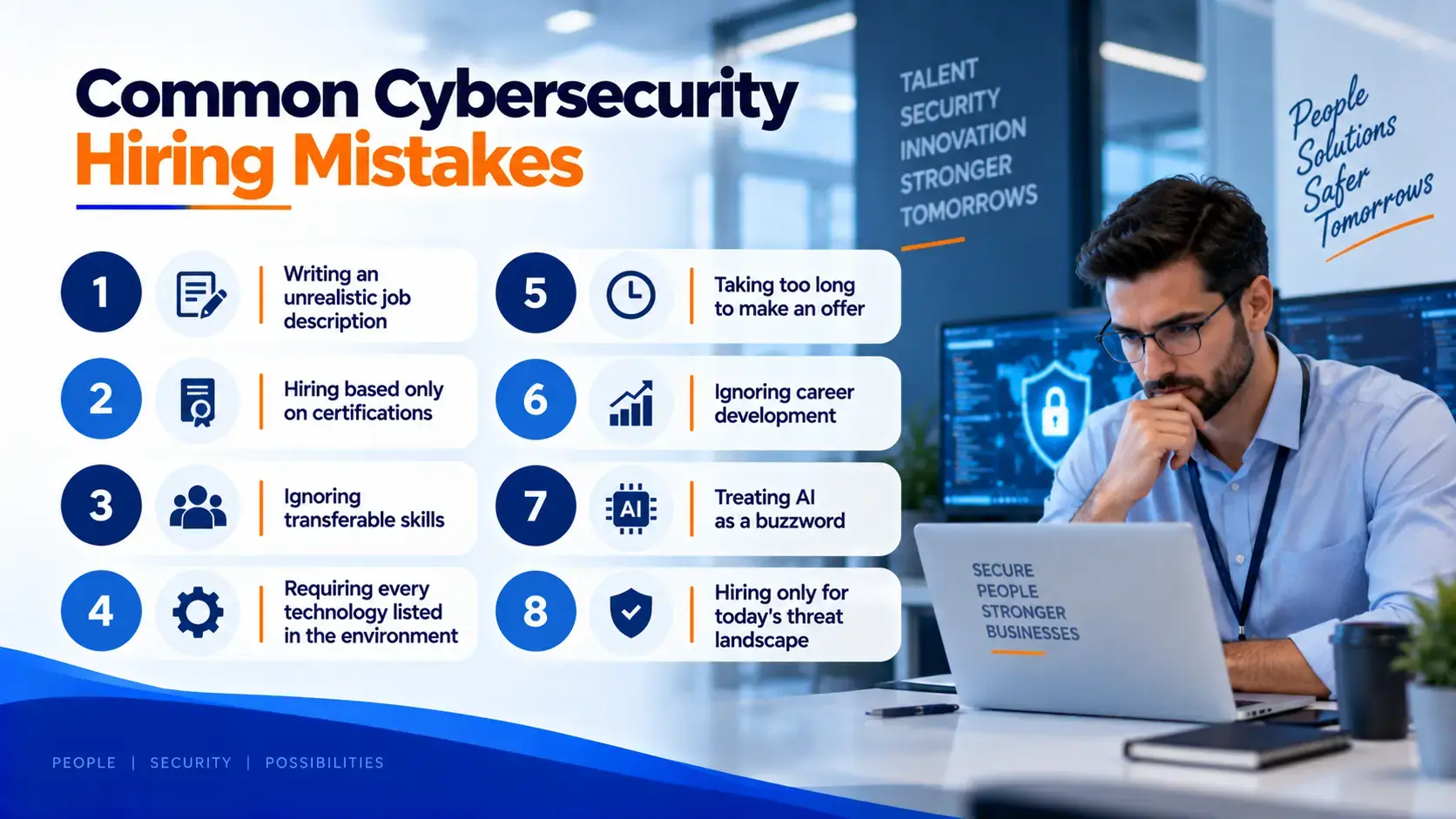
1. Writing an unrealistic job description
More requirements don’t automatically produce better candidates.
2. Hiring based only on certifications
Credentials are useful signals, not substitutes for practical ability.
3. Ignoring transferable skills
A cloud engineer or network professional may have valuable cybersecurity capabilities.
4. Requiring every technology listed in the environment
Some tools can be learned.
Core security reasoning is harder to teach.
5. Taking too long to make an offer
Strong candidates may move before the process ends.
6. Ignoring career development
Cybersecurity professionals want to remain relevant as technology changes.
7. Treating AI as a buzzword
Don’t add AI to the job description unless the role genuinely requires AI-related security capabilities.
8. Hiring only for today’s threat landscape
Look for adaptability.
A security professional who can learn may remain valuable as technologies and threats evolve.
How MetaSense Can Help Companies Hire Cybersecurity Talent
MetaSense Inc. was founded in 1999 as an IT staffing company and today describes itself as a healthcare, technology staffing, and services company offering flexible staffing, temp-to-hire, direct-hire placement, and workforce management solutions.
That technology-staffing heritage is relevant to cybersecurity recruitment because successful hiring requires more than simply matching job titles.
MetaSense can be positioned around several workforce options:
Permanent cybersecurity hiring
For organizations building long-term security teams.
Contract cybersecurity staffing
For projects, migrations, implementations, or urgent capacity requirements.
Contract-to-hire
For organizations that want to evaluate long-term fit.
Flexible technology staffing
For changing workforce requirements.
This approach gives employers options when the cybersecurity requirement isn’t straightforward.
Why a Technology Staffing Partner Can Help
A specialized staffing partner can potentially help organizations:
- Expand the candidate pool
- Identify transferable skills
- Source passive candidates
- Conduct initial technical screening
- Support difficult-to-fill searches
- Provide contract professionals
- Support permanent hiring
- Scale recruiting capacity
But the value should not be measured by the number of resumes delivered.
The real question is:
Can the staffing partner understand the technical requirement well enough to identify candidates who can actually perform the work?
That’s where domain knowledge becomes important.
A Better Cybersecurity Hiring Strategy for 2026
A competitive U.S. cybersecurity hiring strategy should combine six elements:
1. Skills-based hiring
Prioritize demonstrated capabilities.
2. Flexible talent pools
Consider local, regional, national, remote, contract, and adjacent IT talent.
3. Practical assessment
Evaluate how candidates solve security problems.
4. Continuous development
Upskill existing cybersecurity professionals.
5. AI awareness
Understand how AI is changing both cybersecurity threats and security roles.
6. Strong candidate experience
Make the hiring process fast, transparent, and compelling.
This is more sustainable than simply increasing salary or adding more requirements to a job description.
Final Takeaway: Hire for Security Capability, Not Just Keywords
Cybersecurity hiring in the United States is becoming a more sophisticated workforce problem.
The demand is strong: BLS projects 29% growth in information security analyst employment between 2024 and 2034, significantly faster than overall U.S. employment growth.
But organizations shouldn’t respond by simply adding more requirements to job descriptions.
The latest ISC2 research points to a more important issue: skills gaps can exist even when organizations have reasonably adequate headcount. In 2025, 95% of respondents reported at least one cybersecurity skills need, while 59% described their skills needs as critical or significant.
That means the winning strategy is not necessarily:
Hire more people.
It is:
Define the capability → identify the skills → widen the talent pool → validate practical ability → hire strategically → develop continuously.
For some organizations, that means a permanent cybersecurity hire.
For others, it may mean contract staffing while a long-term team is developed.
For others, the best answer may be to upskill an existing IT professional and bring in a specialist for the areas where internal expertise is missing.
MetaSense’s history in IT staffing, dating back to 1999, provides a natural foundation for positioning the company as a technology workforce partner rather than simply a resume source. Its current service model includes flexible staffing, temp-to-hire, direct-hire placement, and workforce management solutions.
In a competitive cybersecurity market, the organizations that hire successfully aren’t necessarily the ones that search harder. They’re the ones that define the right skills, evaluate them properly, and build a workforce strategy around them.
Frequently Asked Questions
Why is cybersecurity talent difficult to hire in the U.S.?
Cybersecurity demand is growing while required skills are becoming more specialized. Current ISC2 research also shows that many organizations face skills shortages even when their overall staffing levels are closer to adequate.
What cybersecurity skills are most in demand?
The exact requirements vary by role, but current workforce research points to needs around AI, cloud computing, risk assessment, application security, and governance, risk and compliance, alongside core security capabilities.
Should companies require CISSP for cybersecurity jobs?
Not necessarily. CISSP and other certifications can demonstrate knowledge, but employers should evaluate practical experience, technical skills, problem-solving, and role-specific capability as well.
How can companies attract cybersecurity professionals?
Competitive compensation, meaningful work, career advancement, professional development, flexible work arrangements, and modern security environments can all influence candidate decisions.
Should companies hire cybersecurity professionals remotely?
Remote hiring can expand the available talent pool, particularly for specialized roles. Whether it is appropriate depends on the organization’s security requirements, regulatory environment, operational model, and role.
Should companies hire cybersecurity professionals on contract?
Contract staffing can make sense for defined projects, urgent workforce gaps, migrations, implementations, specialized expertise, or situations where long-term headcount requirements are uncertain.
What is the difference between cybersecurity staffing and cybersecurity recruiting?
Recruiting primarily focuses on identifying and hiring candidates. Staffing can encompass broader workforce solutions, including contract, temporary, contract-to-hire, staff augmentation, and permanent placement.
How does AI affect cybersecurity hiring?
AI is creating demand for professionals who can secure AI-enabled systems, understand AI-related threats, use AI in security operations, and evaluate the security implications of AI adoption. BLS identifies AI adoption as one factor contributing to continued demand for information security analysts.
Should companies hire for cybersecurity experience or potential?
Ideally, both. Critical roles may require proven experience, while adjacent roles can sometimes be filled by professionals with strong transferable skills and the ability to learn.
How fast should companies hire cybersecurity talent?
There is no universal hiring timeline, but unnecessary delays can increase the risk of losing qualified candidates. Organizations should identify which interview and approval steps genuinely improve hiring quality and eliminate avoidable delays.