
Running a healthcare organization requires more than hiring enough people to fill a staffing chart.
A hospital may technically have hundreds of employees and still face an RN shortage on a night shift, insufficient allied health coverage in one department, rising overtime in another, or delays because a newly hired professional has not completed credentialing.
These are workforce-management problems.
Healthcare workforce management is the coordinated process of forecasting workforce demand, recruiting qualified professionals, verifying workforce readiness, scheduling and deploying staff, managing coverage, monitoring workforce performance, and retaining employees so that staffing capacity aligns with patient-care requirements.
In practical terms, healthcare workforce management answers six questions:
- Who do we need?
- How many professionals do we need?
- Which skills and credentials must they have?
- Where do we need them?
- When do we need them?
- How do we maintain that workforce without creating unsustainable cost or turnover?
That final question is what separates strategic workforce management from ordinary recruiting.
Healthcare Workforce Management at a Glance
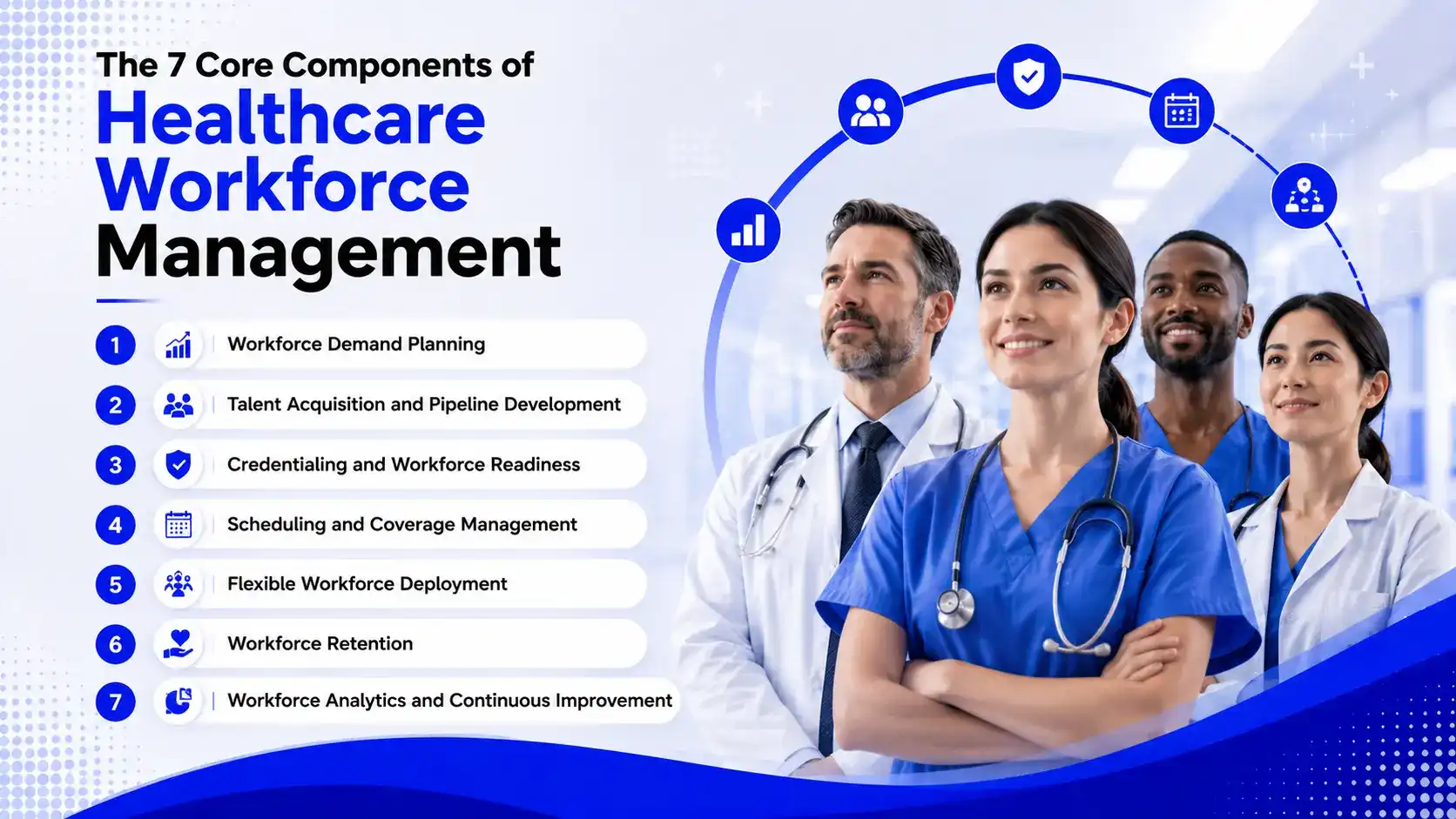
Healthcare workforce management typically connects seven functions:
Forecast → Source → Qualify → Credential → Deploy → Support → Retain
A healthcare organization might therefore use workforce management to:
- Forecast future nursing requirements
- Recruit permanent employees
- Bring in travel clinicians for temporary shortages
- Create per diem coverage for fluctuating demand
- Verify licenses and credentials
- Manage shift coverage
- Track overtime and vacancies
- Monitor turnover
- Build pipelines for difficult-to-fill specialties
- Analyze future workforce risks
The objective is not simply to maintain headcount.
It is to build sufficient workforce capacity, capability, and flexibility to support care delivery.
Why Has Healthcare Workforce Management Become So Important?
Healthcare workforce management has always mattered, but the U.S. labor environment has made it increasingly strategic.
Healthcare organizations are dealing simultaneously with workforce shortages, demographic change, geographic disparities, specialized skill requirements, employee retention challenges, and changing patient demand.
The result is a difficult balancing act.
A hospital needs enough professionals to provide coverage, but excessive staffing creates unnecessary labor expense.
Too little flexibility can leave shifts uncovered, while excessive dependence on premium external labor can increase costs.
Aggressive recruitment can generate candidates, but slow credentialing can prevent those candidates from becoming productive workers.
And filling today’s vacancies does little good if turnover creates another set of vacancies next quarter.
Effective healthcare workforce management attempts to balance all of these factors instead of optimizing one in isolation.
Healthcare Workforce Management vs. Healthcare Staffing: What’s the Difference?
The terms are closely related, but they should not be treated as synonyms.
Healthcare Staffing
Healthcare staffing is primarily concerned with obtaining qualified professionals to meet workforce needs.
For example, a hospital needs five additional registered nurses and works with a healthcare staffing agency to source qualified candidates.
Healthcare Workforce Management
Healthcare workforce management considers what happens before, during, and after recruitment.
The organization asks:
- Why do we need five additional nurses?
- Is the shortage permanent or temporary?
- Which shifts are affected?
- Which specialties are required?
- Can existing workforce capacity be redeployed?
- Should these positions be permanent, travel, contract, or per diem?
- How quickly can qualified professionals complete credentialing?
- What is driving turnover?
- Will the same shortage occur six months from now?
That broader perspective turns staffing from a transaction into a workforce strategy.
Staffing fills workforce requirements. Workforce management determines what those requirements are and how they should be met.
The 7 Core Components of Healthcare Workforce Management
 1. Workforce Demand Planning
Good workforce management begins before a vacancy appears.
Healthcare organizations should estimate future staffing requirements using information such as:
- Patient census
- Historical demand
- Seasonal fluctuations
- Current vacancies
- Employee turnover
- Retirement projections
- Absenteeism
- Service-line expansion
- Facility growth
- Specialty requirements
- Historical time-to-fill
Consider a hospital that experiences increased respiratory admissions every winter.
Waiting until patient volume rises to begin recruiting creates an avoidable staffing emergency.
A workforce-management approach uses previous demand patterns to estimate requirements earlier and builds appropriate staffing capacity before the peak arrives.
This is the difference between responding to workforce demand and anticipating it.
2. Talent Acquisition and Pipeline Development
Healthcare recruitment becomes more difficult when every search starts with an empty candidate pipeline.
Organizations can reduce this risk by continuously developing access to talent through:
- Internal recruitment
- Healthcare staffing partners
- Employee referrals
- Professional associations
- Academic relationships
- Regional recruitment
- Travel professionals
- Per diem talent pools
- Previous candidates
- Specialty-specific pipelines
This is especially valuable for positions with historically long hiring cycles.
If an organization knows that a particular specialty regularly takes months to fill, recruitment should not begin only after someone resigns.
3. Credentialing and Workforce Readiness
Finding a candidate and having a professional ready to work are two different milestones.
Healthcare organizations may need to verify combinations of:
- Licensure
- Certifications
- Education
- Employment history
- Clinical competencies
- Background information
- Immunization documentation
- Facility requirements
- Other compliance documentation
That creates an important workforce-management metric:
Time-to-fill tells you how quickly you found someone. Time-to-readiness tells you how quickly that person can actually begin working.
Healthcare organizations should pay attention to both.
A breakdown between recruitment, credentialing, compliance, and scheduling can create a situation in which an organization has accepted candidates but still has uncovered workforce requirements.
4. Scheduling and Coverage Management
Healthcare demand does not operate on a standard Monday-to-Friday schedule.
Hospitals and many healthcare facilities require continuous coverage.
Workforce scheduling therefore needs to account for:
- Shift requirements
- Patient demand
- Employee availability
- Qualifications
- Specialties
- Overtime
- Paid time off
- Absences
- Employee preferences
- Coverage ratios
- Facility requirements
This is where workforce management becomes operational.
Having 100 nurses on payroll does not automatically mean a hospital has the appropriate nursing coverage at 2 a.m. on Sunday.
The real question is whether available workforce capacity matches when and where care is being delivered.
5. Flexible Workforce Deployment
Not every staffing gap should automatically become a permanent position.
Healthcare organizations can build a workforce using several layers.
Permanent employees
Best suited to stable, recurring workforce requirements and long-term organizational capacity.
Travel professionals
Useful when local talent availability is insufficient or a facility needs qualified professionals for defined assignments.
Per diem and local professionals
Can provide flexibility for schedule gaps, absences, and fluctuating demand.
Contract professionals
Useful for temporary workforce requirements or defined periods of increased demand.
Temp-to-hire
Allows an organization and professional to assess long-term fit before transitioning into permanent employment.
The strategic question is therefore not:
“Should we use permanent or contingent healthcare staffing?”
A better question is:
“Which part of our workforce demand is predictable and permanent, and which part requires flexibility?”
6. Workforce Retention
Recruitment cannot compensate indefinitely for excessive turnover.
Imagine a healthcare organization hires 100 professionals during a year but loses 90.
A recruitment dashboard may show impressive hiring activity, while the organization has added only ten net employees.
That is why retention belongs inside workforce management.
Organizations should investigate workforce signals such as:
- Turnover by department
- Turnover by tenure
- Overtime
- Absenteeism
- Scheduling patterns
- Employee engagement
- Manager-level turnover differences
- Exit feedback
- Internal mobility
The objective should be to identify where workforce capacity is leaking, not merely how quickly new people can be added.
7. Workforce Analytics and Continuous Improvement
Healthcare leaders need visibility into workforce performance.
That does not mean tracking dozens of KPIs simply because the data exists.
A useful workforce dashboard should help leadership answer questions.
| Business Question | Useful Metric |
| Are we carrying too many vacancies? | Vacancy rate |
| How quickly can we recruit? | Time-to-fill |
| How quickly can hires start? | Time-to-readiness |
| Are we covering requested staffing needs? | Fill rate |
| Are employees leaving too frequently? | Turnover rate |
| Are new hires staying? | 90-day/1-year retention |
| Are staffing gaps creating extra work? | Overtime hours |
| Are we relying heavily on external labor? | Contingent labor utilization |
| Are unscheduled absences increasing? | Absenteeism |
| Are specific departments unstable? | Department-level turnover/vacancy |
The most valuable metrics are the ones that trigger better decisions.
What Problems Does Healthcare Workforce Management Solve?
A well-designed workforce strategy can help organizations address several common problems.
Chronic Vacancies
Instead of repeatedly recruiting for the same positions, organizations can examine why those positions remain difficult to fill.
The issue might involve compensation, location, specialty scarcity, hiring speed, scheduling, or retention.
Last-Minute Staffing Gaps
Flexible talent pools, per diem staffing, internal float resources, and better demand forecasting can reduce dependence on emergency staffing.
Excessive Overtime
Consistently high overtime can be a workforce-capacity signal.
Organizations can investigate whether overtime is concentrated around specific shifts, specialties, locations, or seasonal periods.
High Turnover
Workforce analytics can help organizations identify where turnover occurs rather than treating retention as an organization-wide average.
Geographic Talent Shortages
Some healthcare organizations may struggle because qualified professionals are simply difficult to recruit within their local market.
Regional recruitment and travel staffing can expand the available talent pool.
Credentialing Bottlenecks
Better coordination among recruitment, compliance, credentialing, and operations can reduce the gap between candidate acceptance and workforce deployment.
What Does a Strong Healthcare Workforce Strategy Look Like?
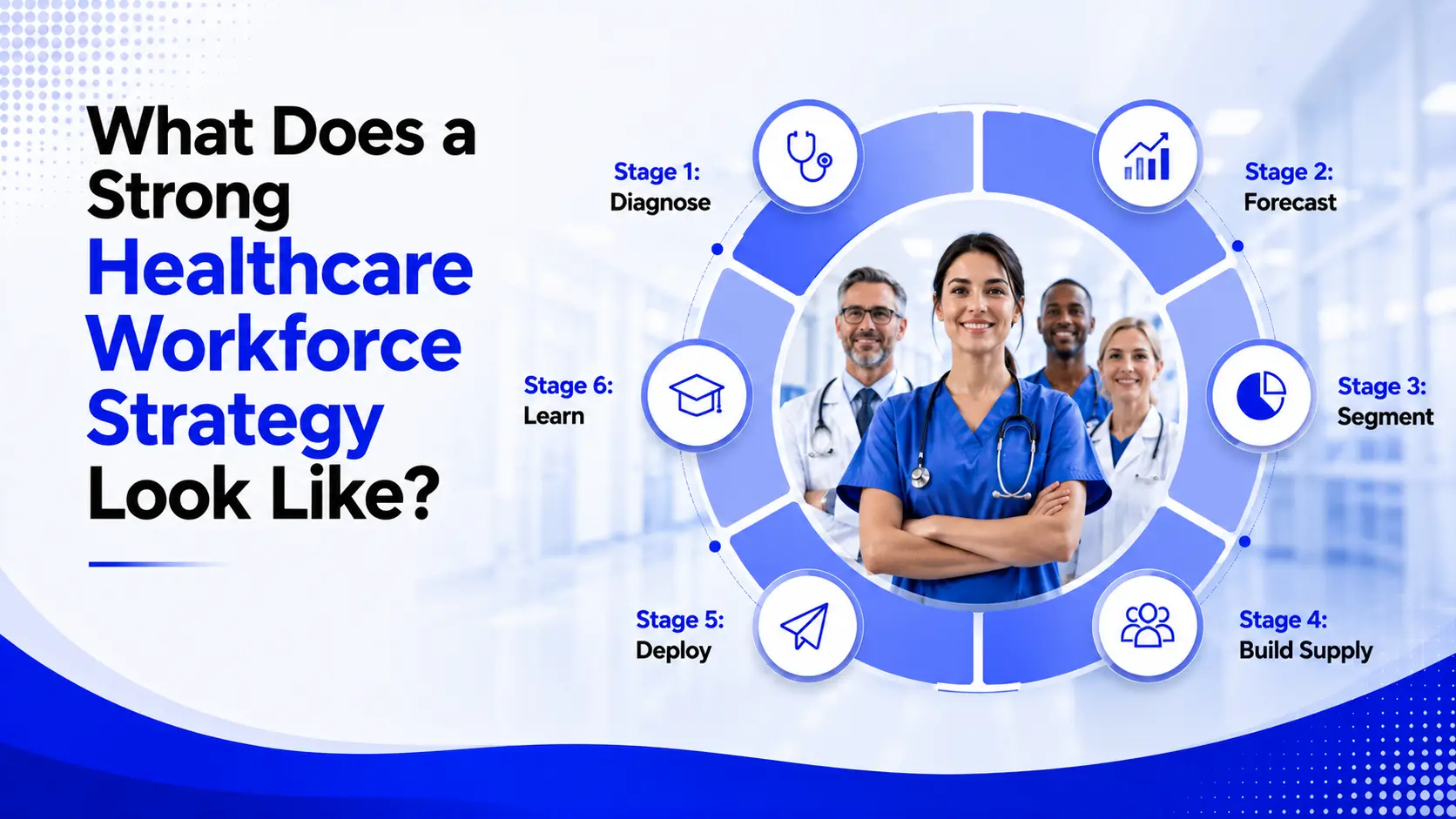
A useful strategy can be built around six stages.
Stage 1: Diagnose
Understand the current workforce.
Measure vacancies, turnover, overtime, absenteeism, contingent labor usage, hiring times, and hard-to-fill positions.
Stage 2: Forecast
Estimate future workforce demand based on patient volumes, retirements, seasonality, expansion, and historical workforce patterns.
Stage 3: Segment
Separate workforce requirements into categories.
For example:
Stable recurring demand → Permanent hiring
Short-term demand → Contract staffing
Local coverage gaps → Per diem
Geographic shortage → Travel staffing
Potential long-term requirement → Temp-to-hire
Stage 4: Build Supply
Create candidate pipelines before demand becomes urgent.
Stage 5: Deploy
Coordinate recruitment, credentialing, onboarding, scheduling, and workforce placement.
Stage 6: Learn
Measure outcomes and feed the findings back into the next workforce forecast.
This creates a continuous cycle:
Diagnose → Forecast → Plan → Source → Deploy → Measure → Improve
An Example: From Nursing Vacancy to Workforce Strategy
Consider a hypothetical 250-bed hospital experiencing nursing coverage problems.
Management initially concludes:
“We need more nurses.”
But workforce analysis reveals a more complicated situation.
Most vacancies occur in two departments. Night-shift overtime has risen. Several experienced nurses are expected to retire within 18 months. Weekend coverage is inconsistent. Local recruitment takes longer for one nursing specialty, and seasonal demand increases during winter.
Simply advertising more RN positions addresses only part of the problem.
A broader workforce strategy might include:
- Permanent recruitment for predictable baseline vacancies
- Early pipeline development for expected retirements
- Per diem coverage for variable weekend requirements
- Travel assignments for difficult-to-fill temporary gaps
- Faster credentialing workflows
- Scheduling changes to reduce concentrated overtime
- Retention analysis within the two high-turnover departments
The hospital has not changed its objective, it still needs adequate nursing coverage.
What changed is how the problem was defined.
That is the value of healthcare workforce management.
What Role Does Technology Play in Healthcare Workforce Management?
Technology is becoming increasingly important because healthcare workforce decisions involve large amounts of interconnected information.
Workforce-management technology can support:
Demand Forecasting
Historical staffing and patient-demand data can help organizations anticipate future requirements.
Scheduling
Automated systems can match available professionals to coverage requirements while considering qualifications and scheduling constraints.
Credential Management
Digital workflows can help organizations monitor documentation, certifications, licenses, and expiration dates.
Workforce Visibility
Dashboards can give leaders a more complete picture of vacancies, available capacity, overtime, and staffing utilization.
Candidate Matching
Recruitment technology can help identify candidates whose skills, location, availability, and experience align with a position.
Administrative Automation
AI can assist with repetitive activities such as data processing, communications, matching, and certain workforce analyses.
But technology has an important limitation.
It can optimize workforce information; it cannot create licensed clinicians where supply does not exist.
Nor should an algorithm independently determine whether a healthcare professional is the right fit for every clinical environment.
The stronger model combines automation for speed and visibility with human expertise for judgment, relationships, and complex workforce decisions.
What Should Healthcare Organizations Look for in a Workforce Solutions Partner?
Choosing a workforce partner should involve more than asking how many candidates are in its database.
Healthcare organizations should consider seven questions.
1. Does the partner understand healthcare-specific staffing requirements?
Healthcare recruitment involves credentials, specialties, clinical experience, compliance, and operational requirements that differ from conventional staffing.
2. Can the partner support different staffing models?
Organizations may require permanent, travel, contract, per diem, local, or other workforce solutions at different times.
3. How does the partner handle compliance and onboarding?
Candidate sourcing has limited value if qualified professionals cannot become workforce-ready efficiently.
4. Can the partner recruit beyond the immediate local market?
Geographic reach becomes important when local talent pools are constrained.
5. How does it support professionals after placement?
Candidate experience should not end on the start date.
6. Can it respond as demand changes?
Healthcare workforce requirements can change quickly.
7. Does the provider think strategically?
A workforce partner should be able to discuss the underlying staffing problem rather than simply respond to requisitions.
How MetaSense Fits Into Healthcare Workforce Management
MetaSense approaches healthcare staffing through multiple workforce models rather than a single type of placement.
The company’s healthcare workforce offerings include travel nursing, allied health, per diem and local opportunities, professional staffing, permanent hiring, float pool, and in-house agency opportunities. MetaSense also states that its service model supports healthcare professionals through onboarding, compliance, and ongoing assignment support.
This model is relevant to workforce management because healthcare organizations do not face one universal staffing problem.
A hospital may simultaneously need permanent clinicians for baseline capacity, travel professionals for difficult-to-fill assignments, and per diem professionals for variable coverage.
MetaSense CEO Dr. Jatin V. Mehta has also described the company’s approach as combining flexible staffing, data-driven workforce insights, talent-pipeline development, technology, and ongoing clinician support.
That supports a broader principle:
The objective of a healthcare staffing partner should not be to recommend the same staffing model for every vacancy. It should help align the source of talent with the type of workforce demand.
Common Healthcare Workforce Management Mistakes
Healthcare organizations can undermine workforce performance even while investing heavily in recruitment.
Mistake 1: Recruiting only after vacancies occur
Better approach: Forecast predictable requirements and maintain talent pipelines.
Mistake 2: Measuring hiring without measuring retention
Better approach: Evaluate net workforce growth and retention alongside recruitment.
Mistake 3: Treating every vacancy identically
Better approach: Segment requirements by urgency, duration, specialty, geography, and operational impact.
Mistake 4: Looking only at organization-wide workforce averages
Better approach: Analyze workforce data by department, location, shift, specialty, and tenure.
Mistake 5: Treating credentialing as separate from staffing
Better approach: Measure the complete journey from candidate identification to workforce readiness.
Mistake 6: Assuming contingent staffing is either always good or always bad
Better approach: Use flexible labor where flexibility has operational value and permanent recruitment where demand is structural.
Mistake 7: Assuming software itself creates a workforce strategy
Better approach: Use technology to execute and inform a strategy designed around actual workforce requirements.
Healthcare Workforce Management Best Practices
Healthcare organizations looking to improve workforce management should prioritize the following:
- Forecast instead of react. Use workforce and patient-demand data to anticipate requirements.
- Segment workforce demand. Distinguish permanent demand from temporary or variable demand.
- Build talent pipelines early. Don’t restart recruiting from zero for every vacancy.
- Connect recruiting and credentialing. Measure how quickly professionals become workforce-ready.
- Use flexible staffing deliberately. Match travel, contract, per diem, and permanent staffing to appropriate needs.
- Track retention by workforce segment. Organization-wide turnover can hide local problems.
- Measure operational outcomes. Monitor vacancy, fill rate, overtime, turnover, and workforce readiness.
- Use technology selectively. Automate repetitive processes while retaining human oversight.
- Listen to healthcare professionals. Scheduling, communication, career goals, and support affect workforce stability.
- Continuously reassess demand. Workforce management should operate as an ongoing cycle.
Healthcare Workforce Management Is Ultimately About Workforce Readiness
The most useful way to understand healthcare workforce management is not as software, scheduling, or recruiting.
It is workforce readiness.
Can the organization consistently provide the qualified workforce required to support its care operations, even when demand changes, employees leave, difficult-to-fill vacancies appear, or local talent is limited?
Answering that question requires healthcare organizations to connect activities that have traditionally operated separately:
workforce forecasting, recruiting, credentialing, scheduling, flexible staffing, retention, and workforce analytics.
Permanent hiring creates long-term capacity. Travel and contract professionals can provide targeted support. Per diem staffing can create flexibility. Workforce analytics can identify emerging gaps. Technology can accelerate repetitive processes. Retention strategies can protect the talent an organization already has.
None of those elements solves the workforce problem alone.
Together, they create a more resilient workforce model.
For healthcare organizations, that is the central shift:
Stop treating every open position as an isolated recruiting problem. Start treating workforce capacity as an operational system that needs to be planned, measured, and continuously improved.
Frequently Asked Questions About Healthcare Workforce Management
What is healthcare workforce management?
Healthcare workforce management is the coordinated process of forecasting staffing demand, recruiting and qualifying healthcare professionals, managing credentials, scheduling and deploying workers, monitoring workforce performance, and improving retention.
Why is workforce management important in healthcare?
Healthcare organizations must maintain sufficient qualified staff to meet changing patient-care requirements. Workforce management helps organizations anticipate staffing gaps, manage labor resources, improve workforce flexibility, and reduce reactive hiring.
Is healthcare workforce management the same as scheduling?
No. Scheduling is one component of workforce management. Healthcare workforce management can also include demand forecasting, recruitment, credentialing, compliance, deployment, analytics, and retention.
What is the difference between healthcare staffing and workforce management?
Healthcare staffing focuses on obtaining professionals for open workforce requirements. Workforce management is broader and determines what workforce is required, how it should be sourced, how professionals are deployed, and how workforce capacity can be maintained over time.
What is healthcare workforce planning?
Healthcare workforce planning involves estimating an organization’s future workforce requirements based on factors such as patient demand, current staffing, vacancies, turnover, retirement, growth, and specialty requirements.
What is a healthcare workforce management system?
A healthcare workforce management system is technology used to support activities such as scheduling, staffing, workforce forecasting, time and attendance, credential management, analytics, and workforce deployment.
Which healthcare workforce metrics should hospitals track?
Useful metrics include vacancy rate, time-to-fill, time-to-readiness, fill rate, turnover, retention, overtime, absenteeism, contingent labor utilization, and credentialing turnaround time.
How can hospitals reduce healthcare staffing gaps?
Hospitals can combine workforce forecasting, stronger retention, permanent recruitment, talent-pipeline development, faster credentialing, internal workforce optimization, and flexible staffing options such as travel, contract, and per diem professionals.
Can AI improve healthcare workforce management?
AI can assist with forecasting, candidate matching, administrative automation, scheduling, and workforce analytics. It cannot replace qualified healthcare professionals or the human judgment required for many clinical workforce decisions.
When should a healthcare organization use a staffing agency?
A healthcare staffing partner can be useful when an organization needs additional recruiting capacity, specialized talent, geographic reach, temporary coverage, travel professionals, per diem staffing, or support filling difficult-to-recruit positions.