
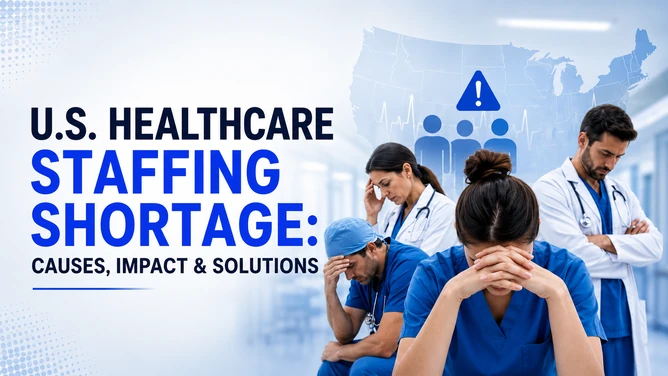
The U.S. healthcare staffing shortage is becoming a long-term workforce challenge rather than a temporary hiring problem. Hospitals, health systems, clinics, long-term care providers, and other healthcare organizations are facing growing demand for qualified professionals while also dealing with retirements, turnover, geographic workforce gaps, and rising demand for specialized care.
The numbers show why the issue deserves attention. The U.S. Bureau of Labor Statistics (BLS) projects that healthcare and social assistance will add approximately 2 million jobs between 2024 and 2034, making it the fastest-growing major industry sector in the country.
Nursing is one of the most visible pressure points. The Health Resources and Services Administration (HRSA) projects a national shortage of approximately 337,970 full-time-equivalent registered nurses by 2036, equivalent to a 9% shortage under its baseline assumptions. HRSA also projects a considerably larger RN shortage in non-metropolitan areas than metropolitan areas.
The physician workforce faces a similar challenge. The Association of American Medical Colleges (AAMC) projects a potential shortage of up to 86,000 physicians by 2036, driven in large part by population growth, an aging population, and an aging physician workforce.
These trends point to an important conclusion:
The U.S. healthcare staffing shortage is not simply a shortage of people. It is a shortage of the right professionals, in the right locations, at the right time.
Solving it will require more than posting jobs and waiting for applications. Healthcare organizations need a combination of workforce planning, retention, permanent recruitment, flexible staffing, geographic talent strategies, and efficient hiring processes.
Key Takeaways
- The U.S. healthcare workforce is expected to expand significantly over the next decade.
- Healthcare demand is growing faster than the overall U.S. employment market.
- Registered nursing remains a major workforce shortage area.
- Physician shortages could reach 86,000 by 2036.
- Rural and non-metropolitan communities face particularly significant workforce challenges.
- Retirement and workforce attrition are contributing to replacement demand.
- Staffing shortages can increase pressure on existing employees and healthcare operations.
- Travel, contract, per diem, allied health, and permanent staffing can address different workforce needs.
- Technology can make recruiting and workforce management more efficient, but it cannot replace qualified healthcare professionals.
- Healthcare organizations need a workforce strategy, not just a recruiting strategy.
What Is Causing the U.S. Healthcare Staffing Shortage?
There is no single explanation for the healthcare workforce shortage. Several structural trends are occurring simultaneously.
1. An Aging Population Is Increasing Demand for Healthcare
One of the biggest drivers is demographic change.
As the U.S. population ages, demand increases for medical services, chronic disease management, hospital care, rehabilitation, home health, and other healthcare services.
BLS expects the healthcare and social assistance sector to grow 8.4% between 2024 and 2034, compared with projected growth of 3.1% across the overall U.S. economy. BLS attributes much of this growth to an aging population and the increasing prevalence of chronic conditions.
This creates a difficult workforce equation:
More patients requiring care + more healthcare services = greater demand for qualified professionals.
Healthcare employers are therefore competing for talent in an expanding market.
2. Experienced Healthcare Professionals Are Reaching Retirement Age
Retirement creates another layer of pressure.
Replacing a healthcare professional is different from replacing an employee in many other industries. A qualified clinician may require years of education, clinical training, licensure, certification, and professional experience.
BLS projects approximately 189,100 openings for registered nurses each year from 2024 through 2034. These openings are not all new positions; many are expected to result from workers leaving the occupation or labor force, including through retirement.
That distinction matters.
Even if the number of healthcare professionals entering the workforce increases, healthcare organizations still need to replace experienced workers who leave.
3. Burnout and Retention Problems Can Intensify the Shortage
Recruitment and retention are two sides of the same workforce problem.
When organizations struggle to maintain adequate staffing levels, existing employees may face increased workloads, scheduling pressure, overtime, and reduced flexibility.
That can contribute to burnout and turnover.
The result can become a cycle:
Staff shortage → increased workload → employee dissatisfaction → turnover → more vacancies.
For healthcare organizations, solving this cycle requires more than recruiting additional candidates.
Retention strategies, including manageable workloads, competitive compensation, career development, supportive leadership, scheduling flexibility, and employee engagement, need to be part of the workforce strategy.
4. The Healthcare Talent Pipeline Takes Years to Build
Healthcare workforce supply cannot be increased instantly.
A person cannot become a registered nurse, physician, therapist, or other licensed healthcare professional simply because an organization has an open position.
Education, clinical training, examinations, licensing, and credentialing all take time.
Physician shortages illustrate this particularly well. AAMC’s workforce projections identify the need for continued investment in physician education and training as part of addressing future supply-demand gaps.
This creates a fundamental difference between healthcare recruitment and recruitment in many other industries:
The supply of qualified talent is constrained by education, licensure, experience, and geography.
The Healthcare Staffing Shortage Is Also a Geographic Problem
National workforce statistics do not tell the entire story.
A healthcare professional can exist somewhere in the United States while still being unavailable to a hospital that urgently needs that professional in another region.
HRSA’s nursing projections demonstrate this geographic disparity. Its baseline projections show a 14% RN shortage in non-metropolitan areas by 2036 compared with 8% in metropolitan areas.
For healthcare organizations in rural or underserved communities, the challenge may therefore be less about the total number of nurses in the country and more about:
- Where nurses are located
- Whether they are willing to relocate
- Which specialties they have
- Their clinical experience
- Local compensation
- Housing and travel considerations
- The availability of competing opportunities
This is why geographic recruitment and workforce mobility have become increasingly important components of healthcare staffing.
Which Healthcare Roles Are Most Affected?
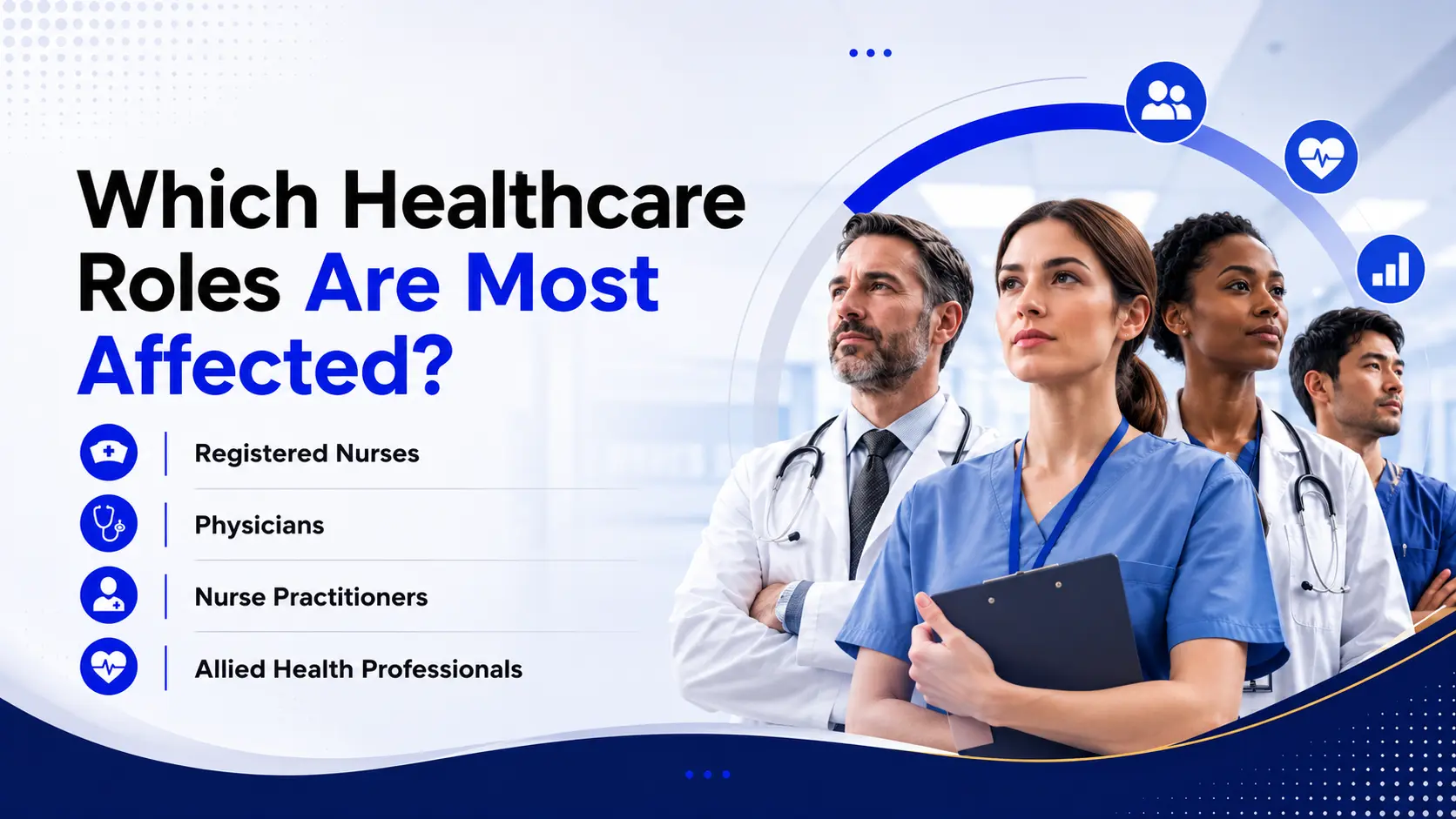
The shortage extends across multiple healthcare occupations rather than affecting one profession alone.
Registered Nurses
Registered nurses remain one of the most important areas of workforce demand.
BLS projects continued employment growth for RNs and approximately 189,100 openings annually through 2034.
Healthcare organizations may experience difficulty filling positions across different care settings and specialties, particularly where local talent pools are limited.
Physicians
The physician workforce faces a significant projected supply-demand gap.
AAMC’s latest workforce projections estimate a potential shortage ranging from 13,500 to 86,000 physicians by 2036, depending on future supply and demand scenarios.
The implications extend beyond physician recruitment. Physician availability affects appointment capacity, specialty access, hospital services, and patient access to care.
Nurse Practitioners
Nurse practitioners are another important part of the changing healthcare workforce.
BLS identifies nurse practitioners as the fastest-growing healthcare occupation projected between 2024 and 2034.
For organizations looking to expand access to care, advanced practice professionals can form an important component of workforce planning.
Allied Health Professionals
Healthcare delivery also depends heavily on allied health professionals.
Depending on the organization and service line, this can include:
- Respiratory therapists
- Physical therapists
- Occupational therapists
- Imaging professionals
- Laboratory professionals
- Medical technologists
- Rehabilitation professionals
- Other specialized clinical personnel
A shortage in an allied health role can create operational constraints even when an organization has adequate physician or nursing coverage.
How Does the Healthcare Staffing Shortage Affect Hospitals and Health Systems?
The impact goes far beyond an empty position.
Increased Pressure on Existing Employees
When vacancies remain open, existing employees may have to absorb additional shifts or responsibilities.
That can affect morale, workload, scheduling flexibility, and retention.
A staffing strategy that focuses exclusively on recruitment without addressing retention can therefore become a revolving door.
Higher Workforce Costs
Persistent vacancies can increase reliance on overtime, contract labor, premium shifts, travel professionals, and other contingent workforce solutions.
That does not mean flexible staffing is inherently inefficient.
In fact, contingent staffing can be strategically valuable when it is used to respond to temporary demand, geographic shortages, seasonal fluctuations, or specialized workforce requirements.
The problem arises when organizations use expensive short-term solutions indefinitely without addressing underlying workforce needs.
Reduced Operational Flexibility
Healthcare demand can change quickly.
Hospitals and healthcare systems may experience fluctuations related to:
- Seasonal illness
- Emergency department volume
- Patient admissions
- Employee absences
- New service lines
- Population growth
- Local workforce changes
A flexible staffing strategy allows organizations to respond to these changes without relying exclusively on permanent headcount.
Access Challenges in Underserved Communities
Workforce shortages can also affect where patients receive care.
When healthcare organizations in rural or underserved areas struggle to recruit qualified professionals, patients may face longer travel distances or fewer available providers.
The geographic component of the workforce shortage therefore makes healthcare staffing an access-to-care issue as well as a recruitment issue.
Why Traditional Healthcare Recruiting Is No Longer Enough
A traditional hiring process typically begins when a vacancy occurs.
The organization posts the position, reviews applications, interviews candidates, makes an offer, completes credentialing, and eventually brings the person onboard.
That process becomes difficult when qualified candidates have multiple employment opportunities.
Healthcare organizations increasingly need to move from reactive recruiting to proactive workforce planning.
Instead of asking:
“How do we fill this vacancy?”
Organizations should also ask:
“Which positions are likely to become difficult to fill six or twelve months from now?”
That shift can change how organizations approach healthcare recruitment.
A proactive strategy can include:
- Workforce demand forecasting
- Retirement and turnover analysis
- Hard-to-fill position identification
- Continuous candidate sourcing
- Regional talent mapping
- Multiple staffing models
- Faster credentialing and onboarding
- Retention initiatives
- Workforce performance measurement
Healthcare Staffing Solutions: What Actually Works?
There is no universal solution to the U.S. healthcare staffing shortage.
Different workforce problems require different staffing models.
Permanent Healthcare Staffing
Permanent recruitment is appropriate when an organization has a long-term workforce requirement.
It can be particularly valuable for:
- Core clinical positions
- Long-term service expansion
- Leadership roles
- Specialized positions
- Recurring workforce gaps
Permanent hiring should remain a central part of long-term workforce planning.
Travel Nursing
Travel nursing can help healthcare organizations access qualified professionals beyond their immediate geographic labor market.
It can be especially useful when a facility has an urgent or temporary shortage that cannot be solved through local recruitment alone.
Travel staffing also illustrates an important principle:
Talent mobility can help address geographic workforce imbalances.
Per Diem and Local Staffing
Per diem staffing can provide additional flexibility when demand changes frequently.
Healthcare organizations can use local and per diem professionals to address:
- Short-term vacancies
- Schedule gaps
- Employee absences
- Seasonal demand
- Variable patient volumes
Contract Healthcare Staffing
Contract staffing can provide access to qualified professionals for defined periods.
It can be useful for organizations experiencing:
- Temporary workforce shortages
- Specialized project requirements
- Expansion periods
- Short-term increases in patient demand
Temp-to-Hire Staffing
Temp-to-hire provides an alternative for organizations that want to assess long-term fit before making a permanent commitment.
This can allow both the organization and professional to evaluate the working relationship before transitioning to a permanent role.
Allied Health Staffing
A comprehensive healthcare staffing strategy should also include allied health.
Healthcare organizations need a multidisciplinary workforce to deliver care effectively.
Recruiting the right combination of nurses, physicians, advanced practice professionals, technicians, therapists, and support professionals can help organizations build more resilient care teams.
How Healthcare Organizations Can Reduce Staffing Challenges
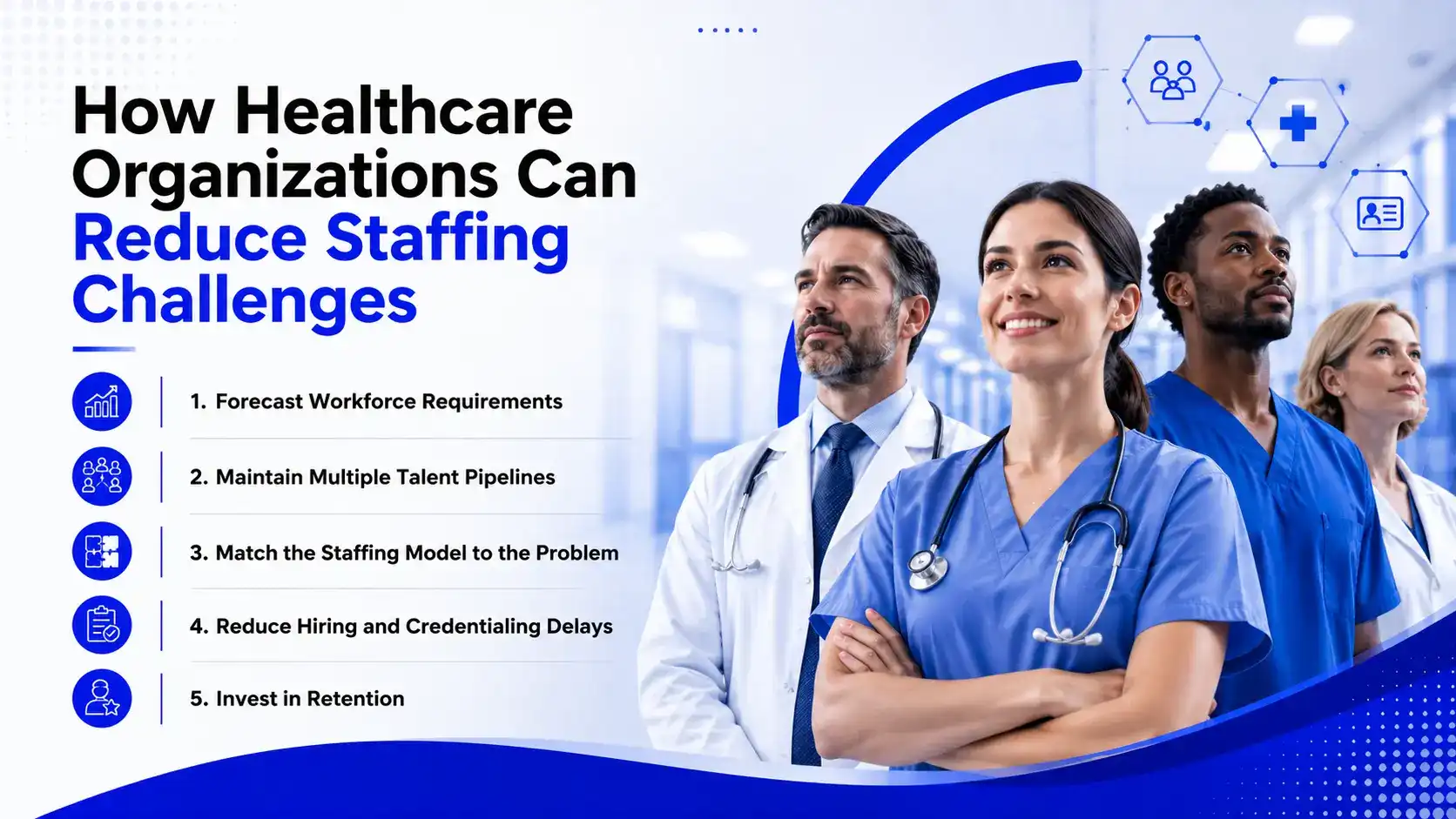
Healthcare employers cannot control every factor driving the national workforce shortage.
They can, however, improve the way they manage their workforce.
1. Forecast Workforce Requirements
Don’t wait for a resignation before starting recruitment.
Organizations should analyze:
- Current vacancies
- Turnover rates
- Retirement risk
- Patient volumes
- Service expansion
- Seasonal demand
- Hard-to-fill specialties
- Historical hiring timelines
This allows recruitment teams to anticipate workforce needs.
2. Maintain Multiple Talent Pipelines
Healthcare employers should avoid relying on a single source of candidates.
A broader talent strategy can combine:
- Direct recruitment
- Healthcare staffing agencies
- Employee referrals
- Professional networks
- Academic partnerships
- Regional recruitment
- Travel staffing
- Local and per diem professionals
The goal is to create a continuous talent pipeline rather than starting from zero whenever a position becomes vacant.
3. Match the Staffing Model to the Problem
Not every workforce gap requires a permanent employee.
For example:
Temporary demand → contract or per diem staffing
Geographic shortage → travel staffing
Long-term vacancy → permanent recruitment
Uncertain long-term fit → temp-to-hire
This approach gives healthcare organizations more workforce flexibility.
4. Reduce Hiring and Credentialing Delays
In a competitive healthcare labor market, speed matters.
Organizations should review the entire journey from candidate identification to first day:
Sourcing → screening → interview → offer → background check → credentialing → compliance → onboarding → placement
Unnecessary delays can increase candidate drop-off and allow competing employers to hire qualified professionals first.
5. Invest in Retention
Recruiting more professionals will not solve a staffing shortage if experienced employees continue leaving.
Healthcare employers should evaluate:
- Workload
- Scheduling
- Compensation
- Career progression
- Professional development
- Leadership
- Workplace culture
- Recognition
- Employee support
Retention is one of the most cost-effective components of workforce planning because organizations are not constantly replacing people they already trained.
What Role Can AI and Technology Play in Healthcare Staffing?
AI is likely to become increasingly important in workforce management, but it should not be presented as a magic solution.
Technology can help staffing teams with activities such as:
- Candidate matching
- Resume screening
- Workforce forecasting
- Scheduling
- Credential tracking
- Administrative workflows
- Candidate communication
- Workforce analytics
BLS expects strong demand for AI-based systems and technology across the broader U.S. economy while healthcare and social assistance remains the fastest-growing major industry sector.
The important distinction is:
Technology can improve the efficiency of healthcare staffing. It cannot eliminate the need for qualified healthcare professionals.
A strong healthcare staffing model should combine technology with human expertise.
Recruiters and workforce specialists still need to understand clinical requirements, candidate experience, organizational culture, licensing, compliance, availability, and the realities of healthcare work.
How MetaSense Inc. Supports Healthcare Organizations Facing Staffing Shortages
At MetaSense Inc., healthcare staffing is approached as a workforce-solutions challenge rather than simply a job-placement exercise.
MetaSense says its Healthcare Workforce Solutions division was established to address critical staffing shortages in complex, high-demand care environments. The company currently offers multiple healthcare staffing models, including:
- Travel nursing
- Allied health staffing
- Per diem and local staffing
- Nurse practitioner staffing
- Non-clinical staffing
- Permanent hiring solutions
This breadth matters because healthcare organizations rarely experience exactly the same staffing challenge.
One facility may need permanent registered nurses.
Another may need travel professionals because its local talent pool is limited.
A third may need per diem coverage to manage fluctuating demand.
Another may need specialized allied health professionals.
A workforce partner needs to understand the difference.
MetaSense Inc. was founded in 1999 as an IT staffing company and subsequently expanded its healthcare workforce solutions. The company states that its healthcare division supports professionals through onboarding, compliance, and ongoing assignment support.
That experience supports a broader approach to workforce management: combining recruitment capabilities with operational processes designed for regulated, complex staffing environments.
For healthcare organizations, the objective is not simply to fill today’s vacancy.
It is to build enough workforce flexibility to respond to tomorrow’s demand.
What Is the Future of Healthcare Staffing in the U.S.?
The healthcare workforce shortage is unlikely to disappear simply because more people enter healthcare professions.
The underlying demand is growing rapidly.
BLS projects that healthcare and social assistance will add roughly 1.98 million jobs from 2024 through 2034 and grow 8.4% during the period.
At the same time, AAMC projects a potential physician shortage of up to 86,000 by 2036, while HRSA projects a shortage of approximately 337,970 full-time-equivalent registered nurses under its baseline scenario.
These figures make one point clear:
The future of healthcare staffing will require flexibility.
Healthcare organizations will increasingly need to combine:
Permanent hiring + contingent staffing + workforce planning + retention + geographic recruitment + technology.
No single staffing model can address every workforce challenge.
The organizations best positioned to navigate the shortage will be those that understand when to recruit permanently, when to use flexible staffing, where talent is available, and how to retain the professionals already on their teams.
Final Takeaway
The U.S. healthcare staffing shortage is not simply a recruitment problem.
It is the result of several forces moving simultaneously: healthcare demand is increasing, experienced professionals are retiring, workforce distribution remains uneven, and healthcare organizations are competing for a limited supply of qualified talent.
The solution requires a broader approach.
Healthcare organizations need to forecast workforce demand, strengthen retention, develop multiple talent pipelines, streamline hiring, and use the right combination of permanent and flexible staffing models.
Travel nursing can address geographic gaps. Per diem staffing can provide flexibility. Contract staffing can handle temporary demand. Permanent recruitment can strengthen long-term workforce capacity. Allied health recruitment can help maintain the multidisciplinary teams required for modern healthcare.
And technology can make the entire process more efficient.
But the central principle remains simple:
Healthcare organizations need the right people, with the right skills, in the right place, at the right time.
That is why healthcare staffing is increasingly becoming a workforce strategy rather than simply a recruiting function.
With its combination of travel nursing, allied health, per diem and local staffing, nurse practitioner staffing, non-clinical staffing, and permanent hiring solutions, MetaSense Inc. provides healthcare organizations with multiple ways to respond to changing workforce requirements.
Frequently Asked Questions About the U.S. Healthcare Staffing Shortage
How serious is the healthcare staffing shortage in the U.S.?
The shortage is significant and varies by profession and location. HRSA projects a shortage of approximately 337,970 full-time-equivalent registered nurses by 2036 under its baseline scenario, while AAMC projects a potential physician shortage of up to 86,000 by the same year.
What is the biggest cause of the healthcare staffing shortage?
There is no single cause. Population aging, increasing demand for healthcare, retirement, workforce attrition, burnout, limited training pipelines, and geographic distribution all contribute to staffing pressure.
Which healthcare professionals are in the highest demand?
Registered nurses, physicians, nurse practitioners, allied health professionals, and other clinical and healthcare support occupations are experiencing strong demand. BLS projects healthcare and social assistance to be the fastest-growing major industry sector through 2034.
Are rural hospitals more affected by staffing shortages?
Many non-metropolitan areas face greater workforce pressure. HRSA’s RN projections show a projected 14% shortage in non-metropolitan areas by 2036 compared with 8% in metropolitan areas.
Can healthcare staffing agencies solve the national staffing shortage?
No single staffing agency can solve a national workforce shortage. However, healthcare staffing companies can help organizations access qualified professionals, expand their talent reach, manage temporary gaps, recruit across geographic markets, and implement flexible staffing strategies.
Is travel nursing a solution to the nursing shortage?
Travel nursing can help healthcare organizations address temporary and geographic nursing shortages. It works best as part of a broader workforce strategy that also includes permanent recruitment and retention.
What is the difference between permanent and contingent healthcare staffing?
Permanent staffing is generally designed to meet ongoing workforce requirements, while contingent models such as travel, contract, and per diem staffing provide greater flexibility for temporary, variable, or specialized workforce needs.
How can hospitals improve healthcare employee retention?
Healthcare organizations can focus on manageable workloads, competitive compensation, scheduling flexibility, career development, professional support, strong leadership, and a positive employee experience.
Can AI replace healthcare staffing professionals?
AI can automate or improve parts of the staffing process, such as candidate matching, scheduling, workforce forecasting, and administrative work. It cannot replace licensed healthcare professionals or the human expertise required to evaluate clinical talent and workforce needs.