

For hospital leaders, the decision between travel nurses and local nurses is rarely as simple as comparing hourly rates.
A hospital may need additional nurses because of an unexpected vacancy, seasonal patient demand, a difficult-to-fill specialty, a geographic shortage, or a temporary increase in census. In another situation, the same hospital may need to build a stable permanent nursing workforce that can support patient care for years.
Those are different workforce problems.
Local nurses are generally the stronger foundation for predictable, long-term staffing needs. Travel nurses can provide valuable flexibility when hospitals face temporary shortages, specialized workforce gaps, geographic challenges, or urgent coverage requirements. For many hospitals, the most effective strategy is a combination of both.
The U.S. nursing workforce makes this decision particularly important. The Bureau of Labor Statistics projects 189,100 registered nurse openings per year, on average, from 2024 through 2034.
HRSA’s latest workforce projections also estimate a 108,960 FTE RN shortage nationally by 2038. The projected shortage is substantially higher in nonmetropolitan areas: 11% compared with 2% in metropolitan areas.
So the question isn’t simply:
“Are travel nurses or local nurses better?”
The better question is:
“What combination of workforce stability and flexibility does our hospital need right now, and what will it need next year?”
Travel Nurses vs Local Nurses: Quick Answer
Choose local nurses when:
- The hospital has a predictable, long-term staffing requirement.
- The position is part of its permanent workforce plan.
- Institutional knowledge and team continuity are important.
- The local talent pool can meet demand.
- The hospital wants to develop long-term employee retention.
Consider travel nurses when:
- A staffing gap needs to be addressed quickly.
- Local recruitment isn’t producing enough qualified candidates.
- A specialty is difficult to source.
- Patient volume temporarily increases.
- A hospital is located in a geographically underserved market.
- Permanent recruitment is underway but coverage is needed immediately.
- The hospital needs temporary workforce flexibility.
Consider a blended model when:
Local nurses provide the core workforce, while travel nurses provide additional capacity when demand exceeds the permanent staffing base.
For many hospitals, that is the most practical approach.
What Is a Local Nurse?
For this article, local nurse refers to a nurse who works within the hospital’s local or regional workforce rather than traveling to the facility for a temporary assignment.
This can include:
- Permanent staff RNs
- Local contract nurses
- Per diem nurses
- Nurses recruited from the surrounding labor market
However, when hospital leaders compare travel nurses vs. local nurses, they typically mean:
Travel/temporary workforce vs. locally recruited permanent workforce.
Local nurses often become deeply familiar with the hospital’s:
- Clinical workflows
- Patient population
- Electronic health record
- Policies
- Department procedures
- Physicians
- Leadership
- Nursing teams
- Community
That accumulated knowledge can be valuable for long-term workforce stability.
What Is a Travel Nurse?
A travel nurse is a licensed nurse who accepts a temporary assignment at a healthcare facility, typically away from their normal home location.
Travel nurses are commonly used when hospitals need additional clinical capacity but cannot meet the requirement through their local workforce alone.
MetaSense Inc. describes travel nurses as professionals who accept short-term assignments when healthcare organizations experience shortages related to factors such as turnover, retirement, or vacation. MetaSense Inc. notes that assignments are commonly around 13 weeks, although assignments can be extended depending on organizational needs.
Travel nursing can therefore provide hospitals with a temporary workforce layer without requiring them to make every staffing increase permanent.
Why Are Hospitals Still Using Travel Nurses?
Travel nursing became highly visible during the COVID-19 pandemic, when hospitals experienced extraordinary staffing pressure.
But temporary nursing isn’t limited to emergencies.
Hospitals may still need travel nurses because healthcare workforce supply and demand don’t always line up geographically or by specialty.
A hospital might have:
100 nursing positions
but only:
92 qualified nurses available locally.
The hospital doesn’t necessarily need to permanently increase its workforce by eight people.
It first needs to determine why the gap exists and how long it is expected to last.
If the gap is temporary, travel nursing can provide flexibility.
If the gap is structural, permanent recruitment may be necessary.
Travel Nurses vs Local Nurses: Key Differences
| Factor | Travel Nurses | Local Nurses |
| Workforce purpose | Flexible/temporary capacity | Core workforce capacity |
| Assignment | Usually defined duration | Generally ongoing |
| Geographic reach | National/broader | Local/regional |
| Speed | Can provide a rapid staffing option | Permanent hiring can take longer |
| Institutional knowledge | Develops during assignment | Builds over longer tenure |
| Workforce flexibility | High | Moderate |
| Long-term continuity | Lower | Higher |
| Useful for shortages | Strong option | Strong option |
| Useful for seasonal demand | Strong option | Less flexible |
| Useful for permanent positions | Usually as a bridge | Strong fit |
| Useful for hard-to-fill locations | Strong option | Can be challenging |
| Best strategic role | Flexible workforce layer | Core workforce foundation |
Neither model wins across every category.
The right choice depends on the hospital’s workforce problem.
The Biggest Difference: Stability vs. Flexibility
The easiest way to understand the difference is:
Local nurses provide stability.
They become part of the hospital’s long-term workforce.
Travel nurses provide flexibility.
They allow a hospital to increase staffing capacity without necessarily making the entire increase permanent.
That makes the two models complementary.
Consider a hospital that normally requires 300 nurses but occasionally needs 320 because of seasonal demand.
Hiring 20 permanent nurses may create excess capacity after the seasonal period.
Using temporary nurses for every staffing requirement could create unnecessary dependence on contingent labor.
A better strategy may be:
300 core local nurses + flexible access to additional nurses when demand increases.
When Should Hospitals Choose Local Nurses?

1. When the Staffing Need Is Permanent
If a hospital expects to need the position year after year, permanent hiring should be part of the workforce strategy.
For example, if a hospital consistently needs ICU nurses, building a permanent ICU workforce makes more sense than treating the requirement as temporary indefinitely.
2. When Institutional Knowledge Matters
Local nurses have the opportunity to develop deep familiarity with the organization.
That can include:
- Hospital protocols
- Documentation practices
- Clinical workflows
- Patient population
- Team communication
- Physician preferences
- Internal escalation procedures
This continuity can make a long-term local workforce particularly valuable.
3. When the Local Talent Pool Is Healthy
If a hospital can consistently attract qualified nurses from its surrounding labor market, permanent recruitment may be the most sustainable option.
The hospital can invest in:
- Recruitment
- Orientation
- Professional development
- Career advancement
- Retention
- Leadership development
The objective becomes building a workforce rather than repeatedly filling short-term gaps.
4. When Long-Term Retention Is a Priority
Local permanent employees can build longer-term careers within the organization.
That creates opportunities for:
- Career progression
- Specialty development
- Leadership pipelines
- Mentoring
- Internal mobility
A hospital that wants to develop future nurse managers, educators, or clinical leaders needs a stable workforce from which to build that pipeline.
When Should Hospitals Choose Travel Nurses?

1. When a Staffing Gap Is Urgent
A hospital may have vacancies today but permanent recruitment may take weeks or months.
The 2026 NSI report places the average cost of bedside RN turnover at $60,090 per RN, illustrating why workforce instability can carry a significant financial impact.
Travel staffing can help provide interim capacity while the hospital works on a permanent workforce solution.
2. When Local Recruitment Is Not Producing Enough Candidates
This is particularly relevant in areas where the available nursing workforce is limited.
HRSA’s latest projections show the problem is not evenly distributed across the country.
By 2038, HRSA projects an 11% RN shortage in nonmetropolitan areas versus 2% in metropolitan areas.
For a rural or geographically isolated hospital, the challenge may not be the attractiveness of the job.
It may simply be the size of the local talent pool.
Travel nursing expands the geographic reach of the search.
3. When a Specialty Is Difficult to Recruit
Hospitals don’t hire “nurses” as a single homogeneous workforce.
They need professionals with specific experience.
For example:
- ICU
- Emergency department
- Operating room
- Labor and delivery
- Telemetry
- NICU
- Behavioral health
- Med-Surg
A shortage in a particular specialty can create an operational problem even when the hospital’s overall nurse count looks healthy.
Travel staffing can help address that mismatch.
4. When Patient Demand Temporarily Increases
Healthcare demand can change quickly.
A hospital may experience temporary increases due to:
- Seasonal illness
- Community health events
- Service-line changes
- Facility expansion
- Emergency conditions
- Temporary increases in census
A temporary workforce gives the organization more flexibility than permanently increasing headcount for a short-term requirement.
Are Travel Nurses More Expensive Than Local Nurses?
This is one of the most important questions, and one of the easiest to oversimplify.
A travel nurse may have a higher direct bill rate than the wage paid to a permanent staff nurse, but direct rate alone does not tell a hospital which option is more expensive overall.
Hospitals should compare the total workforce economics.
Local nurse costs can include:
- Salary
- Benefits
- Recruitment
- Advertising
- Hiring
- Orientation
- Training
- Credentialing
- Turnover
- Overtime
- Vacancy costs
Travel nurse costs can include:
- Agency bill rate
- Travel-related expenses
- Housing/stipends where applicable
- Assignment management
- Credentialing
- Onboarding
- Contract administration
The comparison therefore needs to be:
Total cost of local workforce
versus
Total cost of temporary workforce + value of flexibility
rather than simply comparing hourly wages.
Why the Cost of an Empty Position Matters
Suppose a hospital has a vacant ICU nursing position.
The hospital might focus on the cost of hiring a travel nurse.
But it should also ask:
What does leaving the position vacant cost us?
An open position may contribute to:
- Overtime
- Additional workload
- Schedule instability
- Staff fatigue
- Delayed services
- Lower workforce flexibility
- Additional turnover pressure
The American Hospital Association reports that hospitals spent more than $1 trillion on dedicated healthcare workers in 2025, with workforce costs rising 5.6% that year.
Labor is therefore not a minor line item.
It is a central hospital operating cost.
The objective should be to optimize the workforce, not simply minimize one staffing rate.
Travel Nurses vs Local Nurses: A Better Cost Question
Instead of asking:
“Which nurse costs less per hour?”
Hospital leaders should ask:
“Which staffing model produces the best combination of coverage, quality, flexibility, retention, and total cost for this particular workforce requirement?”
That produces a more useful decision.
What About Nurse Turnover?
Turnover changes the economics of the decision.
The 2026 NSI report puts national RN turnover at 17.6% and estimates the average cost of turnover for a bedside RN at $60,090.
That doesn’t mean a travel nurse automatically becomes the cheaper option.
It means hospital leaders should account for the cost of workforce instability when evaluating staffing models.
If a hospital repeatedly recruits permanent nurses only to lose them quickly, it may need to investigate:
- Work environment
- Scheduling
- Compensation
- Management
- Workload
- Career development
- Unit culture
- Retention strategy
Travel staffing can provide coverage.
It cannot, by itself, solve a retention problem.
The Best Use of Travel Nurses: A Strategic Workforce Layer
One of the biggest mistakes is treating travel nurses as either:
“too expensive”
or
“the solution to everything.”
Neither is accurate.
Travel nurses are most valuable when they solve a specific workforce problem.
For example:
Situation
A hospital has 500 permanent nurses but suddenly needs 25 additional nurses because of increased patient volume.
Possible response
Instead of permanently increasing the workforce by 25, the hospital could temporarily add travel or contract nurses while determining whether the demand is truly permanent.
This provides time to gather data.
If patient volume returns to normal, the hospital avoids unnecessary permanent headcount.
If demand remains elevated, leadership can transition toward permanent recruitment.
When Travel Staffing Becomes a Warning Sign
Travel nursing is useful.
But hospitals should periodically evaluate whether temporary staffing has become a substitute for solving a permanent workforce problem.
Warning signs include:
- The same travel positions remain open continuously.
- Temporary assignments are repeatedly extended.
- Permanent vacancies remain unresolved.
- Agency utilization keeps increasing.
- Overtime remains high.
- The hospital has no permanent recruitment pipeline.
- Local retention continues to deteriorate.
- Temporary staff are being used to cover predictable baseline demand.
At that point, the question changes.
The hospital may no longer have a temporary staffing problem.
It may have a workforce planning problem.
Why Local Nurses Should Still Form the Core Workforce
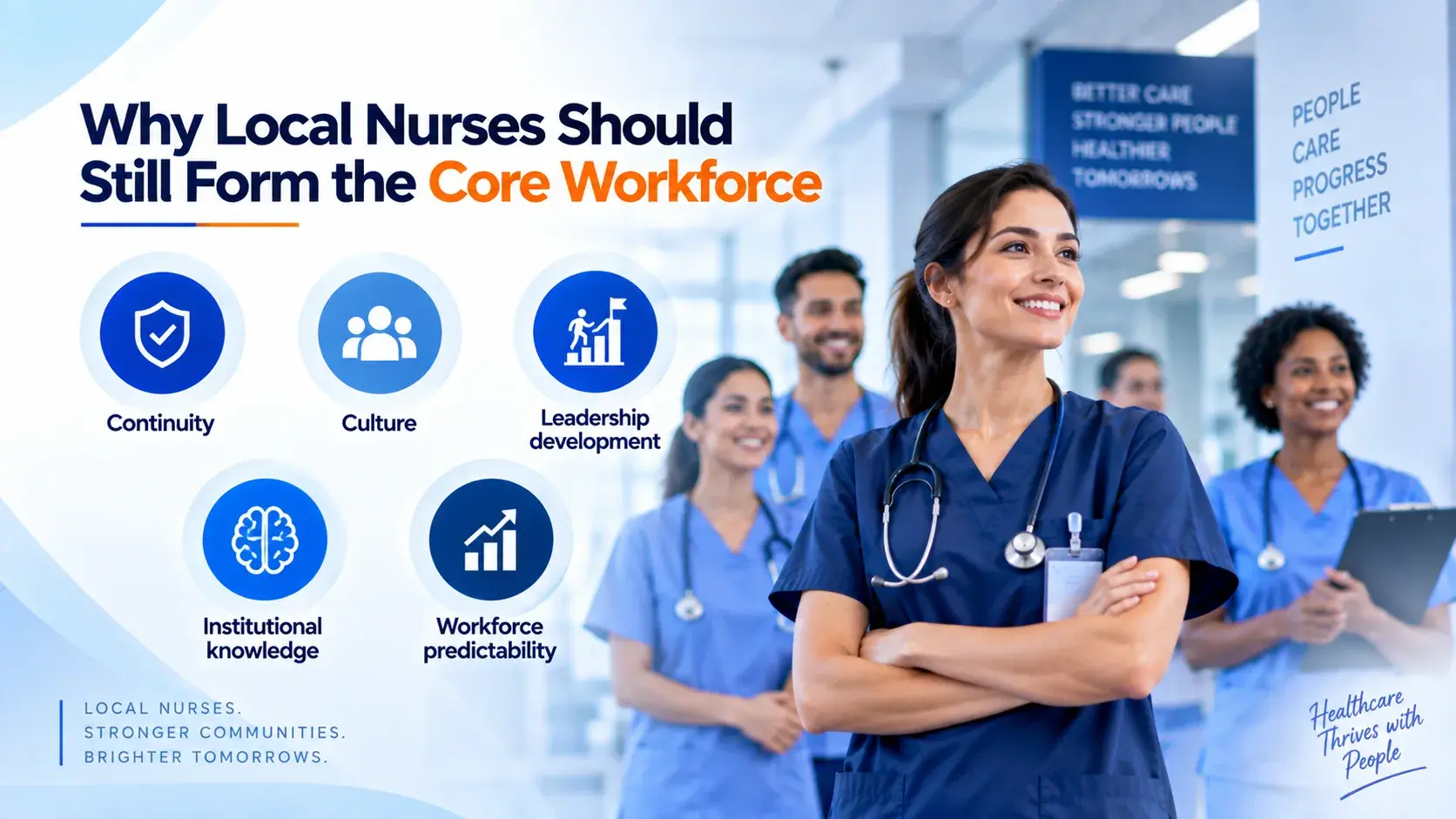
Even hospitals that use travel nurses extensively should consider how much of their workforce should be permanent.
A strong core workforce can provide:
Continuity
Employees develop familiarity with patients, colleagues, systems, and workflows.
Culture
Permanent teams can develop shared standards and organizational identity.
Leadership development
Hospitals can build internal career pathways.
Institutional knowledge
Experience accumulated over time remains within the organization.
Workforce predictability
A stable workforce provides a stronger foundation for long-term planning.
This is why the objective shouldn’t be to eliminate travel nursing.
It should be to use travel nursing where flexibility creates value while continuing to build a sustainable permanent workforce.
Why Travel Nurses Remain Important in the U.S. Healthcare Market
The need for flexible nursing capacity is closely connected to geographic workforce shortages.
HRSA’s current projections estimate that the United States could face a 108,960 FTE RN shortage in 2038.
And the geographic difference is significant.
The projected 2038 RN shortage is:
- 11% in nonmetropolitan areas
- 2% in metropolitan areas
This creates a practical reason for hospitals to maintain access to broader talent markets.
A local-only recruitment strategy may work well in one city and poorly in another.
Travel Nurses vs Local Nurses by Hospital Situation
| Hospital Situation | Local Nurses | Travel Nurses |
| Stable year-round demand | Excellent fit | Supporting role |
| Temporary patient surge | Limited flexibility | Excellent fit |
| Rural talent shortage | Can be difficult | Strong option |
| Hard-to-fill specialty | May take longer | Strong option |
| Long-term service expansion | Excellent fit | Bridge/support |
| Short-term leave coverage | Possible | Excellent fit |
| Permanent workforce building | Excellent fit | Not primary solution |
| Immediate staffing crisis | May take time | Strong option |
| High permanent turnover | Needs retention strategy | Temporary coverage |
| Seasonal demand | Less flexible | Strong option |
A Hybrid Nursing Staffing Model May Be the Strongest Strategy
For many hospitals, the most practical model is:
Permanent/local nurses
Build the core workforce.
Travel nurses
Provide additional capacity during shortages or temporary demand.
Per diem/local contract nurses
Handle shorter-term fluctuations.
Internal float pool
Move available staff between departments or facilities where appropriate.
This creates multiple workforce layers.
For example:
Core demand → Permanent nurses
Variable demand → Per diem
Temporary shortage → Travel nurses
Long-term vacancy → Permanent recruitment
Emergency requirement → Rapid temporary staffing
Instead of asking one staffing model to solve every problem, the hospital builds a workforce portfolio.
A Practical Example
Imagine a 300-bed hospital has a baseline requirement of 250 nurses.
It currently has 236.
There is a shortage of 14 nurses.
Scenario A: The shortage is temporary
Several nurses are on extended leave and patient volume is expected to normalize.
Travel/per diem staffing may make sense.
Scenario B: The shortage is permanent
The hospital has experienced steady growth and expects patient demand to remain higher.
Permanent recruitment should become the priority.
Scenario C: The shortage is partly temporary
The hospital expects to need 250 permanent nurses but needs 15 additional nurses during the next six months.
A blended strategy may be best:
250 permanent nurses + temporary workforce for the six-month peak.
This is the key distinction.
The number of nurses needed today isn’t necessarily the same as the number the hospital should permanently employ.
A 6-Question Framework for Hospital Leaders

Before choosing travel or local nurses, ask:
1. How long will we need the additional nurses?
Weeks/months → Temporary may fit
Indefinitely → Permanent recruitment
2. Is demand predictable?
Stable → Local workforce
Variable → Flexible workforce
3. Can we recruit locally?
Yes → Local recruitment
No → Expand geographic reach
4. Is the specialty difficult to fill?
If yes, consider a broader talent pool and temporary options while building a permanent pipeline.
5. What is the cost of leaving the position vacant?
Include overtime, operational disruption, turnover risk, and lost capacity.
6. What will our workforce requirement look like 12 months from now?
This prevents short-term staffing decisions from becoming accidental long-term strategy.
A Realistic MetaSense Approach to Travel Nursing
MetaSense’s current healthcare workforce model includes travel nursing, allied health staffing, per diem and local staffing, nurse practitioner staffing, non-clinical staffing, and permanent hiring solutions.
That breadth supports a more practical approach to the travel-versus-local decision.
A hospital doesn’t necessarily need to choose one model permanently.
Its workforce requirements can change.
For example:
Immediate shortage → Travel nursing
Local short-term coverage → Per diem/local staffing
Long-term requirement → Permanent hiring
Specialized shortage → Broader healthcare staffing
MetaSense Inc. also describes its healthcare workforce division as supporting organizations with rapid deployment, compliance, credentialing, and ongoing assignment support.
The company’s approach emphasizes matching qualified professionals to organizational requirements rather than treating staffing as a one-size-fits-all transaction.
What Makes a Good Travel Nurse Staffing Partner?
Hospitals shouldn’t evaluate a staffing partner solely by how many resumes it can produce.
Important considerations include:
Credentialing
Does the agency verify licenses, certifications, experience, and required documentation?
Clinical fit
Does the candidate actually match the hospital’s specialty and requirements?
Speed
Can the partner respond when workforce needs become urgent?
Geographic reach
Can the staffing partner access talent beyond the local market?
Communication
Does the agency maintain communication with both the hospital and clinician?
Assignment support
Does support continue after placement?
Workforce strategy
Can the partner help determine whether a requirement is temporary or points toward a longer-term workforce need?
MetaSense Inc. says its service model supports professionals from onboarding and compliance through daily assignment support, while its client work includes large-scale, multi-site staffing programs requiring rapid deployment and ongoing operational oversight.
What Hospitals Should Not Do
Don’t eliminate travel nurses simply because the bill rate is higher.
Look at the total workforce economics.
Don’t rely on travel nurses indefinitely without reviewing the permanent workforce strategy.
Temporary staffing should solve temporary or flexible requirements where appropriate.
Don’t assume local recruitment will work everywhere.
Talent availability varies significantly by geography.
Don’t treat all nursing vacancies equally.
An ICU vacancy, seasonal Med-Surg requirement, and rural specialty shortage are different workforce problems.
Don’t focus only on filling today’s shifts.
Workforce planning should consider future demand.
Final Verdict: Travel Nurses vs Local Nurses
Local nurses should generally form the foundation of a hospital’s long-term workforce. Travel nurses can provide the flexibility needed when local workforce capacity cannot keep pace with immediate, temporary, specialized, or geographically challenging requirements.
The best answer isn’t always:
Travel OR Local
It may be:
Local + Travel + Per Diem + Workforce Planning
A hospital can maintain a stable permanent workforce while using travel nurses strategically when additional capacity is needed.
That approach recognizes the realities of the U.S. nursing market.
BLS projects 189,100 RN openings annually through 2034, while HRSA projects a 108,960 FTE RN shortage by 2038.
At the same time, hospitals are managing substantial workforce expenses. The AHA reports that hospitals spent more than $1 trillion on dedicated healthcare workers in 2025, with workforce costs increasing 5.6% during the year.
The answer, therefore, isn’t to eliminate flexibility.
It’s to use flexibility deliberately.
The practical rule:
Build your core workforce locally. Use travel nurses when flexibility, speed, specialty access, or geographic reach creates value. Then continuously evaluate whether temporary demand is becoming permanent.
That is a more sustainable approach than treating travel nurses and local nurses as competing alternatives.
MetaSense Inc. supports hospitals with multiple workforce options, including travel nursing, per diem and local staffing, allied health staffing, and permanent hiring solutions.
The right staffing model is the one that gives the hospital the workforce it needs today without compromising the workforce it will need tomorrow.
Frequently Asked Questions
Are travel nurses better than local nurses?
Neither is universally better. Local nurses are generally better suited to stable, long-term workforce requirements, while travel nurses provide flexibility for temporary shortages, geographic gaps, specialty needs, and changing demand.
Are travel nurses more expensive than local nurses?
A travel nurse may have a higher direct bill rate, but that does not automatically mean higher total workforce cost. Hospitals should also consider vacancy costs, overtime, recruitment, benefits, turnover, and the value of rapid staffing.
Why do hospitals use travel nurses?
Hospitals use travel nurses to address temporary shortages, specialty gaps, geographic workforce limitations, seasonal demand, extended leave, and urgent staffing requirements.
How long do travel nurse assignments typically last?
Travel assignments vary. MetaSense states that assignments are commonly 13 weeks and may be extended depending on the healthcare organization’s needs.
Should hospitals replace travel nurses with permanent nurses?
Not necessarily. Travel nurses can provide valuable flexibility even when a hospital maintains a strong permanent workforce. The appropriate balance depends on demand, geography, specialty, and workforce strategy.
When should a hospital hire local nurses?
Hospitals should prioritize local/permanent recruitment when positions represent stable, recurring, long-term workforce requirements and the organization wants to build continuity and internal workforce capacity.
When should a hospital use travel nurses?
Travel nurses may be appropriate when the hospital has urgent staffing needs, difficult-to-fill specialties, limited local talent, temporary demand increases, or a gap that needs to be covered while permanent recruitment continues.
Can hospitals use travel and local nurses together?
Yes. A blended workforce can use local permanent nurses for core staffing and travel, contract, or per diem professionals for variable requirements.
Do rural hospitals benefit from travel nurses?
They can. HRSA projects a larger RN shortage in nonmetropolitan areas than metropolitan areas by 2038, 11% versus 2%, which can make broader geographic recruitment particularly relevant for rural hospitals.
What is the biggest mistake hospitals make when using travel nurses?
The biggest risk is treating temporary staffing as a permanent substitute for workforce planning. If the same positions require travel nurses continuously, leadership should investigate the underlying permanent workforce and retention problem.