
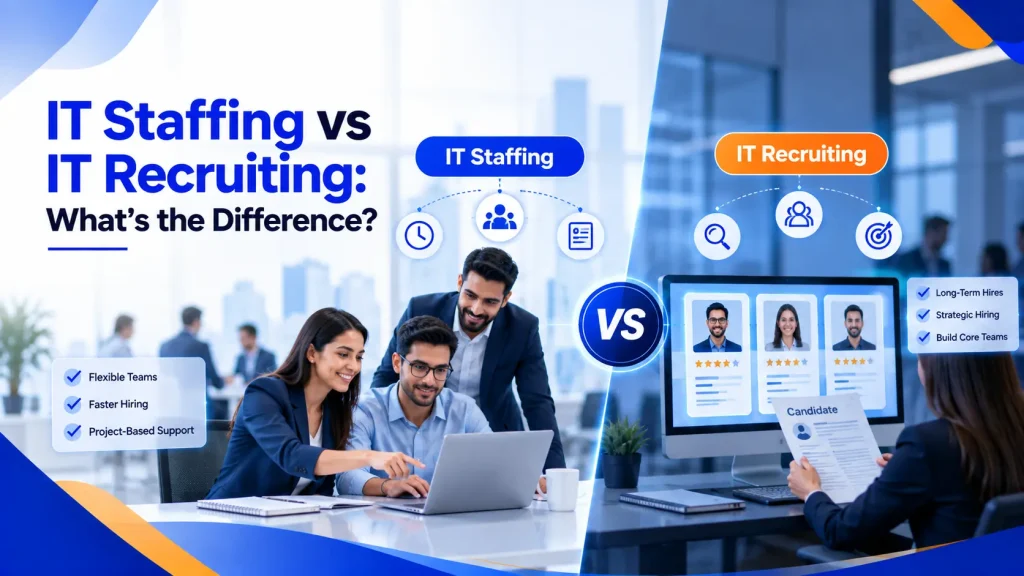
When a company needs technology talent, it may hear two terms repeatedly: IT staffing and IT recruiting.
They are related, but they are not the same thing.
IT recruiting primarily focuses on finding, evaluating, and hiring candidates for technology positions. IT staffing is broader: it can provide temporary, contract, contract-to-hire, or permanent professionals depending on the organization’s workforce requirements.
The distinction becomes especially important when a company needs to decide whether it should:
- Hire one permanent software engineer
- Add contractors to an existing development team
- Bring in specialists for a short-term project
- Fill an unexpected technology vacancy
- Build a new IT department
- Use contract-to-hire before making a permanent commitment
- Scale technical resources up or down as project requirements change
So the real question isn’t:
“Is IT staffing better than IT recruiting?”
It is:
“What kind of technology workforce problem are we trying to solve?”
That distinction can save organizations time, money, and unnecessary hiring friction.
IT Staffing vs IT Recruiting: Quick Answer
| IT Staffing | IT Recruiting |
| Broader workforce solution | Primarily talent acquisition |
| Can include temporary and contract workers | Usually focused on hiring candidates |
| Can include contract-to-hire | Often focused on permanent positions |
| Can include direct/permanent placement | Permanent recruitment is common |
| Useful for fluctuating workforce demand | Useful for stable hiring requirements |
| Can provide staff augmentation | Primarily fills specific vacancies |
| Workforce flexibility is a major benefit | Long-term talent acquisition is the focus |
There is also significant overlap.
An IT staffing company may recruit candidates as part of delivering staffing services.
An IT recruiter may work for a staffing company.
That’s why the terms are sometimes used interchangeably.
The difference is primarily in the scope of the workforce solution, not simply in who searches for the candidate.
What Is IT Recruiting?
IT recruiting is the process of identifying, attracting, evaluating, and helping an organization hire qualified technology professionals.
The process may involve:
- Understanding the job requirement
- Defining required skills
- Sourcing candidates
- Reviewing qualifications
- Conducting initial screening
- Coordinating technical interviews
- Presenting candidates
- Supporting the interview process
- Facilitating the offer
- Supporting the hiring process
IT recruiting can be handled internally by a company’s talent acquisition team or externally by a recruitment firm.
Example
A financial-services company needs a permanent cloud architect.
Its internal team may not have access to enough qualified candidates.
An external IT recruiter can source candidates with experience in:
- AWS or Azure
- Cloud architecture
- Infrastructure security
- DevOps
- Enterprise migration
- Distributed systems
The objective is to identify the right person for a long-term position.
That is recruiting.
What Is IT Staffing?
IT staffing is broader than candidate recruitment.
A staffing provider can help an organization obtain technology professionals under different workforce arrangements, depending on the business need.
These can include:
- Temporary IT staffing
- Contract staffing
- Contract-to-hire
- Direct hire
- Staff augmentation
- Project-based staffing
- Specialized technical staffing
The American Staffing Association notes that engineering and IT staffing firms can support workforce flexibility, project-based work, staffing gaps, software conversions, and fluctuating business requirements. Staffing firms may provide contract, project-based, temporary-to-hire, and direct-hire placements.
Example
A healthcare organization is migrating to a new electronic system and needs six developers and two QA professionals for nine months.
Hiring all eight employees permanently may not make sense.
An IT staffing partner can help provide qualified professionals for the project period.
That’s staffing.
The Simplest Way to Understand the Difference
Think about it this way:
IT recruiting asks:
“Who is the right person to hire?”
IT staffing asks:
“What workforce capacity does the organization need, and how should we provide it?”
Recruiting is therefore primarily talent acquisition.
Staffing is workforce delivery and capacity management.
This is why IT staffing can include recruiting, but recruiting doesn’t necessarily include the broader workforce solutions associated with staffing.
IT Staffing vs IT Recruiting: A Detailed Comparison
| Factor | IT Recruiting | IT Staffing |
| Primary objective | Find the right candidate | Provide the right workforce solution |
| Permanent hiring | Yes | Yes |
| Contract workers | Sometimes | Yes |
| Temporary workers | Sometimes | Yes |
| Contract-to-hire | Possible | Common |
| Staff augmentation | Limited | Core use case |
| Project-based workforce | Less common | Common |
| Workforce flexibility | Moderate | High |
| Long-term hiring | Strong fit | Strong fit |
| Short-term requirements | Less suitable | Strong fit |
| Scaling workforce | Limited | Strong |
| Talent sourcing | Core activity | Core activity |
| Workforce management | Usually limited | Can be part of solution |
The boundaries aren’t absolute.
Different companies define their services differently.
But for an employer evaluating providers, the scope of the solution matters more than the label.
When Should a Company Use IT Recruiting?
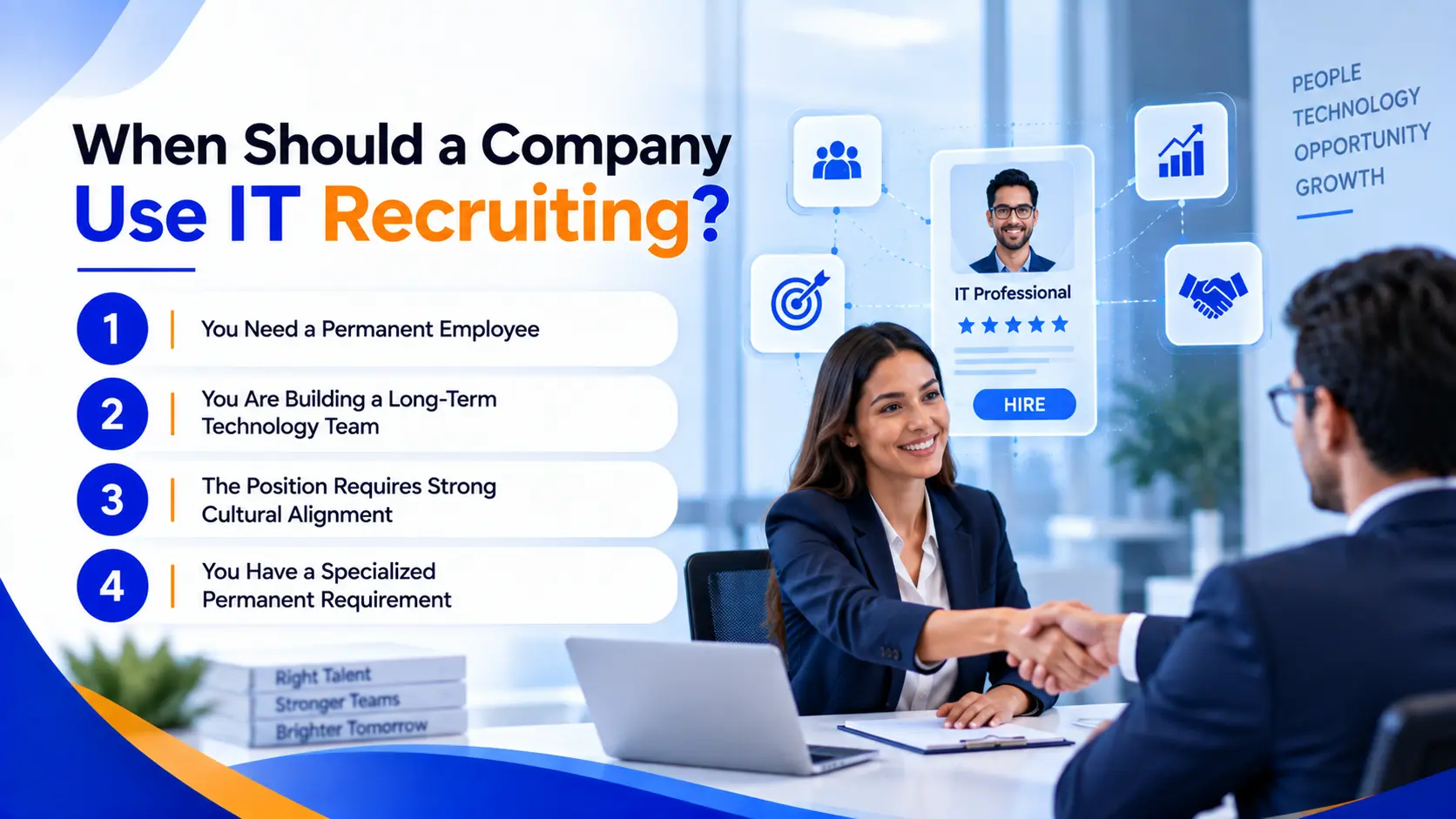
IT recruiting is usually a strong option when the organization has a clear, long-term position that it wants to fill.
1. You Need a Permanent Employee
Suppose a company has approved a permanent Senior Software Engineer position.
The role is expected to remain part of the organization for years.
A recruiting-focused engagement may be appropriate.
2. You Are Building a Long-Term Technology Team
Startups and growing companies often need to build their internal technology capabilities.
For example:
- CTO
- Engineering Manager
- Software Engineers
- Data Engineers
- DevOps
- Product Managers
- Cybersecurity
These are often permanent workforce requirements.
3. The Position Requires Strong Cultural Alignment
Some roles require deep integration with the organization’s:
- Leadership
- Product strategy
- Technology architecture
- Business goals
- Internal processes
Permanent recruitment can make sense when long-term organizational fit is particularly important.
4. You Have a Specialized Permanent Requirement
A company may need someone with a rare combination of:
Technical expertise + industry knowledge + leadership experience.
For example:
Senior cybersecurity architect with financial-services experience and cloud security expertise.
A specialized IT recruiting search may be appropriate.
When Should a Company Use IT Staffing?
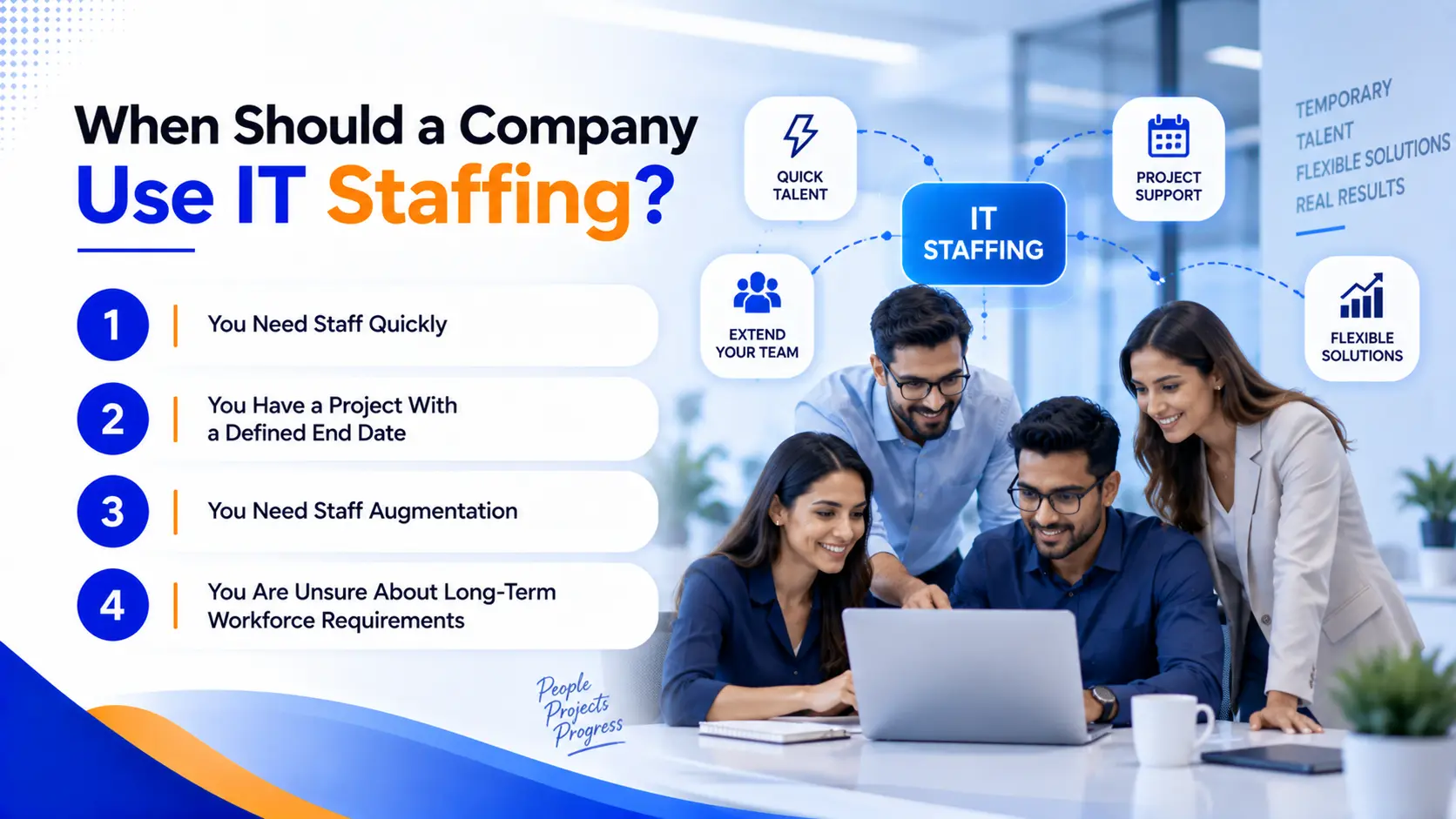
IT staffing becomes particularly valuable when workforce requirements are more flexible.
1. You Need Staff Quickly
A technology project cannot always wait for a lengthy permanent hiring cycle.
A staffing partner can potentially provide qualified professionals for immediate or near-term workforce needs, depending on talent availability.
2. You Have a Project With a Defined End Date
Consider a company migrating its infrastructure to the cloud.
It needs:
- Cloud engineers
- DevOps engineers
- Security specialists
- QA professionals
for the migration project.
The organization may not need all of those professionals permanently.
Contract staffing can provide the required workforce during the project.
3. You Need Staff Augmentation
Staff augmentation allows an organization to add external professionals to an existing internal team.
For example:
Internal team: 8 developers
Project requirement: 12 developers
Additional capacity needed: 4 developers
Instead of permanently increasing headcount, the company can bring in contract professionals for the period of increased demand.
4. You Are Unsure About Long-Term Workforce Requirements
Technology projects can evolve quickly.
A company may know that it needs additional developers today but not know whether the requirement will still exist next year.
Contract-to-hire can provide a middle ground.
The company gets workforce capacity while both sides evaluate long-term fit.
Is IT Staffing More Expensive Than IT Recruiting?
This question is more complicated than comparing a staffing bill rate with a recruiter’s fee.
The two services can create value in different ways.
Recruiting costs can include:
- Internal recruiter time
- External recruiting fees
- Job advertising
- Candidate sourcing
- Interviewing
- Background checks
- Onboarding
- Time spent by hiring managers
Staffing costs can include:
- Contractor bill rates
- Staffing provider fees
- Assignment management
- Compliance
- Workforce administration
- Potential conversion costs
But there is another number companies often forget:
The cost of leaving the position vacant.
An open IT position can delay:
- Software releases
- Cloud migrations
- Cybersecurity projects
- Product development
- System implementations
- Digital transformation initiatives
So the real calculation should be:
Total workforce cost + speed + flexibility + vacancy impact + long-term requirement
rather than simply:
Hourly contractor rate vs recruiting fee.
Why Speed Matters in IT Hiring
Technology projects are often deadline-driven.
A company launching a product doesn’t necessarily have the option of waiting indefinitely for the perfect permanent candidate.
The same applies to:
- Cloud migrations
- ERP implementations
- Cybersecurity initiatives
- Data modernization
- Application development
- Infrastructure upgrades
This is where staffing can provide a strategic advantage.
The objective isn’t necessarily to avoid permanent hiring.
It can be to provide capacity while the organization determines its longer-term workforce structure.
IT Staffing Can Also Lead to Permanent Hiring
One common misconception is that staffing and permanent recruitment are completely separate.
They don’t have to be.
A professional may begin as a contractor and eventually become a permanent employee through a contract-to-hire arrangement, depending on the agreement between the staffing provider, client, and professional.
This can help organizations evaluate:
- Technical capability
- Communication
- Team collaboration
- Work quality
- Reliability
- Cultural alignment
before making a long-term commitment.
For candidates, it can provide an opportunity to experience the organization before deciding whether permanent employment is desirable.
IT Staffing vs IT Recruiting for Different Situations
Here’s a practical decision framework.
| Your Situation | Likely Best Starting Point |
| One permanent software engineer | IT recruiting |
| Building a permanent engineering team | IT recruiting |
| 6-month development project | IT staffing |
| Cloud migration | IT staffing |
| Temporary cybersecurity requirement | IT staffing |
| Long-term cybersecurity leadership role | IT recruiting |
| Need 10 developers quickly | IT staffing |
| Uncertain future headcount | Contract-to-hire |
| Seasonal technology demand | IT staffing |
| Permanent executive technology role | IT recruiting |
| Existing team needs extra capacity | Staff augmentation |
| Long-term role with uncertain fit | Contract-to-hire |
The important word is starting.
A company can move from staffing to permanent recruitment as its workforce requirements become clearer.
IT Staff Augmentation vs IT Recruiting
These two services are often confused.
Staff augmentation
The company adds external IT professionals to its existing team.
The internal organization generally retains control over the project and day-to-day work.
Recruiting
The organization is looking to hire an employee into its own workforce.
Example
A software company has:
- 10 internal developers
- A product launch in eight months
- A temporary need for five additional engineers
Staff augmentation may make more sense.
If the company expects to permanently expand its engineering department, recruiting may be more appropriate.
What About Contract-to-Hire?
Contract-to-hire sits between traditional staffing and permanent recruitment.
It can be particularly useful when:
- The organization needs someone immediately.
- Long-term demand is probable but not certain.
- The company wants to evaluate technical performance.
- The candidate wants to evaluate the employer.
- The organization is growing rapidly.
It reduces the pressure to make a permanent hiring decision without first observing the professional in the working environment.
However, companies should understand the specific conversion terms and contractual obligations before selecting this model.
How AI Is Changing IT Staffing and Recruiting in 2026
The difference between IT staffing and recruiting is also becoming more nuanced because AI is changing how talent is sourced and evaluated.
AI can assist with:
- Candidate sourcing
- Skills matching
- Resume analysis
- Candidate ranking
- Interview scheduling
- Workforce analytics
- Talent-pool identification
- Candidate communication
But AI doesn’t eliminate the need for experienced recruiters.
A resume can say:
AWS + Python + Kubernetes + AI
An experienced recruiter still needs to determine:
- What did the person actually build?
- At what scale?
- What was their responsibility?
- Was the system production-ready?
- How did they solve problems?
- Can they communicate with stakeholders?
- Is the candidate appropriate for this specific environment?
This distinction is especially important in IT staffing because the quality of the match can matter more than the number of resumes produced.
IT Staffing and Recruiting Are Becoming More Skills-Based
Technology changes faster than job descriptions.
A candidate’s job title from five years ago may not tell an employer everything it needs to know about current capability.
For example:
A “Software Developer” may now have experience with:
- Generative AI
- AI-assisted coding
- Cloud-native architecture
- DevOps
- Automation
- API development
- Data pipelines
The hiring process therefore increasingly needs to focus on skills and demonstrated capability, not just job titles.
This is one reason experienced staffing and recruiting partners can add value.
They can help translate a business requirement into a practical talent profile.
A Real MetaSense Perspective: From IT Staffing to Workforce Solutions
MetaSense has an unusually relevant history for this distinction.
The company was founded in 1999 as an IT staffing company. According to MetaSense, its early focus was building an IT staffing business before the company expanded into healthcare in 2019. Today, MetaSense describes its services as including flexible staffing, temp-to-hire, direct-hire placement, and workforce-management solutions.
That evolution illustrates an important point:
IT staffing doesn’t have to mean simply supplying contractors.
It can develop into a broader workforce model covering different stages of an organization’s talent requirements.
MetaSense’s current leadership also describes investment in AI platforms for talent discovery and matching, predictive analytics, proprietary ERP systems, and platform modernization as part of the company’s evolution into a technology-enabled workforce partner.
That creates a useful distinction for today’s employers:
Modern IT staffing should combine technology-enabled talent discovery with human evaluation and workforce strategy.
A Practical Example: Which Would You Choose?
Imagine a U.S. healthcare technology company is launching a new patient-data platform.
It needs:
- 4 software engineers
- 2 cloud engineers
- 1 cybersecurity specialist
- 1 QA engineer
The project is expected to last nine months.
Option A: Permanent recruiting
The company hires all eight professionals permanently.
Potential advantage: Long-term workforce capacity.
Potential drawback: The company may have eight additional positions after the project ends.
Option B: IT staffing
The company brings in contract professionals for the project.
Potential advantage: Workforce flexibility.
Potential drawback: The organization may lose some project knowledge when assignments end.
Option C: Blended strategy
The company hires:
- 2 permanent software engineers
- 1 permanent cloud engineer
and uses contract professionals for the remaining project-specific requirements.
This may provide a balance between:
Long-term capability + short-term capacity.
The correct answer depends on the organization’s future technology roadmap.
What Should Companies Look for in an IT Staffing or Recruiting Partner?
Don’t choose a provider solely because it has a large candidate database.
Ask:
1. Do they understand technology?
Can they distinguish between a software developer, DevOps engineer, cloud architect, data engineer, and cybersecurity specialist?
2. Can they understand the business requirement?
A technical job description isn’t always the same thing as the actual business problem.
3. Do they offer the staffing model you need?
Can they provide:
- Contract
- Temporary
- Contract-to-hire
- Direct hire
- Staff augmentation
- Specialized staffing
4. How do they evaluate candidates?
Ask how technical skills and experience are verified.
5. How quickly can they respond?
Speed matters when a project is already underway.
6. What happens after placement?
Candidate and client support shouldn’t necessarily end when a candidate starts.
7. Can they scale?
A company may need one developer today and 50 technology professionals next year.
The provider should be capable of supporting changing workforce requirements.
7 Signs You Need IT Staffing Instead of Traditional Recruiting
Consider IT staffing if:
1. Your project has a defined end date.
2. You need technical talent quickly.
3. Your internal team needs temporary capacity.
4. Local talent is difficult to find.
5. You need specialized expertise for a specific project.
6. You aren’t certain how long the workforce requirement will last.
7. You want the flexibility to scale technology resources.
7 Signs You Need IT Recruiting
Traditional recruiting may be the stronger starting point if:
1. You are filling a permanent position.
2. The role will remain important for years.
3. You are building an internal technology department.
4. Institutional knowledge is critical.
5. You need a long-term technology leader.
6. You want to invest heavily in employee development and retention.
7. The workforce requirement is predictable.
What If You Need Both?
This is where the distinction becomes less important.
A growing company may need:
Recruiting for permanent employees
plus
Staffing for immediate project capacity
plus
Contract-to-hire for uncertain positions
plus
Specialized staffing for hard-to-find skills
A modern workforce partner should be able to help organizations evaluate those requirements rather than forcing every vacancy into the same model.
IT Staffing vs IT Recruiting: The Bottom Line
IT recruiting is primarily about finding the right technology professional for a hiring requirement.
IT staffing is about providing the workforce capacity an organization needs through flexible models such as contract, temporary, contract-to-hire, direct hire, and staff augmentation.
Neither is automatically better.
The right choice depends on:
- How long the role is needed
- How quickly the position must be filled
- Whether demand is predictable
- Whether the project has an end date
- How specialized the skills are
- Whether the company needs flexibility
- Whether the organization wants permanent workforce capacity
A useful way to remember it is:
Recruiting fills a position. Staffing solves a workforce requirement.
And sometimes, you need both.
MetaSense’s history demonstrates why the distinction can be broader than terminology. Founded in 1999 as an IT staffing company, MetaSense has evolved toward flexible staffing and workforce solutions that include contract, temp-to-hire, direct-hire placement, and workforce management.
The goal shouldn’t be to decide whether IT staffing or IT recruiting is universally better.
The goal is to determine what type of talent, capacity, flexibility, and long-term workforce structure the organization actually needs.
Frequently Asked Questions
Is IT staffing the same as IT recruiting?
No. IT recruiting primarily focuses on finding and evaluating candidates for technology positions. IT staffing is broader and can include temporary, contract, contract-to-hire, direct-hire, and staff-augmentation solutions.
What does an IT staffing company do?
An IT staffing company helps organizations access technology professionals according to their workforce requirements. Depending on the provider, services may include contract staffing, temporary staffing, staff augmentation, contract-to-hire, and permanent placement.
What does an IT recruiter do?
An IT recruiter sources and evaluates technology candidates for open positions. Recruiters may work internally for an employer or externally through a staffing or recruiting company.
Is IT staffing more expensive than hiring directly?
Not necessarily. Staffing can have a higher hourly or bill rate, but organizations should compare total costs, including recruiting, vacancy costs, project delays, benefits, onboarding, turnover, and workforce flexibility.
When should a company use IT staffing?
IT staffing can be useful for short-term projects, staff augmentation, urgent technical requirements, temporary vacancies, specialized skills, fluctuating demand, and situations where long-term workforce requirements are uncertain.
When should a company use IT recruiting?
IT recruiting is generally appropriate when an organization needs permanent employees for stable, long-term technology positions.
What is IT staff augmentation?
IT staff augmentation involves adding external technology professionals to an existing internal team, usually to increase capacity or provide specialized expertise for a defined period.
What is contract-to-hire IT staffing?
Contract-to-hire allows a technology professional to begin in a contract capacity while the organization evaluates whether a permanent employment relationship is appropriate.
Can an IT staffing company also provide permanent recruitment?
Yes. Many staffing companies provide multiple workforce models. MetaSense, for example, lists flexible staffing, temp-to-hire, and direct-hire placement among its services.
How is AI changing IT staffing and recruiting?
AI is helping staffing and recruiting teams with candidate sourcing, skills matching, resume analysis, scheduling, and workforce analytics. Human recruiters remain important for evaluating context, technical depth, communication, motivation, and overall fit.