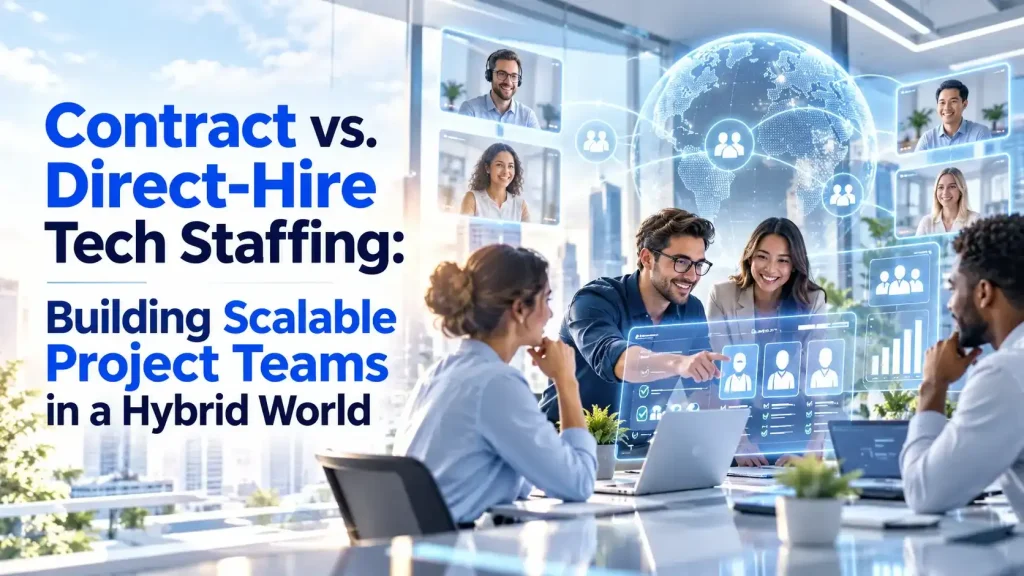
Contract vs. Direct-Hire Tech Staffing: Building Scalable Project Teams in a Hybrid World
Technology teams in the United States are under pressure to deliver more projects while adapting to changing business priorities, hybrid work models, AI adoption, cybersecurity requirements, and ongoing skills shortages. For many organizations, the challenge is not simply finding a technology professional. It is determining how that professional should be hired. Should the organization hire a full-time employee directly? Or should it use contract IT staffing to bring in specialized talent for a defined project or period? The answer can significantly affect workforce flexibility, hiring speed, project continuity, costs, and long-term team structure. This is why understanding contract vs direct hire tech staffing has become increasingly important for technology leaders, CIOs, CTOs, HR teams, project managers, and business owners. The U.S. Bureau of Labor Statistics projects employment in computer and information technology occupations to grow faster than the average for all occupations from 2024 through 2034, with approximately 317,700 openings per year projected across these occupations due to employment growth and replacement needs. At the same time, technology projects increasingly require specialized expertise that may not be needed permanently. That creates a strategic question: When should a company use contract IT staffing, and when does direct hiring make more sense? What Is Contract IT Staffing? Contract IT staffing involves hiring a technology professional for a defined period, project, or business requirement. The professional may be employed or engaged through a staffing company while working directly with the client organization’s team. Contract assignments can range from short-term project support to longer engagements. Common contract technology roles include: Software developers Cloud engineers Data engineers Data analysts Cybersecurity professionals DevOps engineers Network engineers Systems administrators Business analysts Project managers QA engineers AI and machine-learning professionals Contract staffing can be particularly useful when a company needs specialized expertise without committing immediately to a permanent position. What Is Direct-Hire Tech Staffing? Direct hire means the technology professional becomes a permanent employee of the hiring organization. A staffing agency may still manage the sourcing and recruitment process, but the candidate joins the client company’s workforce directly. Direct hiring is commonly used for roles that are expected to remain important to the organization over the long term. Examples include: Software engineering IT management Cybersecurity leadership Cloud architecture Data engineering Infrastructure Enterprise applications IT operations Product technology Technology leadership Direct hiring can help organizations build institutional knowledge and maintain continuity within their internal teams. Contract vs. Direct-Hire Tech Staffing at a Glance Factor Contract IT Staffing Direct-Hire Staffing Employment duration Defined period or project Indefinite/permanent Workforce flexibility Generally higher Generally lower Hiring for specialized projects Strong fit May be unnecessary long term Long-term organizational knowledge May be limited by assignment Typically greater Speed to access specialized talent Can be faster depending on availability Can take longer Project-based work Strong fit Useful when role becomes permanent Workforce scalability High More structured Long-term team building Limited by contract Strong fit Employee benefits Depends on staffing arrangement Employer’s standard benefits Hiring commitment Lower Higher Best use case Defined or changing demand Ongoing business requirement These are general characteristics. Actual hiring timelines, costs, benefits, and employment terms vary by company, staffing agency, role, location, and candidate. Why Companies Are Using More Flexible Technology Staffing Models Technology demand is changing rapidly. Organizations may need skills for a project that did not exist in their workforce plan six months earlier. For example, a company may suddenly need: Generative AI expertise Cloud migration specialists Cybersecurity professionals Data modernization skills ERP implementation specialists DevOps expertise Application modernization talent But the organization may not need all of those capabilities permanently. This is where contract staffing can provide workforce flexibility. A company can bring in specialized professionals when the project requires them while continuing to develop its permanent technology organization around its long-term priorities. The Hybrid Work Factor Hybrid work has added another dimension to technology staffing. A technology team may include: Permanent employees Contract professionals Remote specialists Hybrid employees Consultants Project-based teams External vendors This creates what can be thought of as a blended technology workforce. Instead of maintaining a completely fixed workforce structure, organizations can combine permanent employees with flexible talent based on business requirements. For example: Core team: Permanent software engineers Project team: Contract developers Specialized support: Contract cybersecurity professionals Leadership: Permanent engineering manager This structure can allow organizations to scale specific capabilities without changing the entire permanent workforce. When Should You Choose Contract IT Staffing? Contract staffing may be appropriate when the technology requirement is: Project-specific If the work has a clear beginning and end, contract staffing can align the workforce with the project timeline. Examples include: Cloud migration Data migration ERP implementation Application modernization Security assessment System integration Software development projects Highly specialized A company may need expertise that is difficult to find locally or does not justify permanent employment. Urgent If a project has already started and specialized talent is needed quickly, a contract staffing agency may provide access to available candidates. Temporary Contract staffing can support: Employee leave Temporary workload increases System implementations Business transformations Acquisitions Technology upgrades Uncertain Sometimes the organization knows it needs a skill but does not yet know whether that requirement will become permanent. A contract arrangement can provide time to evaluate the long-term need. When Does Direct Hiring Make More Sense? Direct hiring can be appropriate when the role is expected to remain strategically important. Consider direct hiring when: The role is permanent If the company expects the position to exist for years, building permanent capability may be appropriate. Institutional knowledge matters Some technology roles require deep knowledge of: Internal systems Architecture Customers Business processes Security requirements Organizational strategy A permanent employee can accumulate that knowledge over time. The role is part of the core technology organization If a professional is central to the company’s technology strategy, direct employment may align with long-term organizational planning. Leadership is required Technology leadership positions often require sustained involvement in organizational strategy, people development, and long-term planning. Team continuity is important Permanent employees can provide continuity as projects evolve