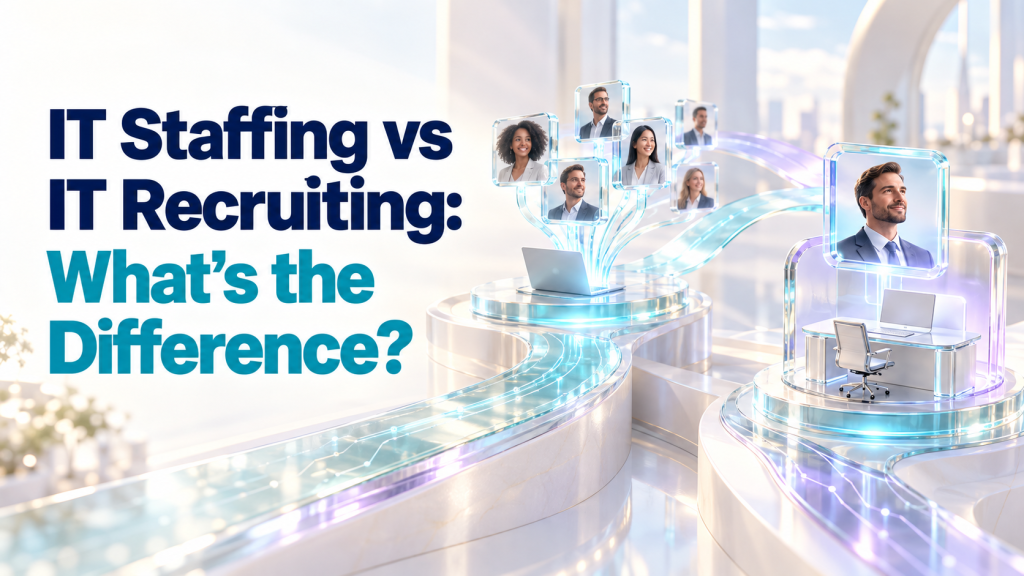
IT Staffing vs IT Recruiting: What’s the Difference?
When a company needs technology talent, it may hear two terms repeatedly: IT staffing and IT recruiting. They are related, but they are not the same thing. IT recruiting primarily focuses on finding, evaluating, and hiring candidates for technology positions. IT staffing is broader: it can provide temporary, contract, contract-to-hire, or permanent professionals depending on the organization’s workforce requirements. The distinction becomes especially important when a company needs to decide whether it should: Hire one permanent software engineer Add contractors to an existing development team Bring in specialists for a short-term project Fill an unexpected technology vacancy Build a new IT department Use contract-to-hire before making a permanent commitment Scale technical resources up or down as project requirements change So the real question isn’t: “Is IT staffing better than IT recruiting?” It is: “What kind of technology workforce problem are we trying to solve?” That distinction can save organizations time, money, and unnecessary hiring friction. IT Staffing vs IT Recruiting: Quick Answer IT Staffing IT Recruiting Broader workforce solution Primarily talent acquisition Can include temporary and contract workers Usually focused on hiring candidates Can include contract-to-hire Often focused on permanent positions Can include direct/permanent placement Permanent recruitment is common Useful for fluctuating workforce demand Useful for stable hiring requirements Can provide staff augmentation Primarily fills specific vacancies Workforce flexibility is a major benefit Long-term talent acquisition is the focus There is also significant overlap. An IT staffing company may recruit candidates as part of delivering staffing services. An IT recruiter may work for a staffing company. That’s why the terms are sometimes used interchangeably. The difference is primarily in the scope of the workforce solution, not simply in who searches for the candidate. What Is IT Recruiting? IT recruiting is the process of identifying, attracting, evaluating, and helping an organization hire qualified technology professionals. The process may involve: Understanding the job requirement Defining required skills Sourcing candidates Reviewing qualifications Conducting initial screening Coordinating technical interviews Presenting candidates Supporting the interview process Facilitating the offer Supporting the hiring process IT recruiting can be handled internally by a company’s talent acquisition team or externally by a recruitment firm. Example A financial-services company needs a permanent cloud architect. Its internal team may not have access to enough qualified candidates. An external IT recruiter can source candidates with experience in: AWS or Azure Cloud architecture Infrastructure security DevOps Enterprise migration Distributed systems The objective is to identify the right person for a long-term position. That is recruiting. What Is IT Staffing? IT staffing is broader than candidate recruitment. A staffing provider can help an organization obtain technology professionals under different workforce arrangements, depending on the business need. These can include: Temporary IT staffing Contract staffing Contract-to-hire Direct hire Staff augmentation Project-based staffing Specialized technical staffing The American Staffing Association notes that engineering and IT staffing firms can support workforce flexibility, project-based work, staffing gaps, software conversions, and fluctuating business requirements. Staffing firms may provide contract, project-based, temporary-to-hire, and direct-hire placements. Example A healthcare organization is migrating to a new electronic system and needs six developers and two QA professionals for nine months. Hiring all eight employees permanently may not make sense. An IT staffing partner can help provide qualified professionals for the project period. That’s staffing. The Simplest Way to Understand the Difference Think about it this way: IT recruiting asks: “Who is the right person to hire?” IT staffing asks: “What workforce capacity does the organization need, and how should we provide it?” Recruiting is therefore primarily talent acquisition. Staffing is workforce delivery and capacity management. This is why IT staffing can include recruiting, but recruiting doesn’t necessarily include the broader workforce solutions associated with staffing. IT Staffing vs IT Recruiting: A Detailed Comparison Factor IT Recruiting IT Staffing Primary objective Find the right candidate Provide the right workforce solution Permanent hiring Yes Yes Contract workers Sometimes Yes Temporary workers Sometimes Yes Contract-to-hire Possible Common Staff augmentation Limited Core use case Project-based workforce Less common Common Workforce flexibility Moderate High Long-term hiring Strong fit Strong fit Short-term requirements Less suitable Strong fit Scaling workforce Limited Strong Talent sourcing Core activity Core activity Workforce management Usually limited Can be part of solution The boundaries aren’t absolute. Different companies define their services differently. But for an employer evaluating providers, the scope of the solution matters more than the label. When Should a Company Use IT Recruiting? IT recruiting is usually a strong option when the organization has a clear, long-term position that it wants to fill. 1. You Need a Permanent Employee Suppose a company has approved a permanent Senior Software Engineer position. The role is expected to remain part of the organization for years. A recruiting-focused engagement may be appropriate. 2. You Are Building a Long-Term Technology Team Startups and growing companies often need to build their internal technology capabilities. For example: CTO Engineering Manager Software Engineers Data Engineers DevOps Product Managers Cybersecurity These are often permanent workforce requirements. 3. The Position Requires Strong Cultural Alignment Some roles require deep integration with the organization’s: Leadership Product strategy Technology architecture Business goals Internal processes Permanent recruitment can make sense when long-term organizational fit is particularly important. 4. You Have a Specialized Permanent Requirement A company may need someone with a rare combination of: Technical expertise + industry knowledge + leadership experience. For example: Senior cybersecurity architect with financial-services experience and cloud security expertise. A specialized IT recruiting search may be appropriate. When Should a Company Use IT Staffing? IT staffing becomes particularly valuable when workforce requirements are more flexible. 1. You Need Staff Quickly A technology project cannot always wait for a lengthy permanent hiring cycle. A staffing partner can potentially provide qualified professionals for immediate or near-term workforce needs, depending on talent availability. 2. You Have a Project With a Defined End Date Consider a company migrating its infrastructure to the cloud. It needs: Cloud engineers DevOps engineers Security specialists QA professionals for the migration project. The organization may not need all of