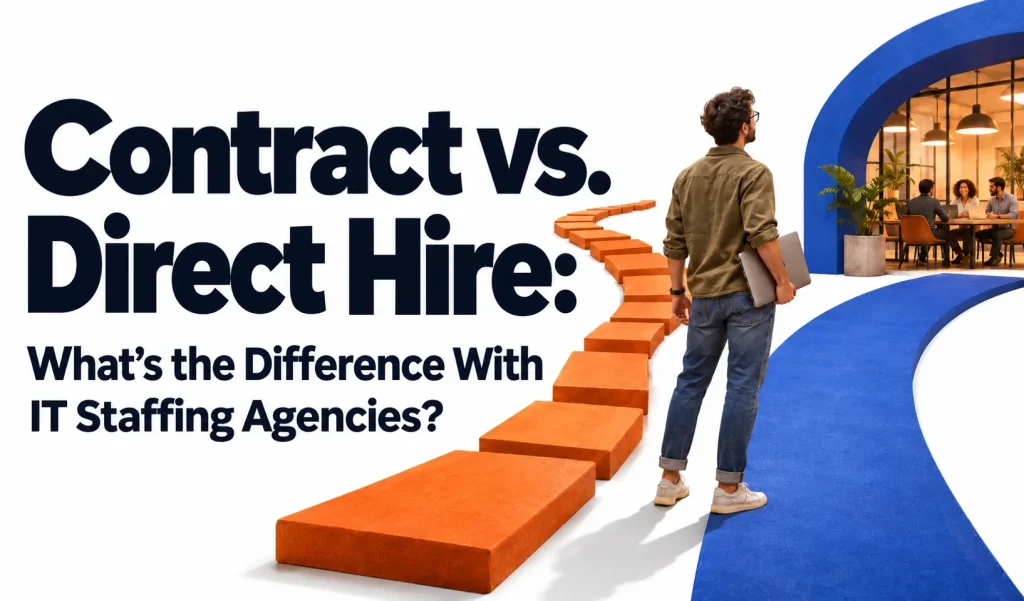
Contract vs. Direct Hire: What’s the Difference With IT Staffing Agencies?
Hiring the right technology professionals is essential for businesses that want to maintain productivity, complete projects, strengthen IT infrastructure, and stay competitive. However, choosing the right employment arrangement can be just as important as finding the right candidate. When working with an IT staffing agency, businesses commonly consider two recruitment options: contract staffing and direct-hire recruitment. Both approaches help organizations access qualified technology professionals, but they differ in employment structure, cost considerations, workforce flexibility, and long-term hiring commitments. Contract staffing allows businesses to engage IT professionals for a defined period or project, while direct-hire recruitment focuses on placing candidates into permanent positions within the hiring organization. So, which option should your business choose? The answer depends on your project requirements, budget, hiring timeline, internal resources, and long-term workforce strategy. This guide explains the differences between contract and direct hire, how IT staffing agencies support each model, and how to determine which approach is right for your organization. What Is Contract IT Staffing? Contract IT staffing is a recruitment arrangement in which a business engages a technology professional for a specified period, project, or temporary workforce requirement. Instead of immediately hiring someone as a permanent employee, the organization obtains the technical expertise it needs for a defined engagement. An IT staffing agency may source candidates, evaluate their qualifications, coordinate interviews, and manage relevant staffing arrangements. Depending on the agreement, the staffing agency may employ the contractor and assign them to the client organization, or another contractual structure may apply. How Does Contract IT Staffing Work? The process generally follows these steps: Identify the requirement: The employer defines the technical skills, experience, project responsibilities, and expected engagement duration. Engage an IT staffing agency: The business shares its requirements with a staffing partner. Source qualified candidates: The agency identifies professionals whose backgrounds match the position. Screen and evaluate candidates: Relevant experience, technical capabilities, availability, and other requirements are assessed. Conduct interviews: The hiring company evaluates shortlisted candidates and makes its selection. Finalize the agreement: The parties confirm the engagement structure, billing arrangements, responsibilities, and duration. Begin the assignment: The selected professional starts working according to the agreed terms. Common Examples of Contract IT Staffing Contract staffing is often considered when businesses need specialized technology expertise without creating an immediate permanent headcount. Examples include: Hiring a cloud engineer for a cloud migration project. Engaging a cybersecurity specialist for a security assessment or implementation. Bringing in software developers to support a product launch. Hiring IT support professionals during a temporary increase in service requests. Engaging a data engineer for a defined data integration project. Adding DevOps professionals during infrastructure modernization. The actual duration and employment structure depend on the project and staffing agreement. What Is Direct-Hire IT Recruitment? Direct-hire IT recruitment is a hiring arrangement in which an IT staffing agency helps a business identify and recruit candidates for permanent employment. Unlike contract staffing, the selected professional generally joins the hiring organization directly as its employee. The staffing agency supports the recruitment process, but the employer makes the final hiring decision and establishes the employment relationship with the selected candidate. How Does Direct-Hire Recruitment Work? The process generally includes: Define the permanent position: The employer establishes job responsibilities, technical requirements, experience, and compensation. Select a recruitment partner: The business engages an IT staffing agency for candidate sourcing and recruitment support. Identify potential candidates: The agency searches for professionals whose qualifications align with the position. Screen and shortlist: Candidates are evaluated against the job requirements. Conduct interviews: The employer interviews shortlisted candidates and assesses their suitability. Extend an offer: The hiring organization makes an employment offer to the selected candidate. Complete onboarding: The candidate joins the company under its employment policies and onboarding procedures. Common Examples of Direct-Hire IT Recruitment Direct-hire recruitment may be appropriate when an organization needs professionals for ongoing business operations or long-term technology responsibilities. Examples include: Hiring a permanent software engineering team. Recruiting a full-time IT manager. Bringing in a cybersecurity manager to oversee security operations. Hiring a cloud architect to manage ongoing infrastructure. Recruiting a permanent database administrator. Adding an IT project manager to support long-term technology initiatives. Direct hire is generally suited to positions where the business expects an ongoing need for the role. Contract vs. Direct Hire: What Is the Difference? Although both options can be facilitated by an IT staffing agency, their employment structures and business implications are different. Comparison factor Contract IT staffing Direct-hire recruitment Employment arrangement Defined contractual engagement Permanent employment with the hiring company Engagement duration Agreed period or project-based requirement Ongoing employment, subject to employment terms Employer relationship Depends on the staffing and contractual arrangement Candidate generally joins the hiring organization directly Payment structure Usually an agreed hourly, daily, or other billing rate Employer pays the employee under its compensation structure Benefits Depend on the employment arrangement and applicable requirements Generally governed by the hiring company’s benefits policies Recruitment focus Skills, availability, and assignment suitability Skills, experience, and long-term organizational fit Workforce flexibility Useful for changing or temporary requirements Better suited to ongoing staffing needs Hiring commitment Usually limited to the agreed engagement Intended for a continuing employment relationship Administrative responsibilities May be shared between staffing agency and client Primarily managed by the hiring organization Common use cases Projects, temporary coverage, specialized assignments Core IT operations and long-term positions The distinction is not simply temporary versus permanent work. It also involves who employs the professional, how the engagement is structured, how compensation is managed, and which organization is responsible for particular employment obligations. These details should always be confirmed in the staffing agreement. Contract vs. Direct Hire: Understanding the Cost Difference Cost is one of the most important factors businesses consider when comparing contract and direct-hire IT staffing. However, comparing only the contractor’s hourly rate with a permanent employee’s salary can produce an incomplete picture. Businesses should evaluate the total cost of each hiring arrangement. Contract IT Staffing Costs Contract staffing generally involves an agreed billing rate for the professional’s services. Depending on